Showing posts with label Rawls. Show all posts

Saturday, October 15, 2011

Rawls's framework for global justice

Rawls's A Theory of Justice was immediately received as a major and progressive contribution to the theory of justice within existing societies. His Law of Peoples (1999) was intended to carry his basic ideas about justice to the international realm.  (Here is a PDF of a preliminary version of the title essay of the book as published in Critical Inquiry in 1993.) Here is how he defined the goal of a law of peoples in 1993:
The law of peoples ... is a family of political concepts along with principles of right justice, and the common good that specify the content of a liberal conception of justice worked up to extend to and apply to international law. It provides the concepts and principles by reference to which that law is to be judged. (43)
In contrast to the reception A Theory of Justice received, his work on the international part of the theory has not had much influence, and was roundly criticized for being too accepting of international inequalities.   Philip Pettit put the point this way in his contribution to Rex Martin and David Reidy's Rawls's Law of Peoples: A Realistic Utopia:
John Rawls's work on the law of peoples is notorious for its anti-cosmopolitan stance: roughly, its insistence that those of us in well-ordered societies do not owe to the members of other societies the sort of justice we owe to one another. (38)
This is exactly the critique that Philippe van Parijs offered to Rawls prior to publication of the book (link).

Given that Rawls's intuitions seem to have been solidly progressive in other spheres, it is worth considering why he took this very limited view of the obligations of justice in the global context. Why did he begin with the perspective of peoples rather than persons?  (Here I'll make use of the 1993 statements of the view.)

A number of the critics put their cases in terms of Rawls's anti-cosmopolitanism.  "Cosmopolitanism" is the view that we are all citizens of the world, and we have positive moral relationships with each other no matter what nation issues our passports.  No one would deny that everyone has some kinds of moral relationships to everyone else -- for example, the obligation not to impose harm on innocent people.  But cosmopolitanism extends to the idea of positive obligations -- the obligation to render assistance as well as the obligation to refrain from gratuitous harm.  The contrary to cosmopolitanism might be called "nationalism", but this implies assumptions that Rawls would presumably not have accepted.  So let's call it "bounded people-ism": the claims of justice that a person has against other persons extend only to other members of his/her people and government.

One deep reason for the direction that Rawls took was the assumption he made about how to make use of the original position and the veil of ignorance in arriving at principles of international justice.  If this framework involved all human beings, then the results would have been very similar to the argument made in the case of a well-ordered society: inequalities need to be the least system possible consistent with maximizing the position of the least-well-off stratum of society.  However, Rawls chose instead to include "peoples" rather than "persons" in the argument from the original position in the case of international justice. What is a people?
By peoples I mean persons and their dependents seen as a corporate body and as organized by their political institutions, which establish the powers of government. In democratic societies persons will be citizens; in hierarchical and other societies they will be members. (41)
And he directly addresses the question of why it should be peoples rather than persons whose perspectives are represented in the original position for international justice:
Wouldn't it be better to start with the world as a whole, with a global original position, so to speak, and discuss the question whether, and in what form, there should be states, or peoples, at all? ... I think there is no clear initial answer to this question. We should try various alternatives and weigh their pluses and minuses. Since in working out justice as fairness I begin with domestic society, I shall continue from there as if what has been done so far is more or less sound. So I simply build on the steps taken until now, as this seems to provide a suitable starting point for the extension to the law of peoples. A further reason for proceeding thus is that peoples as corporate bodies organized by their governments now exist in some form all over the world. (42-43)
So his reasons for beginning with this premise are, first, we have to start somewhere and there isn't a philosophically compelling reason to favor persons over peoples in this setting; and second, peoples (and states) exist as actors in the world, so it is feasible to begin the analysis at this level. This way of formulating the original position is designed to establish fair terms of interaction between societies -- or in other words,
... fair conditions under which the parties, this time as representatives of societies well ordered by liberal conceptions of justice, are to specify the laws of peoples and the fair terms of their cooperation. (45)
This formulation, of course, immediately precludes certain questions, including all questions of difference in outcomes for the least-well-off in the various societies.  The fact that the LWO in country X are worse off than the LWO in country Y cannot be a factor in this deliberation, and therefore there cannot emerge a positive obligation to transfer resources from society Y to X to ameliorate this difference.

Here are the principles that Rawls arrives at through this construction:
  1. Peoples (as organized by their governments) are free and independent, and their freedom and independence is to be respected by other peoples.
  2. Peoples are equal and parties to their own agreements.
  3. Peoples have the right of self-defense but no right to war.
  4. Peoples are to observe a duty of nonintervention.
  5. Peoples are to observe treaties and undertakings.
  6. Peoples are to observe certain specified restrictions on the conduct of war (assumed to be in self-defense).
  7. Peoples are to honor human rights. (46)
In the final version of the argument in 1997 he adds a final principle:
8. Peoples have a duty to assist other peoples living under unfavorable conditions that prevent their having a just or decent political and social regime.
Later in 1993 he comments on the idea of a human right:
Human rights have, then, these three roles:
1. Their being fulfilled is a necessary condition of a regime's legitimacy and of the decency of its legal order.
2. Their fulfillment is also sufficient to exclude justified and forceful intervention by other peoples, say by economic sanctions or, in grave cases, by military force.
3. "They set a moral limit to pluralism" among peoples. (59)
Several things are evident from these lists.  First, the obligations represented here are indeed minimalist; basically, they are limitations on the use of coercive means by peoples (states) to achieve their ends.  Even the 8th principle added in the 1997 version creates an obligation only to assist other peoples in achieving a just political regime.  Second, there are no requirements of distributive justice in this list of principles.  Each society has internal requirements of distributive justice; but there is no inter-society requirement of distributive justice.  The fact that there are large inequalities of resources between countries is not a basis for a claim of injustice, according to these principles.

This framework has been strongly criticized by philosophers and others who found that it was far too accepting of global inequalities.  Alan Buchanan focuses on the global inequality part of the story in his 2000 contribution in Ethics. Buchanan holds that even representatives of peoples would not have overlooked the significant inequalities imposed on peoples by the global economic system.  He maintains that the original position concerned with international justice would have to take into account two important facts:
There is a global basic structure, which, like the domestic basic structure, is an important subject of justice because it has profound and enduring effects on the prospects of individuals and groups, including peoples in Rawls's sense.
The populations of states are not "peoples" in Rawls's sense and are not likely to become so without massive, unjustifiable coercion, but rather are often conflicting collections of "peoples" and other groups. (700-1) 
The first fact, if recognized, would ensure that the international original position would necessarily take into account the inequalities created by this system for different peoples.  He also believes that the second fact raises salient issues for the international original position.  Essentially the issue here is this: what happens when the multiple peoples of a single state come into conflict? By making the assumptions that "peoples within unified states" are the agents within the international original position, Rawls makes it impossible to arrive at principles of international justice that would specify just behavior in the face of civil war or secessionist movements. This approach makes it impossible to address intrastate conflict.

Tom Pogge extends his own critique of Rawls's position on international distributive justice in a Fordham Law Review article (link) (also included in Martin and Reidy's Rawls's Law of Peoples: A Realistic Utopia).  Fundamentally, Pogge is highly critical of Rawls's failure to arrive at an international theory of justice that provides a basis for critique of global inequalities. In this piece he argues that Rawls's two theories are in fact inconsistent with each other.

As indicated above, much of this body of criticism has to do with the view that Rawls's Law of Peoples creates only the most limited obligations across peoples.  His view is not "cosmopolitan".  But a more fundamental criticism, which Buchanan hints at, is that there is a major strand of injustice embedded within the world system that is wholly invisible within Rawls's formulation of the law of peoples.  This is the fact that global institutions may create systematically imbalanced economic relations among states, with the result that some states are in a position to take unfair advantage of other states. This is a form of injustice that would not be accepted within the terms of a domestic society. But there is no basis within the framework of the law of peoples to identify and criticize these types of injustices.

These criticisms are surely correct.  As a theory of global justice, the Law of Peoples doesn't begin to provide enough of a normative basis to arrive at sound judgments about international arrangements.  I began by asking how it came to pass that Rawls presented such a limited theory of international justice. The best answer I can offer is that he was focusing on the wrong issues.  He focused on issues of war and interstate violence, and he did not sufficiently bring into his view the empirical realities associated with a highly unequal world economic structure.  And this is puzzling, since questions of global inequalities -- of resources, of power, and of self-determination -- were certainly widely debated at Harvard in the 1970s and 1980s while Rawls's thinking on this subject was developing.

(In addition to critics, Rawls has some defenders in this area.  Samuel Freeman provides an extensive and reasoned response to many of these criticisms of Rawls's theory of international justice here (link).)

Saturday, September 3, 2011

Rawls on the EU

During the final preparation of The Law of Peoples: with "The Idea of Public Reason Revisited" John Rawls had extensive interaction with Philippe van Parijs. Van Parijs was particularly interested in the political and legal circumstances surrounding the establishment of the legal structure of the European Union and the obligations states and their citizens would have to each other within the EU. A key question is whether a political body -- a state or confederation -- needs to encompass a single unified "people" (whether by language, traditions, or culture); or if, on the contrary, such a body can consist of multiple peoples who nonetheless have duties of justice to each other.

What turns on this from a moral point of view is the level of moral concern that members of this kind of union owe each other. Are their obligations limited to the domain of "concern" that gives rise to some obligations of charity? Or are they closely enough interconnected that they are subject to the demands of justice towards each other? If the latter then the difference principle applies to them when inequalities of life circumstances are apparent. If the former then only weaker principles of assistance apply.

For van Parijs this question is particularly acute in the case of Belgium, which was even then subject to fissional pressures along linguistic-cultural lines between Flemings and Walloons.

Van Parijs and Rawls exchanged several careful and thoughtful letters on these issues in 1998, and these letters were published in their entirety in Revue de philosophie économique in 2003 (link).

The disagreements between van Parijs and Rawls are very interesting to follow in detail. There is one aspect of the exchange that is particularly intriguing on the subject of Rawls's own assessment of modern capitalism. The passage is worth quoting. Here is an excerpt from Rawls's letter:
One question the Europeans should ask themselves, if I may hazard a suggestion, is how far–reaching they want their union to be. It seems to me that much would be lost if the European union became a federal union like the United States. Here there is a common language of political discourse and a ready willingness to move from one state to another. Isn't there a conflict between a large free and open market comprising all of Europe and the individual nation-states, each with its separate political and social institutions, historical memories, and forms and traditions of social policy. Surely these are great value to the citizens of these countries and give meaning to their life. The large open market including all of Europe is aim of the large banks and the capitalist business class whose main goal is simply larger profit. The idea of economic growth, onwards and upwards, with no specific end in sight, fits this class perfectly. If they speak about distribution, it is [al]most always in terms of trickle down. The long–term result of this — which we already have in the United States — is a civil society awash in a meaningless consumerism of some kind. I can't believe that that is what you want.

So you see that I am not happy about globalization as the banks and business class are pushing it. I accept Mill's idea of the stationary state as described by him in Bk. IV, Ch. 6 of his Principles of Political Economy (1848). (I am adding a footnote in §15 to say this, in case the reader hadn't noticed it). I am under no illusion that its time will ever come – certainly not soon – but it is possible, and hence it has a place in what I call the idea of realistic utopia.
Several aspects of this passage are noteworthy. The first is a tentative skepticism about the goal of creating a European community in a strong sense -- a polity in which individuals have strong obligations to all other citizens within the full scope of the expanded boundaries. Rawls seems to equate this goal with the idea of creating a somewhat homogeneous and pervasive European culture, replacing German, French, or Italian national cultures. And he offers the idea that the traditions, affinities, and loyalties associated with national identities are important aspects of an individual's pride and satisfaction with his/her life.

What is surprising about these views is that Rawls seems to overlook the polyglot, poly-cultural character of the United States and Canada themselves. Both North American countries seem to have created some remarkable solutions to the problem of "unity with difference." It is possible to be a committed United States citizen but also a Chicago Polish patriot, a Los Angeles Muslim, or a Mississippi African American. Each of these is a separate community with its own traditions and values. But each can also embody an overlay of civic culture that makes them all Americans. It certainly doesn't seem impossible to imagine that Spaniards will develop a more complex identity, as both Spaniard and European. So Rawls's apparent concerns about homogenization and loss of collective meaning seem ill founded.

Even more interesting, though, are his several comments about globalization and capitalism. As we observed in a post about the property-owning democracy (link), Rawls has already expressed the idea that capitalism has a hard time living up to the principles of justice. Here he goes a step further and reveals a significant mistrust of the value system created by capitalism. He refers to the world the "bankers and capitalists" want to create -- one based on acquisitiveness and the pursuit of profit -- and he clearly expresses his opinion that this is incompatible with a truly human life.

The goal of perpetual growth expresses this ideology, and Rawls reveals his skepticism about this idea as well. He offers the opinion that the pursuit of growth by this class is no more than the pursuit of greater wealth and more meaningless consumption. And he clearly believes this is a dead-end. Instead, he endorses J. S. Mill's idea of a steady-state (link). (Interestingly, this position lines up well with current thinking of environmentalists; for example, James Gustave Speth and The Bridge at the Edge of the World: Capitalism, the Environment, and Crossing from Crisis to Sustainability (link).)

Here Rawls seems to express a cultural critique of capitalism: the idea that the driving values of a market society induce a social psychology of consumerism that overrides the individual's ability to construct a thoughtful life plan of his/her own.

Finally, Rawls criticizes the neo-liberal dogmas about distribution of income that had dominated public discourse in the U.S. almost since the publication of A Theory of Justice: the theory of trickle-down economics. That theory holds that everyone will gain when businesses make more profits. And, of course, the data on income distribution in the U.S. since 1980 has flatly refuted that theory (link).

(Van Parijs' most recent book, Linguistic Justice for Europe and for the World (Oxford Political Theory), will be published in October. It is highly relevant to this debate with Rawls.)


Wednesday, August 10, 2011

Economic thinking in Rawls's thought


John Rawls's (1971) A Theory of Justice: Original Edition (TJ) had a sizable impact on a number of disciplines, including economics and economic policy thought. (His ideas in this original version of the theory are clarified and further developed in his 2005 Justice as Fairness: A Restatement (JF).)  Rawls's influence on economics largely derived from one aspect of his theory of justice, the theory of justice in distribution, which has implications for economic inequalities, taxation, and social welfare benefits.  Did Rawls actually think about these issues in the ways that an economist would have done?

One of the primary goals of Rawls's theory of justice is directly relevant to economic policy. He specifically wanted to work out the implications of the theory of justice for the justice of fundamental economic institutions:
My aim in this chapter is to see how the two principles work out as a conception of political economy, that is, as standards by which to assess economic arrangements and policies, and their background institutions. (Welfare economics is often defined in the same way. I do not use this name because the term "welfare" suggests that the implicit moral conception is utilitarian; the phrase "social choice" is far better although I believe its connotations are still too narrow.) (TJ, 259)
What is the purpose of this aspect of the theory of justice?
A doctrine of political economy must include an interpretation of the public good which is based on a conception of justice. It is to guide the reflections of the citizen when he considers questions of economic and social policy. (259)
Rawls is explicit in addressing the issue of the relationship between his own theorizing and the theories of the economists:
It is essential to keep in mind that our topic is the theory of justice and not economics, however elementary. We are only concerned with some moral problems of political economy. For example, I shall ask: what is the proper rate of saving over time, how should the background institutions of taxation and property be arranged, or at what level is the social minimum to be set? In asking these questions my intention is not to explain, much less to add anything to, what economic theory says about the working of these institutions. ... Certain elementary parts of economic theory are brought in solely to illustrate the content of the principles of justice. (265)
So what use does Rawls in fact make of current economic theories? Does he think like an economist? Key to thinking like an economist is thinking in terms of incentives, markets, and institutions. Let's start with incentives. Rawls pays attention to the incentives that citizens have within various sets of institutions:
Moreover, the theory of justice assumes a definite limit on the strength of social and altruistic motivation. It supposes that individuals and groups put forward competing claims, and while they are willing to act justly, they are not prepared to abandon their interests. (281)
He also does a good job of articulating and motivating the central insights of public choice theory -- essentially, reasoning about public goods within a democratic public (TJ, 265 ff.). He analyzes the two key features of a public good -- indivisibility and non-excludability. He explains the free rider problem and the prisoners' dilemma clearly and accurately, and reproduces the conclusion that a public of independent citizens will not achieve public goods at an appropriate level without legislation. The discussion is compact, but it is solidly linked to the best available literature on public goods (Baumol, Sen, Buchanan, Olson). Rawls thinks this is a good place to start, because the institutions of the state have a very substantial role to play in establishing conditions in which public goods are achieved. He also addresses a series of reasons for favoring, and limiting, the institutions of the market as determinants of investments and incomes. He refers to allocative efficiency and personal liberty as positive features, while noting the possibility or likelihood that markets by themselves will create economic inequalities in excess of the requirements of the difference principle. "There is with reason strong objection to the competitive determination of total income, since this ignores the claims of need and an appropriate standard of life" (277).

When discussing the role of government in economic activity Rawls refers to four "branches" of fiscal and resource management activity (TJ 275 ff.). The allocation branch keeps the price system competitive and "prevents the formation of unreasonable market power" (276), and actively monitors market imperfections and externalities. The stabilization branch "strives to bring about reasonably full employment". The transfer branch is responsible for managing the transfer of incomes necessary to establish the social minimum. And the distribution branch "is to preserve an approximate justice in distributive shares by means of taxation and the necessary adjustments in the rights of property" (277).

The primary implications of the theory of justice for economics cross several topics: distribution, taxation, and the idea of a social minimum. Rawls thinks about taxation in several places. The topic arises in TJ under "Institutions for Distributive Justice" (277-280):
The taxes and enactments of the distribution branch are to prevent this limit [in the range of wealth inequalities] from being exceeded. (278)
The second part of the distribution branch is a scheme of taxation to raise the revenues that justice requires. Social resources must be released to the government so that it can provide for the public goods and make the transfer payments necessary to satisfy the difference principle. (278)
A parallel discussion of taxation occurs under the topic of "Economic Institutions" in JF (160-162). There Rawls makes several comments on wealth and inheritance taxes:
First, consider bequest and inheritance: we borrow from Mill (and others) the idea of regulating bequest and restricting inheritance. ... The principle of progressive taxation is applied at the receiver's end. Those inheriting and receiving gifts and endowments pay a tax according to the value received and the nature of the receiver.... The aim is to encourage a wide and far more equal dispersion of real property and productive assets.
Second, the progressive principle of taxation might not be applied to wealth and income for the purposes of raising funds (releasing resources to government), but solely to prevent accumulations of wealth that are judged to be inimical to background justice....
Third, income taxation might be avoided altogether and a proportional expenditure tax adopted instead, that is, a tax on consumption at a constant marginal rate. People would be taxed according to how much they use of the goods and services produced and not according to how much they contribute. (JF, 161)
Another important economic idea that emerges from Rawls's theory is the notion of a social minimum -- essentially an income guarantee for low-income people, established through an income supplement system if needed. This principle derives from the difference principle, Rawls's view that inequalities need to be the least system of inequalities consistent with the maximum result for the least-well-off segment of society.
Once the difference principle is accepted, however, it follows that the minimum is to be set at that point which, taking wages into account, maximizes the expectations of the least advantaged group. By adjusting the amount of transfers (for example, the size of supplementary income payments), it is possible to increase or decrease the prospects of the more disadvantaged, their index of primary goods (as measured by wages plus transfers), so as to achieve the desired result. (285)
Here is what seems to come out of Rawls's discussion of economic institutions and justice. It is a theory of political economy that holds that government has substantial obligations based on distributive justice. It has the obligation of maintaining and correcting the system of economic institutions so as to prevent "unacceptable" levels of inequalities of income and wealth. It has the obligation of providing the resources for securing public goods at an appropriate level. and it has an obligation of collecting taxes sufficient to fund the social minimum for all citizens. It is an account that is well informed about then-current thinking about institutions and public choice. It rests on realistic assumptions about motivation and incentives. And it appears to set the stage for a set of institutions that appear to be economically feasible, along the lines of Scandinavian forms of social democracy.

(Some readers may wonder, as I do, whether the concept of a "proportional expenditure tax" has been seriously explored by economic experts. Here is a review by Michael Graetz in the Harvard Law Review in 1979, arguing that the system is politically infeasible.)

Friday, January 14, 2011

Rawls on political liberalism

Long after the transformative impact Rawls brought to social and political philosophy with A Theory of Justice: Original Edition (1971), Rawls continued to wrestle with the question of how a just society ought to work.  One major part of this question is how a just society ought to encompass major disagreements among its citizens about values and "conceptions of the good;" and much of his thinking is reflected in his 1993 collection of essays, Political Liberalism.  Here is how he formulates the central problem:
A modern democratic society is characterized not simply by a pluralism of comprehensive religious, philosophical, and moral doctrines but by a pluralism of incompatible yet reasonable comprehensive doctrines.  No one of these doctrines is affirmed by citizens generally.  Nor should one expect that in the foreseeable future one of them, or some other reasonable doctrine, will ever be affirmed by all, or nearly all, citizens.  Political liberalism assumes that, for political purposes, a plurality of reasonable yet incompatible comprehensive doctrines is the normal result of the exercise of human reason within the framework of the free institutions of a constitutional democratic regime.  Political liberalism also supposes that a reasonable comprehensive doctrine does not reject the essentials of a democratic regime. (xvi)
So, to start, Rawls recognizes that modern society is not based on consensus around the major values or issues; rather, individuals differ in their commitments about rights, justice, and the good human life.  How in the context of this pluralism of important value systems, is it possible for a modern society to nonetheless possess the features of civility and stability that we would desire?

Here, then, is what Rawls calls the problem of political liberalism:
How is it possible that there may exist over time a stable and just society of free and equal citizens profoundly divided by reasonable though incompatible religious, philosophical, and moral doctrines? Put another way: How is it possible that deeply opposed though reasonable comprehensive doctrines may live together and all affirm the political conception of a constitutional regime?  What is the structure and content of a political conception that can gain the support of such an overlapping consensus? (xviii)
One prior thought we may have had about a liberal society is that the state establishes no more than a neutral system of law, within the context of which individuals can pursue their own separate and incompatible conceptions of the right and the good.  So the liberal state is a neutral state -- one that gives no privilege to one conception of the good over another.

Neutrality is certainly part of the ideal of a liberal state; but it isn't quite enough.  The reason is that some conceptions of the good and the right require the intervention of the state for enforcement.  If the Alpha group believe that fetal stem cells are nascent human beings and therefore should never be used for the purpose of scientific research, while the Beta group believe that fetal stem cells are no more than useful compounds of organic molecules that can relieve human misery; then both sides of the debate want to prevail through legislation -- either to prohibit stem cell research or to permit stem cell research.  Each side sees its position as being driven by a moral imperative -- and therefore not to be compromised without an unacceptable loss of moral integrity on the part of the losing group.

To overcome this contradiction, neutrality is not enough.  We need to add a commitment to democratic, constitutional procedures as being the moral trump card when it comes to legislation about areas of conflict based on fundamental disagreements about the right and the good.  Essentially this comes down to a second-order commitment that every citizen needs to share:  When policy issues arise that lead to profound disagreement among blocs of citizens, the right solution is the procedurally correct solution arrived at through legitimate democratic processes.  In other words, all citizens need to put their commitment to legitimate democratic procedures ahead of their commitment to a particular conception of the good and the right. Democratic values supersede religious, political, and moral convictions when there is no choice but to legislate an issue.  Citizens are entitled to argue their case for or against proposed legislation; but they are then morally obligated to accept the democratically chosen outcome as a legitimate resolution of the issue.

Rawls captures this conundrum with the idea of toleration: the idea that citizens must tolerate and respect the strongly-held convictions of their fellow citizens, even while participating in a political process that leads to legislation that is inconsistent with those convictions.  This means that if the Alphas prevail through the political process, the Betas need to accept the outcome as morally legitimate -- even though it contradicts their own firmly held moral convictions.  But why would one accept the moral necessity of toleration?  Doesn't this mean sacrificing one's own moral convictions to the will of a contrary majority?  And doesn't this imply that one's own convictions are tentative and conditional?

The answer seems to go along something like these lines.  When one is a member of a society, one recognizes the inevitable fact of the kind of fundamental pluralism Rawls has described here.  This means that society will sometimes legislate about issues concerning which reasonable citizens disagree, based on fundamental moral convictions on both sides.  So the citizen is asked to bracket his/her particular moral convictions when considering outcomes, even as he/she is free to vigorously argue on the basis of those convictions during the process leading up to legislation.  The citizen is asked to take a double perspective on his/her own moral convictions: first-person, that these are my convictions and they seem binding and justified from my point of view; and third-person, that there is disagreement about these matters, and the only defensible process for resolving the issue is the democratic process in which each person's reasons count as much as every other person's.  This is something like Thomas Nagel's understanding of altruism in The Possibility of Altruism; the individual is asked to recognize the moral reality of other persons and not to assign a privileged role to his/her own perspective.

A key part of Rawls's own solution to this problem of democratic pluralism is the idea of an "overlapping consensus" among citizens.  Here is how he defines that idea:
Such a consensus consists of all the reasonable opposing religious, philosophical, and moral doctrines likely to persist over generations and to gain a sizable body of adherents in a more or less just constitutional regime, a regime in which the criterion of justice is that political conception itself. (15)
In such a consensus, the reasonable doctrines endorse the political conception, each from its own point of view.  Social unity is based on a consensus on the political conception; and stability is possible when the doctrines making up the consensus are affirmed by society's politically active citizens and the requirements of justice are not too much in conflict with citizens' essential interests as formed and encouraged by their social arrangements. (134)
So the ideal here is the notion that some set of constitutional arrangements may be acceptable from all points of view -- from Christian to libertarian to Muslim to socialist.  This hope seems to rest on the idea that a neutral, democratic set of political institutions give the best opportunity for the adherents of any particular theory of the good to pursue their interests; so each of the "reasonable opposing religious doctrines" may have good reason to endorse the neutral democratic constitution.  (This is a kind of "original position" argument, applied to opposing comprehensive doctrines.)

What makes this a consensus of any kind is not the notion that there is an overlapping set of values that persist across all the comprehensive doctrines; rather, it is the hope that there will be at least one political arrangement that can serve as the consensus choice of all the incompatible comprehensive doctrines.
The preceding account says that the consensus goes down to the fundamental ideas within which justice as fairness is worked out.  It supposes agreement deep enough to reach such ideas as those of society as a fair system of cooperation and of citizens as reasonable and rational, and free and equal.  As for its breadth, it covers the principles and values of a political conception ... and it applies to the basic structure as a whole. (149)
So -- what is a political liberal, according to Rawls?  It seems to boil down to this.  It is a moral individual who has his/her own conception of the good and set of fundamental doctrines; who recognizes nonetheless that he/she is a member of a polity that is fundamentally plural when it comes to conceptions of the good; who recognizes that there is no basis for insisting on privilege for one's own conception of the good; and who recognizes the moral legitimacy of constitutional democratic procedures when it is necessary to decide among policies that involve conflicting conceptions of the good.  It is a person who puts civic commitment to constitutional democratic processes ahead of one's one fundamental convictions when necessary.  And it is a person who is fully committed to ensuring the neutrality of the state across fundamental convictions.  Neutrality of law across persons and conceptions of the good, full recognition of fundamental pluralism within a modern society, respect for the equal worth of all other citizens, and a recognition that one's own beliefs have no basis for being privileged over those of other citizens -- these are the fundamental commitments of a political liberal.

We can now give a fairly simple explication of illiberal thinking as well.  It is moral, religious, or political fundamentalism -- the idea that one's own moral convictions are so compelling that no democratic process could legitimately override them.  It is the idea that the individual has a persistent right to oppose the state when the state's actions are inconsistent with one's own moral convictions.  It is authoritarian -- it endorses the idea that one's own group or party has the right to override the majority's will when the state contradicts one's fundamental convictions.  And it is, of course, a position that is fundamentally disrespectful of democracy and of the equal dignity and worth of one's fellow citizens.

Tuesday, October 5, 2010

Rawls and the history of economics

What did John Rawls know about the history of political economy? In particular, how much did he know about classical political economy, including especially the theories of Smith, Ricardo, Malthus, Marx, or Mill?

It appears from his writings and lectures that he was generally familiar with the most basic theoretical positions and debates in classical political economy -- the labor theory of value, the invisible hand, the theory of land rent, and the simple theory of a competitive market. And beginning with the marginal revolution (Jevons, Pareto, and Marshall), he seems to have studied economic theory more carefully. But I don't find any evidence in his corpus of a careful reading of Smith, Ricardo, or Malthus. So what was the source of his knowledge of classical political economy?

One source of exposure to the history of economics occurred during his first two years of teaching as a lecturer at Princeton.  Tom Pogge indicates in John Rawls: His Life and Theory of Justice that Rawls did significant reading and study of political economy during 1950-52:
In the fall of 1950, he attended a seminar of the economist William Baumol, which focused mainly on J. R. Hicks's Value and Capital and Paul Samuelson's Foundations of Economic Analysis.  These discussions were continued in the following spring in an unofficial study group.  Rawls also studied Leon Walras's Elements of Pure Economics and John von Neumann and Oskar Morgenstern's Theory of Games and Economic Behavior. (16)
So there is some direct evidence of Rawls's reading in economics.  Another way in which he might have gained a speaking acquaintance of the history of economics is through secondary surveys of the field.  Were there standard histories of political economy in Rawls's formative years from 1950 to 1965?

One of the great historians of economic thought during those years was Joseph Schumpeter.   Schumpeter's Ten Great Economists appeared in 1952. This book focuses largely on post-classical political economy; after a long chapter on Marx, Schumpeter provides short discussions of Walras, Menger, Marshall, Pareto, von Bohm-Bawerk, Taussig, Fisher, Mitchell, and Keynes.  More important than TGE is Schumpeter's major contribution to the history of economic thought, History of Economic Analysis, which appeared posthumously in 1954.  It is possible that Rawls used these books as a sort of intellectual guide to his understanding of the history of economic thought. The only reference to Schumpeter in Rawls's corpus is a single citation of Capitalism, Socialism, and Democracy in A Theory of Justice.  This doesn't preclude the possibility that he read Schumpeter's histories of economics.  But is there any basis for supposing that Rawls was in fact acquainted with Schumpeter's work?

Here is a clue worth pursuing.  Pogge notes that Rawls spent a final year of fellowship at Princeton in 1949-50, and that he spent part of this time in an economics seminar with Jacob Viner, a distinguished Princeton economics professor. (The other main area of study during that year was in the history of U.S. political thought with Alpheus Mason.) And this establishes a tenuous connection to Schumpeter and the history of economic thought.  Viner was a significant contributor to economic theory and policy in the 1930s and 40s at the University of Chicago and Princeton, and he also had a sustained interest in the history of economic thought.  In 1954 he wrote one of the first (and most prominent) reviews of History of Economic Analysis in American Economic Review (link).

So here is a hypothesis: it seems likely enough that part of the work that Rawls did in 1949-50 with Viner was concerned with the history of economic thought, and it seems likely as well that he would have learned of Schumpeter's ambitious research on the history of economics from Viner. Schumpeter's book existed only in extensive notes and drafts at the time of his death in 1950 and was edited for publication by his wife, Elizabeth Boody Schumpeter, following his death. Exposure to Schumpeter through Viner would have given Rawls the motivation to study History of Economic Analysis carefully when it appeared in 1954. Rawls was an assistant professor of philosophy at Cornell by that time, and Pogge emphasizes his discipline when it came to reading and reflecting on the materials that he found relevant to his philosophical work.

Two other books on the history of economic thought that appeared during the approximate time period are Mark Blaug's Economic Theory in Retrospect (1962) and George Stigler's Essays in the History of Economics (1965).  There are two references to Blaug in A Theory of Justice, so Rawls was certainly familiar with this book.  Maurice Dobb's Theories of Value and Distribution since Adam Smith: Ideology and Economic Theory (1973) appeared a few years later.

    Rawls and economics

    A topic of continuing interest to me is the role that serious engagement with economic theory played in the formation and development of John Rawls's thought (link).  To what extent were important aspects of the theory of "Justice as Fairness" influenced by elements of economic theory?

    I'm inclined to think that we can look at Rawls's major papers between 1955 and 1971 as a fairly reasonable sample of the intellectual influences that affected the development of his thought.  His first major paper, "Two Concepts of Rules," appeared in 1955, and A Theory of Justice appeared in 1971.  All of his major papers are included in Collected Papers, so this is a fairly convenient way of surveying his thought during this first portion of his career.
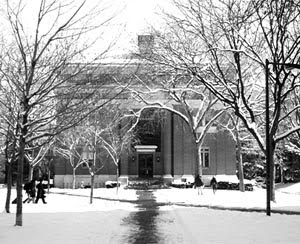
    So what can we learn from these papers when it comes to the influence of the economists on Rawls?

    Here is an inventory of Rawls's references to economists from 1955 to 1971, from the essays included in Collected Papers.

    Two Concepts of Rules (1955)
    • Lionel Robbins, The Theory of Economic Policy in English Political Economy (1952)
    Justice as Fairness (1958)
    • John von Neumann and Oskar Morgenstern, The Theory of Games and Economic Behavior (1947); R. Duncan Luce and Howard Raiffa, Games and Decisions (1957) (56)
    • IMD Little, A Critique of Welfare Economics (1957); KJ Arrow, Social Choice and Individual Values (1951); JR Hicks, Value and Capital (1946); Tibor Scitovsky, Welfare and Competition (1952) [66]
    • Jerome Rothenberg, The Measurement of Social Welfare; JC Harsanyi, "Cardinal Utility" (1953) and "Cardinal Welfare" (1955) [85]
    The Sense of Justice (1963)
    • WJ Baumol, Welfare Economics and the Theory of the State; RD Luce and Howard Raiffa, Games and Decisions [104]
    Legal Obligation and the Duty of Fair Play (1964)
    • KJ Arrow, Social Choice and Individual Values (1951)
    Distributive Justice (1967)
    • RD Luce and Howard Raiffa, Games and Decisions (1957) [133]
    • Wilfredo Pareto, Manuel d'economie politique (1909) [135, 160]
    • Nicholas Kaldor, An Expenditure Tax (1955) [143]
    Distributive Justice: Some Addenda (1968)
    • JC Harsanyi, "Cardinal Utility" (1953), "Cardinal Welfare" (1955) [173]
    Justice as Reciprocity (1971)
    • FY Edgeworth, "The Pure Theory of Taxation" (1958) [203]
    • John von Neumann and Oskar Morgenstern, The Theory of Games and Economic Behavior (1947); Luce and Raiffa, Games and Decisions (1957) [205]
    • RB Braithwaite, Theory of Games as a Tool for the Moral Philosopher (1955)
    • IMD Little, Critique; KJ Arrow, Social Choice; JR Hicks, Value; JC Harsanyi, "Cardinal Welfare", Tibor Scitovsky, Welfare and Competition (1963) [217]
    A couple of things are noteworthy in this inventory.  First, Rawls's references are highly contemporary to the 1950s.  He appears to have a reasonable level of acquaintance with what was happening in economics in that decade. And there are virtually no references to earlier figures in the history of economics; Pareto is virtually the only repeat entry in the index (Pareto principle).

    Second, there is a decided focus on several areas: welfare economics, social choice theory, and game theory.  Von Neumann and Morgenstern are cited several times, as are Luce and Raiffa; and Kenneth Arrow and John Harsanyi are repeat visitors as well. (Amartya Sen is cited in later essays, but not prior to 1971.)  Keynes is not mentioned in these early articles, and only tangentially in TJ.  And there is no mention of general equilibrium theory.

    Third, none of these citations corresponds to a significant or substantive discussion of the economist's views.  Rather, Rawls tends to illustrate a philosophical point by finding a relevant theoretical claim in one economist or another.  This indicates a degree of familiarity with the contemporary literature, but a fairly low level of intellectual engagement with the debates and analytical approaches.  In contrast to his treatment of utilitarianism, Kant, or Rousseau, Rawls's treatment of economic theory is brief and non-substantive.

    Significantly absent from this inventory of references is any mention of the classical political economists. The index of Collected Papers contains no references to Ricardo, Quesnay, or Malthus, and only one reference to Adam Smith (ideal spectator theory; 201).  John Stuart Mill is discussed in some detail, but always as a utilitarian philosopher, not an economist.  Marx is mentioned briefly (Critique of the Gotha Programme; 252). The labor theory of value -- the central construct of classical political economy -- is not mentioned once.

    There are a few references to Smith in A Theory of Justice, but they are superficial and incidental: Smith as a utilitarian, the concept of the invisible hand (57), the moral sentiments (184, 479), and impartial spectator theory (263).  There is nothing to suggest a careful or extensive reading of Smith, Ricardo, or Malthus in A Theory of Justice.

    It is hard to avoid the conclusion that the history of economic thought played a limited role in Rawls's thought.  Rawls was reasonably well acquainted with contemporary economics as of the 1950s and plainly found some aspects relevant to his philosophical agenda (Arrow, Harsanyi, von Neumann).  But I don't find much reason to believe that Rawls's important philosophical insights on justice were very much shaped by a reading of the history of economics.  Contemporary economists appear to have had greater influence -- decision theory, game theory, and social choice theory in particular.

    (See an earlier entry on "Rawls and decision theory" for more on this; link.)

    Saturday, August 14, 2010

    Rawls on Rousseau 1973, 1975


    As noted in an earlier post, John Rawls delivered a fundamentally important course on the history of political philosophy at Harvard throughout much of his career. (See the earlier post for more about the course and for a set of notes on the section on Marx.) The 1973 course followed these main topics:
    1. The nature of political philosophy 
    2. Natural law and contract theory. [kinds of natural law doctrines; Locke's account of political obligation; Hume's critique of contract theory; Rousseau's theory of the General Will] 
    3. The notion of the original position 
    4. Some principles of justice 
    5. J. S. Mill 
    6. Marx 
    Readers of my post on Josh Cohen's excellent recent book on Rousseau (Rousseau: A Free Community of Equals) may be interested in these course notes I took as a graduate student in Rawls's course. Cohen points out how important Rawls's lectures on this subject were for the formation of his own understanding of Rousseau. The notes are not detailed enough to give a full picture of Rawls's interpretation of Rousseau; but they give an idea of the issues he highlighted as well as an indication of how he related Rousseau's views to his own arguments in A Theory of Justice.

    I attended the 1973 version of the course as a graduate student and served as a teaching assistant in the 1975 version of the course. So I have two sets of notes for most of the course, and it is interesting to compare them. (Here is a PDF document that presents the two sets of lectures side-by-side for easier comparison.)

    Several things stand out upon reading both versions of the lectures. First is a very high degree of consistency between the two years. Rawls clearly worked from a very detailed lecture outline; the same topics occur in the same order, with the same breaking point between lecture 1 and lecture 2. Second, there is a great deal of consistency of content as well. Rawls's explanations of the general will, the well-ordered society, the central problem of the social contract, and the role of unanimity and voting are essentially the same in the two series. Even a somewhat puzzling statement in 1973 -- "The 'system' of the world has a general will; its object is the law of nature." -- recurs in 1975: "The law of nature is the general will of the universe." Third, both series indicate Rawls's interest in relating Rousseau's ideas to his own constructions in A Theory of Justice.

    Finally, the availability of two independent sets of notes from different years gives some basis for judging Rawls's meaning at various points. For example, when Rawls asks, "What does the general will will?", he answers "the public good" and "justice". But Rousseau doesn't write that "the general will wills justice"; so we have to ask what Rawls means by this. The fact that he repeats the assertion in both years indicates that he has something specific in mind. And it would appear that the connection in his mind proceeds through the idea of the well-ordered society (again, not a concept that Rousseau uses but one that is critical in Rawls's own thinking).

    A synthesis of Rawls's lectures on the history of political philosophy over a number of years is provided in Samuel Freeman's edition of Rawls's lectures in Lectures on the History of Political Philosophy.

    A core text for the course was Ernest Barker, ed., Social Contract: Essays by Locke, Hume, and Rousseau, which includes the full text of Rousseau's Social Contract. Here is a link to the G. D. H. Cole translation of the Social Contract.

    John Rawls, History of Political Philosophy, Phil 171, fall 1973 and 1975

    [The following are notes taken by Daniel Little; they were intended to capture Rawls's formulations of the main points presented in the lecture. Text in red is from the 1975 lectures, and text in black is from the 1973 lectures.]

    [Quoting Rawls:]

    Rousseau. If inequalities are between property owners and non-property owners, giving rise to political differences, it is hard to see that the have-nots have equal opportunity. Especially if the contract view allows for entrenching of privileged class and restricts equality of opportunity.

    Like Locke, Rousseau offers a complex view. We will look at one aspect of the Social Contract, with an explicitly narrow approach. 


    Rousseau, The Social Contract. The General Will. What is the general will the will of? Every association of people is held together by some common interest. (The "system" of the world has a general will; its object is the law of nature.) Within a political association each sub-association has a general will. This is a theory of associations as general-will-bearing agents. The general will is the general will of the political association. It is the will of the public person or body politic. When active, it is the will of the sovereign. An act of sovereignty is the declaration of the General Will. The general will is the will of the citizen -- i.e. as a rational person not determined by his particularity.

    The general will. Here is a question: what is it the will of? Every human association has a general will. As long as people identify themselves as belonging to a group having a common aim, the resulting group has a general will. The law of nature is the general will of the universe. If we think of factions within associations, each of them has a general will also; but this is a particular will with respect to the whole association. Normally an association has procedures for making up its collective mind. The general will is the general will of the association established by the Social Contract of the body politic. The declaration of the General Will is the act of sovereignty.

    The general will is the will of each person qua member of the association. It is the will that each person would have if they were rational, undeceived, unbiased, undistracted by private interests. We can identify three selves: self as member of political community, self as member of sub-association, and self as private individual.


    What does the general will will? The common good -- i.e. the good of the public person, just as private will wills the private advantage. The general will wills justice (I.4.4 [ perhaps a reference to TJ I.4, "The Original Position and Justification"]). It wills the preservation of the whole and every part. In the social contract the person only alienates as much of his liberty as is necessary for the sovereign to rule.

    Political economy (P114 [perhaps a reference to TJ V.41, "The Concept of Justice in Political Economy"]). The general will wills justice. The Original Position. To ascertain the general will, conditions lead each person to put himself in the place of all others. The general will is therefore the will of all, and applies to all. It must be general in purpose and nature: spring from all and apply to all.

    The general will always extends to what is right (but it may be deceived or misinformed).

    What does the general will will? It wills the common good, public interest, justice. The general will aims at the preservation and welfare of the whole and every part. This is related to the fact that in the social contract each alienates only so much of his liberty as relates to the community as a whole. This creates authority within limits. (2:4:3) The general will wills justice. It is the most just of wills. To be certain of following the general will it is enough to act justly. Why is the general will right even if not always enlightened? Happiness of everyone qua citizen is wished for by everyone.

    In voting no one fails to take "each" to refer to himself. This proves a notion of rights derives from a predilection to oneself. (2:4:4) Qua rational citizens what we are to do is to adopt a certain general point of view. The general will wills justice from adopting the perspective of the citizen as citizen. 


    By what acts does the general will act? It acts and expresses itself through enactments of basic laws -- particularly through decrees that set up fundamental conventions. It can set up privileges, but it cannot decide who gets them by name. The object of the general will is general.

    By what acts does the general will act? It acts in the form of general laws and enactments. These are enactments of a constitutional sort: basic legislative agreements; fundamental laws that regulate the form of a regime.

    Book II, chapter iii (link). Institutional questions. Under what conditions is it likely that the general will will express itself? No large public interests affecting voting. No coalitions. A vote is a statement of opinion, not an expression of interest or desire. As a vote approaches unanimity it tends to come closer to the expression of the general will.

    The original position is a way of articulating conditions for the expression of the general will. The book describes a well-ordered society.

    Institutional expression of the general will. What each citizen would will if rational, etc. We want to work out what form of institutional expression would do this. Consider the contrast between the will of all vs. general will. Former: what everyone would will if their sectional or personal interests ruled. Optimal conditions for establishing the general will within an association:
    1. No large sectional interests which affect general deliberations, and personal interests cancel out and leave the vote unaffected. 2:3:1-2 
    2. No communication or mutual influence in deliberation. No coalitions. 2:3:2 
    3. Rules of order ensure that the question is perfectly put. What is most of interest of this political association? 
    4. Assurance that we get expression of the general will comes from unanimity or approximate unanimity. 
    5. Every vote has to be counted and no one is excluded. No classes are excluded by constitution. 
    6. People have to be reliably informed. 
    The more these conditions are satisfied, the greater our assurance that the outcomes of votes is an expression of the general will. The more important and serious the matter, the greater the need for unanimity. The social contract must be unanimous.

    [continued on second lecture]

    Last time: What would the conditions have to be for an enactment to represent the general will?

    The general will is the will of persons qua citizen. How are we to determine this will? (1) No large private interests should determine action; rather, many small interests which cancel out (II:iii). The notion of the original position is designed to represent the same idea.

    One can view the society of the original contract as a description of a well-ordered society. ["A well-ordered society is one designed to advance the good of its members and effectively regulated by a public conception of justice" (TJ chap VIII, sect 69).] What are the characteristics of this view in Rousseau? The general will is not historical, but rather a sociological fact. The conditions of the general will must be expressed in institutional form. Rousseau's society is a natural rights type of society.

    What is the content of the general will? Rousseau doesn't say in sufficient detail what the general will wills. He depends upon social institutions and education to bring about the general will, rather than trying to sketch it out a priori. But one would like at least to know what the general principles are which govern the general will.

    Describing a well-ordered society: an association having some conception of the common good which has public institutional expression. Public conception of justice, as expressed in institutional enactments.

    We can supplement Rousseau by trying to see what these principles might be. The principles must satisfy a mutual advantage condition. Rousseau doesn't explore details, however.

    What is Rousseau's special contribution to contract theory? It is clear in Rousseau that the social contract is not historical; not a sequence of actual agreements, as Locke seems to suggest. Rather, it represents conditions on any well-ordered society.

    The general will as an interest that exists in every citizen. It is the basis upon which people decide how to vote or what is in the common interest. It is Rousseau's view that these conditions are realized and secure.

    It is a natural rights view of some sort. Rousseau thinks of society as generating in people as they grow up a general will. That interest then determines their public reasoning. This leads them to act as the general will requires them to act, in conjunction with other interests. The society of the social contract is therefore stable. Rousseau does not discuss what the possible conceptions are of justice. Are they many or few?


    Rousseau notes a hierarchy of interests: citizen qua citizen, citizen qua bourgeois, citizen qua individual. The object of the general will is the constitutional form, that of the particular is the individual's own private goals. The higher interests regulate the lower ones. These interests need to be articulated. There is no contradiction between say willing as citizen to establish a law and say willing as individual to avoid the application of the law in my own case. Rawls's four-stage sequence in Chapter 4 of A Theory of Justice is designed to provide much the same kind of articulation of interests.

    Another notion in Rousseau is a hierarchy of interests. The self is not an aggregate of interests, but rather a structure. We have interests of different orders. Higher order interests are interests having other lower-order interests. E.g. an interest or desire not to have compulsive sensuous desires. To get rid of desire we might take specific actions. Higher order interests in some way regulate the growth of lower-order desires. How does Rousseau use this notion? The general will is the highest order desire. It is not necessarily the strongest; this is a logical characteristic rather than a measure of strength. Highest order desire is the most fundamental; it regulates all others.

    We might now discuss Rousseau's fundamental problem: how to find an institutional form which protects the interests of each with the weight of all and yet also leaves each autonomous and as free as before. We may interpret his solution in terms of justice. (1) Each person alienates himself totally and his rights to the whole community and the public conception of justice. This means everyone gives himself absolutely to be regulated by the public conception of justice. (2) The giving of oneself is unconditional; no one is independent of the normative force of the public conception. (3) In giving oneself to the community, he gives himself to no one. There is no one in a superior relation to him; justice is mutual. (Book 1, chap 6, paragraphs 4, 6-8; link)

    The central problem of the social contract may be thought to have the following solution. The problem: How to form an association which protects all without losing freedom. Each totally alienates all his rights and freedom to the whole association absolutely and without qualification. When the association conforms to the general will it is all right. If the association is seen as regulated by the common good, then what Rousseau says can be satisfied.

    No one then has any rights except those defined by this conception of justice or the common good. Each person in giving himself to the community gives himself to no one. Everyone does the same, and everyone has the same rights. Giving oneself over to being regulated by the notion of the common good.

    I-8: being forced to be free. This addresses a concern with the free-rider problem. People may agree that rules are fair but prefer to be an exception. They can be compelled to comply with fair rules. Justice defines rights and defines equal freedoms.


    Sunday, July 25, 2010

    A property-owning democracy

    John Rawls offered a general set of principles of justice that were formally neutral across specific institutions.  However, he also believed that the institutions of a "property-owning democracy" are most likely to satisfy the two principles of justice. So what is a property-owning democracy?

    In Justice as Fairness: A Restatement (2001) Rawls offered a more explicit discussion of this concept than was offered in A Theory of Justice: Original Edition (1971).  Here are several important descriptions:
    Let us distinguish five kinds of regime viewed as social systems, complete with their political, economic, and social institutions: (a) laissez-faire capitalism; (b) welfare-state capitalism; (c) state socialism with a command economy; (d) property-owning democracy; and finally, (e) liberal (democratic) socialism.
    Regarding any regime four questions naturally arise.  One is the question of right: that is, whether its institutions are right and just.  Another is the question of design: that is, whether a regime's institutions can be effectively designed to realize its declared aims and objectives.  This implies a third question: whether citizens, in view of their likely interests and ends as shaped by the regime's basic structure, can be relied on to comply with just institutions and the rules that apply to them in their various offices and positions.  The problem of corruption is an aspect of this.  Finally, there is the question of competence: whether the tasks assigned to offices and positions would prove simply too difficult for those likely to hold them.
     What we would like, of course, are just and effectively designed basic institutions that effectively encourage aims and interests necessary to sustain them.  Beyond this, persons should not confront tasks that are too difficult for them or that exceed their powers.  Arrangements should be fully workable, or practicable.  Much conservative thought has focused on the last three questions mentionsed above, criticizing the ineffectiveness of the so-called welfare state and its tendencies toward waste and corruption.  But here we focus largely on the first question of right and justice, leaving the others aside.  (136-137)
    (Notice that these four questions converge closely with the feasibility conditions on reforms mentioned in an earlier post.)

    There is similar but less developed language in the original version of the Theory of Justice:
    Throughout the choice between a private-property economy and socialism isleft open; from the standpoint of the theory of justice alone, various basic structures would appear to satisfy its principles. (TJ, 258)
    Rawls argues that the first three alternatives mentioned here (a-c) fail the test of justice, in that each violates conditions of the two principles of justice in one way or the other.  So only a property-owning democracy and liberal socialism are consistent with the two principles of justice (138).  Another way of putting this conclusion is that either regime can be just if it functions as designed, and the choice between them is dictated by pragmatic considerations rather than considerations of fundamental justice.

    Here is how Rawls describes the fundamental goal of a property-owning democracy:
    In property-owning democracy, ... the aim is to realize in the basic institutions the idea of society as a fair system of cooperation between citizens regarded as free and equal.  To do this, those institutions must, from the outset, put in the hands of citizens generally, and not only of a few, sufficient productive means for them to be fully cooperating members of society on a footing of equality (140).
    Rawls isn't very explicit about the institutions that constitute a property-owning democracy, but here is a general description:
    Both a property-owning democracy and a liberal socialist regime set up a constitutional framework for democratic politics, guarantee the basic liberties with the fair value of the political liberties and fair equality of opportunity, and regulate economic and social inequalities by a principle of mutuality, if not by the difference principle.  (138)
    This last point is important:
    For example, background institutions must work to keep property and wealth evenly enough shared over time to preserve the fair value of the political liberties and fair equality of opportunities over generations. They do this by laws regulating bequest and inheritance of property, and other devices such as taxes, to prevent excessive concentrations of private power. (51)
    And concentration of wealth is one of the deficiencies of a near-cousin of the property-owning democracy, welfare-state capitalism:
    One major difference is this: the background institutions of property-owning democracy work to disperse the ownership of wealth and capital, and thus to prevent a small part of society from controlling the economy, and indirectly, political life as well.  By contrast, welfare-state capitalism permits a small class to have a near monopoly of the means of production. (139) [also Collected Papers, p. 419]
    The past thirty years have taken us a great distance away from the social ideal represented by Rawls's Theory of Justice.  The acceleration of inequalities of income and wealth in the US economy is flatly unjust, by Rawls's standards.  The increasing -- and now by Supreme Court decision, almost unconstrained -- ability of corporations to exert influence within political affairs has severely undermined the fundamental political equality of all citizens.  And the extreme forms of inequality of opportunity and outcome that exist in our society -- and the widening of these gaps in recent decades -- violate the basic principles of justice, requiring the full and fair equality of political lives of all citizens.  This suggests that Rawls's theory provides the basis for a very sweeping critique of existing economic and political institutions. In effect, the liberal theorist offers radical criticism of the existing order.

    (Thomas Pogge's John Rawls: His Life and Theory of Justice has a good discussion of this topic.)

    Sunday, March 21, 2010

    Influences and arguments


    Lately I've been writing about the influences that can be discerned in the theories of John Rawls.  Rawls was a "social contract theorist"; to what extent were his theories shaped and framed by his reading of the great contract theorists such as Locke, Rousseau, or Kant?  He was also influenced by the history of economic thought; so is it possible to find parallels or echoes of the thought systems of Adam Smith or Karl Marx in Rawls's thinking?  And to what extent were there more local influences in the 1940s and 1950s that created fairly specific directions and characteristics in Rawls's thinking?

    This is an interesting question in application to one particular philosopher.  But it also raises a more general question: where do philosophical theories come from?  To what extent is it the case that a given philosopher is working within a "micro-tradition" -- a particular and specific field of influence -- and to what extent is the thinker "original", bringing forward new ideas on a topic?  And once a fundamental topic has been established for a thinker -- e.g., "What defines the principles of justice for a property-owning democracy?" -- to what extent does the theory then develop autonomously according to the arguments and analysis of the philosopher?

    This way of formulating the problem invokes several related ideas: influence and tradition; originality and creativity; and orderly, logical development of a position or theory.  

    I suppose that there are many instances of philosophers who fall mostly in the "influence" part of the map: their philosophical work largely takes the form of carefully working out the ideas of their influencers.  (This might be part of the legacy of Rawls; I suppose there has been quite an ocean of philosophical work dedicated to specifying more exactly what "primary goods" are, or how "reflective equilibrium" works.)  This might be described as "normal science" -- taking the foundations of a field of study as being unquestioned, and then attempting to work out the details more exactly.

    There are also some good examples of philosophers who were largely driven by the "logical analysis" part of the map: formulate a good, difficult question, and then spend the rest of one's career working out analytically sound answers to the problems this question spawns.  "Naturalized epistemology" might fall in this sector; we might say that the philosophers who have tried to give a biological interpretation of the conditions of knowledge are taking one fundamental question -- how do biological organisms arrive at knowledge of their environment? -- and attempt to apply the findings of cognitive science and evolutionary biology to the issues that arise.  Kant's philosophy also seems to have this character: once having chosen the topics "What can we know metaphysically?" or "What creates moral duty?", his mind seems to have proceeded analytically and logically, without correction or stimulus from a contemporary literature.

    And what about originality?  Are there examples of philosophers who have largely invented a set of questions and approaches that defined a new philosophy for a given domain?  Wittgenstein is commonly recognized as a highly original philosopher; but certainly his theories were embedded in a tradition of philosophy.  Several things are apparently true about Wittgenstein when it comes to influence and argument.  (a) Many of his ideas and assumptions in the Tractatus Logico-Philosophicus derived from careful readings of Frege and Russell; (b) his insights and assertions in Philosophical Investigations were responsive to a surrounding set of ideas about language, behavior, and meaning, but his solutions and theories still strike one as being highly original; and (c) for certain themes and problems he continued to work carefully to move his position forward through analytical discovery and inference.  So Wittgenstein seems to illustrate all three dimensions of philosophical theory formation and knowledge construction.

    Several things seem to be true about the formation of the theories and perspectives of individual philosophers:
    • They are introduced into a fairly specific "philosophical research community" through graduate education that provides paradigm examples of philosophical questions and issues and prescriptive advice about the nature of philosophical argument and analysis.
    • They are introduced to their field at a particular moment in social history: World War II, the Holocaust, the Vietnam War, the civil rights period, 9-11; and historical events and shifts have an influence on the formation of their thought.
    • "Originality" can take the form of arriving at new questions ("How is group mentality possible?"); new methods of analysis (Frege-Russell's formal deductivism as a solution to the question of the nature of mathematical truth); or new substantive approaches to philosophical theory (Kant's Copernican Revolution in thought).
    An interesting contribution to this set of topics is an innovative series of volumes posing "5 Questions" to philosophers in a variety of fields (link).  A recent volume is Philosophy of the Social Sciences: 5 Questions,  edited by Diego Rios and Christoph Schmidt-Petri.  Contemporary philosophers were asked to respond to five important questions about their approaches to the field of the philosophy of social science.  The format offers the beginning of a triangulation among "beginnings," "fundamental assumptions," and "future directions" for each of these philosophers.  The questions that were provided to the philosophers are these:
    1. How did you get interested in the philosophical aspects of the social sciences?
    2. Which social sciences do you consider particularly interesting or challenging from a philosophical point of view?
    3. How do you conceive the relation between the social sciences and the natural sciences?
    4. What is the most important contribution that philosophy has made to the social sciences?
    5. Which topics in the philosophy of social science will, and which should, receive more attention than in the past?
    Contributors include David Bloor, Raymond Boudon, Mario Bunge, Nancy Cartwright, Margaret Gilbert, Daniel Hausman, Harold Kincaid, Daniel Little, Steven Lukes, David Papineau, Philip Pettit, Alexander Rosenberg, David-Hillel Ruben, John Searle, and Raimo Tuomela.  This list includes quite a few of the people who have helped to shape current thinking in this sub-discipline of philosophy; so it is very interesting to have a chance to see what they have to say about some of the original influences on their thinking about the social sciences, as well as their own definitions of the frameworks they have arrived at.  I found it very interesting to think seriously about these questions in my own case, because it forces one to reflect on the ideas, events, and ideologies that led one to choose one set of topics and approaches rather than another.  I would have added a sixth question for each of the contributors: "What are the most basic ideas that you have come to in the course of your studies of the social sciences?"

    What I would like to see is a next step conducted by a gifted sociologist of the professions, who would attempt to map out the streams of influence and contribution that are documented within the essays in this volume.  Andrew Abbott's careful analysis of the currents of thought constituting the discipline of sociology in the 1960s and 1970s is a good case in point (Chaos of Disciplines).  Another good example is William Sewell's attempt to provide a geography of the discipline of social history in the 1960s (Logics of History: Social Theory and Social Transformation).

     
    Design by Free Wordpress Themes | Bloggerized by Lasantha - Premium Blogger Templates