Showing posts with label CAT_China. Show all posts

Sunday, December 18, 2011

Protest in Wukan


A period of demonstration and protest in the Chinese village of Wukan has caught the attention of world media in the past several weeks (link, link). The village is in Guangdong, the dynamic coastal province.  The demonstrations began in September against major land seizures by local government in alignment with developers, and became more intense in the past week when leader Xue Jinbo died in police custody.  (Here is a good Wikipedia article on the village.)  Land seizures seem to be the most volatile issue in China today, producing a large proportion of the roughly 90,000 civil disturbances the country currently faces a year.

Analysts are interested in probing the causes and dynamics of protest and resistance in contemporary China, including C. K. Lee (Against the Law: Labor Protests in China's Rustbelt and Sunbelt) and Kevin O'Brien (Rightful Resistance in Rural China).  Here, though, it may also be interesting to compare the current situation with the occurrence of similar incidents during the Qing Dynasty.

Fortunately, it is possible to do so on the basis of a recent relevant study. Ho-Fung Hung's recent Protest with Chinese Characteristics: Demonstrations, Riots, and Petitions in the Mid-Qing Dynasty addresses exactly this issue in historical context. He looks at the period 1740-1839 and finds that the character of protest and resistance varied throughout the period. This is the early modernization period of Chinese history, and Hung believes that the subject of popular unrest has been overlooked in this period. The grasp of the central power of the state increased during this period, and it also represented a major advance in commercialization of Chinese society.

The main source of data on protests during this period that Hung analyzes is the Veritable Records of the Qing, a compendium of shortened versions of edicts and memorials from the emperor and other officials. Out of the 2,096 volumes of this archive Hung identifies 514 events of popular protest and 450 events of petitions to higher officials (55).  His empirical work involves coding hundreds of contentious events during the period, classifying them, and looking for patterns of change over time.  But how to categorize?  Here is his overview description of his approach:
I classify the documented protest events into different types according to their claims and repertoires. A protest's claim is a set of articulated demands advanced by the participants. The repertoire of a protest is the set of learned or invented acts that the protesters performed to attract the attention of potential participants and the authorities, as well as to persuade or force the authorities to meet their demands. (58)
One distinction between events that he draws from the existing literature on contention and rebellion is between backward looking and modernizing protests. Essentially the former represent demands to secure existing rights (or re-establish recently extinguished rights). The latter take the form of proactive protests aimed at creating new opportunities and rights within an emerging set of economic or social institutions. Hung rightly rejects the idea that European experience can provide a full theory of contentious politics. So he insists on using the evidence of non-western movements as an alternative basis of analysis and theory. China's experience in the mid-Qing provides an ample basis for arriving at such a scheme.

Hung doubts the utility of the concept of "backward-looking" protest in the mid-Qing period. Instead, he argues that protests throughout the period were proactive and aimed at securing better outcomes in the future for the protesters, in light of changing political and economic conditions. The large distinction that Hung favors as a way of categorizing contention has to do with the purpose and style of the mobilization. "Filial protest", or "state-engaging" protest, involves collective action intended to implore the state to honor its obligations. "State-resisting" protest involves action deliberately designed to challenge the authority and power of the state, often with the threat or reality of violence (58). And Hung believes this scheme is valuable for China, in part, because some surprising patterns emerge through these lenses. In particular, he finds the frequency of state-resisting protest varies significantly along this timeframe, from a high point in 1600-44 of 94% to a low in 1740-59 of 40%, rising again between 1776 and 1839 (figure 6.1).

Hung's account highlights several important things about Chinese protest. First is the point that protests exist within a set of material social arrangements that provide the interests that lead to mobilization. So an important dimension of analysis for uncovering the causes of a wave of protests is to analyze the changing economic and political circumstances that created new pressures and opportunities for ordinary people.  Second is the point that culture and repertoires of resistance give form to the protests that emerge.  Here he gives causal importance to Confucian ideas about the state, but also to heterodox ideas stemming from non-Confucian traditions (for example, White Lotus Buddhism).

A very old feature of Chinese protest involves the delivery of petitions to the central government (emperor) to protest abuses by local officials, tax farmers, or other scourges of peasant life.
In Qing times (1644-1911), a common remedy for powerless subjects abused by local officials was to travel all the way to Beijing to appeal to the emperor as their grand patriarch, hoping he would sympathize with their plight and penalize corrupt local officials. (1)
And, as Hung points out, this tradition continued through 1989 and beyond.

So what about Wukan?  Does Hung's analysis of mid-Qing protest shed any light on the nature of protest there?

Accounts make several things clear.  First, the cause of popular unrest that precipitated the first round of protest in Wukan had to do with an important material issue (land seizures) and the actions of potentially corrupt local officials in collusion with powerful developers.  Second, the protest intensified dramatically in the past 10 days after security officials took violent action against elected leaders of the protesters, leading to the seizure of Xue Jinbo and his death in police custody. Third, it appears through news reports that protests took the form of non-violent appeals for relief against corrupt officials -- similar to the tradition of filial protest.  The tradition of taking the protest to higher officials is also illustrated here, with the stated intention of marching to Lufeng, the local administrative center. Here is an indicative passage from the New York Times:
Almost to a person, the villagers are holding out hope that leaders in Beijing will intervene to settle the dispute and to investigate what they contend is widespread corruption in local affairs, including land sales. Saturday’s rally, laced with chants like “We love the Communist Party,” stressed the villagers’ loyalty to the central government. One prominent banner begged the central government to come to their aid. (link)
But the same article raises the possibility that this protest may move from state-engaging to state-resisting as villagers come to believe that they have no recourse from the central government:
“Our original intent was just to get our land back,” a 29-year-old homemaker who identified herself only as Mrs. Zhu said as she stood under a Chinese flag, mounted on a makeshift pole at a protesters’ checkpoint on the village outskirts. “We never intended that things would get into such a situation.”Asked what could be done, she replied: “We have to fight to the end. That’s the only way out. If we retreat now, all the hardships the government imposed on us will come true.”
Hung provides an interesting tabulation of several important characteristics of protests in mid-Qing China that I've reproduced below. I've supplemented the table in two ways.  First, I've included in this table the data Hung reports on the incidence of state-resisting protests, which vary significantly throughout the period he studies (figure 6.1). Second, I've added an additional column of my own indicating how Wukan seems to measure up on these criteria.  The finding that I've come to is that Wukan began as a "filial protest" through which villagers sought to engage the state to obtain relief from local officials.  The protest has been pushed into a more "state-resisting" posture, however, as a result of the violence and intransigence of local and county officials, and the fact that Beijing has so far ignored the villagers' demands.


Tuesday, February 22, 2011

New thinking about the Red Guards


Andrew Walder has spent almost all of his academic life, on and off, studying the Chinese Cultural Revolution.  In Fractured Rebellion: The Beijing Red Guard Movement (2009) he offers some genuinely new insights into this crucial and chaotic period of China's revolutionary history.  Some historians have focused on the political motivations of Mao and other top leaders in the party; others have examined the economic and social cleavages that existed in China only a decade and a half into its Communist Revolution.  Walder is interested in a much more grass-roots question: what were the motivations, calculations, and states of mind of the "foot soldiers" of the CR, the Red Guards in the earliest years of the upheavals?  And why did the political activism of the CR devolve almost inevitably into intense factionalism between groups whose ideologies seemed virtually indistinguishable -- loyalty to Mao, defense of the revolution, attacks on treacherous leaders?  Walder is a political sociologist, and he wants to understand the dynamics of mobilization and affiliation that led to the group violence and inter-group factionalism in the early years of this period.

Here is an example of the kind of factionalism that most interests Walder:
Chapter 8 examines the puzzling disintegration of the rebel movement in January 1967, soon after the decisive victory over its opponents.  Why did the victorious rebel coalition rapidly split into two opposing camps?  In their earlier attacks on ministries and commissions, rebels stayed within separate bureaucratic hierarchies.  Work teams were dispatched down these hierarchies to the schools under them, and the pursuit of work teams led rebels directly back up this hierarchy to the ministry or commission that sent them.  When these rebels moved to seize power in national and municipal agencies, however, they crossed into different bureaucratic hierarchies.  Rebel groups from different schools who went to the same organs of power turned quickly from allies into competitors.  These competitive rivalries were exacerbated by deep splits that had earlier developed among rebel forces in the two largest and most important campuses, Beijing and Quinghua universities.  The splits at Beida and Qinghua served as a wedge to divide rebel forces citywide, as factions of different schools aligned themselves with one or another faction at these two large campuses.  The resulting split between "Heaven" and "Earth" factions crippled the student movement and frustrated the CCRG until the very end. (26-27)
Walder suggests that earlier scholars have sought to understand the motivations and factions of China's young people in terms of the class position of the participants and the pervasive political indoctrination of youth that had been ubiquitous in the 1950s and 1960s.  Factions existed, according to this line of thought, either because different groups had different interests, or they had different political theories and ideologies ("conservative" and "radical").  Walder finds these explanations unsatisfactory, since they apply equally to both sides in all the factions -- and so he wants to identify some other feature of the political landscape that would explain the behavior and the factionalization.  And, unlike the scholars of the 1970s and 1980s who had to largely speculate about these issues, Walder takes advantage of primary sources that allow the researcher to get a great deal of information about the participants in their own words, and in their relationships to other activists.

Walder also questions the relevance of the core assumptions of social mobilization theory for the Cultural Revolution -- the idea that social movements need to be understood in terms of grievances, resources, and the state's ability to resist group demands.  Fundamentally his objection is that this theory doesn't help to explain the early months of the Cultural Revolution because all the postulated conditions were present in 1966, and mobilization did in fact occur (14).  But it occurred in a very distinctive way that resource mobilization theory seems not to prove a basis for explaining -- the constant fissioning of a group of activists into two or more factions, bitterly opposed to each other.  It appears, then, that resource mobilization theory lacks the tools necessary to explain this specific pattern of mobilization -- radicalization followed by bitter factionalism.

Walder's explanation is a novel one.  He argues that factionalization was a consequence, not of class differences or ideological disagreements between individuals, but simply of the early choices that various individuals made early in the period.  A central feature of this period was the fact of denunciation -- denouncing past or current leaders for disloyalty to the revolution or other ideological errors.  And these denunciations within the universities were highly consequential: "by mid-July 55 percent of all university party first secretaries and 40 percent of all general branch secretaries had been labeled anti-party reactionaries and placed in category 4" (57).  The rapid proliferation of denunciations meant that persons close to the denounced leader needed to decide -- should they join the denunciation or should they refrain?  The work teams that were sent into Beijing's elite universities in June 1966 (Peking University, to begin with) were forced to make choices in light of radical students' denunciation of top university officials; lower officials had to make similar choices; and activist student leaders had to decide whether to support or oppose the activities of the work teams.  And, Walder argues, this choice was fateful and enduring.  It meant that the individual would be shunted into this group or that group, with further decisions cementing the affinity with the group.
Another way of stating the argument is that factional identities and the common interests that define them are the product of political interactions rooted in specific contexts whose properties must be researched, not simply assumed.  Individual decisions -- to join factions, to oppose or support a work team -- are not the product of prior socialization or social ties but are actdively shaped by political encounters.  The focus is on the interactions that generate choices and outcomes, not the prior statuses of individuals or their preexisting social and political ties. These processes determine when prior social statuses or network ties are activated in a conflict, and when they are not. (13)
In other words, Walder argues that the fact of pervasive factionalization in the Cultural Revolution does not reflect fundamental underlying disagreements or contradictions between the factions; it does not reflect prior sociological distinctions among the participants; but rather reflects the emergence of separate networks of political affiliation from which there was no exit.
Chapter 3 describes how the work teams split university power structures into warring factions, with a focus on the issues that bred conflict between work teams and militant students.  Only in rare and fleeting circumstances were the issues of contention about attacks on the incumbent power structure -- a question that might distinguish "conservative" from "radical" political orientations.  Instead, they were usually about the work team's authority over student actions and the physical control of officials held for interrogation, and about heavy-handed work-team punishment of students who proved hard to control. (24)
This is a fascinating micro-sociology of a crucial span of a few months of violent upheaval in a single city.  It helps to explain a particularly pervasive feature of a broad and chaotic period of political unrest in China -- the constant factionalism that occurred at virtually every level of conflict.  It introduces an innovative model of political behavior (path-dependent choices by individuals leading to a durable configuration of political affiliations).  And it provides a new avenue through which the methods of network analysis can be fruitfully used to explain complex social processes.  It is a valuable contribution to the new wave of scholarship that is currently underway about the Cultural Revolution.  (Other contributions to this new scholarship are included in Esherick, Pickowitz, and Walder, eds., China's Cultural Revolution As History.)

A side note, not crucial to Walder's argument but interesting nonetheless, is the apparently simple question of when the Cultural Revolution took place.  It is conventional by many historians to date the CR to the years 1966-1976.  In 1966 the Red Guard movement erupted with wall posters and virulent activism in Beijing, among high school and university students.  And in 1976 Mao died, the Gang of Four were arrested, and the disruptions of the decade were decisively put aside.  But Walder dates the CR to a much shorter period, 1966-68, beginning with the same Red Guard explosion that occurred in 1966 but ending in 1968 when Mao unleased the military to put down the radical activists: "Not until August 1968 were the flames of China's Cultural revolution extinguished by the imposition of a harsh regime of martial law" (1).

Thursday, January 6, 2011

Historical GDP estimates for early modern China


Li Bozhong is one of China's most influential economic historians, and he is undoubtedly the most internationally connected.  Much of his work in the past several decades has been devoted to constructing a detailed economic history of the lower Yangzi Delta (for example, Agricultural Development in Jiangnan, 1620-1850).  His findings have been crucial empirical contributions to the "involution" debate (link, link, link) about whether the Chinese economy was stagnant and significantly less productive than the European economy.  Thanks to his research we now have a much more informed understanding of the economic dynamics of the Lower Yangzi region in the early modern period (1620-1850).  And his research largely supports the "no involution, significant productivity growth" interpretation.  (Ken Pomeranz has a nice review of Agricultural Development in Jiangnan, 1620-1850 here.)

Li's most recent book has now appeared in Chinese, and it takes an important step forward in terms of methodology.  (The cover and title are included above.  The book includes an extended summary in English, which allows non-Chinese speakers to get the highlights of method and findings.)  The important step that Li introduces here is a first effort to apply the methodology of historical national accounts to China. Essentially this method allows the researcher to use the discipline of GDP accounting to arrive at systemic and internally validated estimates of economic activity in a region over a period of time.  (Jan-Pieter Smits, Edwin Horlings, and Jan Luiten van Zanden provide an extensive and detailed description of the method in "Dutch GNP and its Components, 1800-19193" (link).  Olle Kranz describes the method in application to Sweden here.)

Li's current book is a massive effort (over 600 pages), but it is itself only a pilot project for a more ambitious study to come in future years.  Li has selected one limited district within his previous area of study in the lower Yangzi Delta (Huating-Lou), and attempts to apply the method of historical GDP to this limited region for a single period of time (1823-29).  His goal is to determine whether the discipline and method of historical GDP can shed new light on the scattered economic statistics and materials that more traditional economic histories have assembled.  The results are highly interesting, and they challenge several key assumptions that have been made about the early Qing economy.

Li hopes for two advantages from this approach.  The first is that it provides a unified framework within which to organize and validate existing economic data.  "Because the methods of the GDP study are quite elaborate and standardized, they can provide a coherent macroeconomic framework covering the whole economy" (603).  And the second is to provide a consistent basis for comparison with other historical regions where the same methods have been utilized.  This means that the kinds of comparisons suggested by recent work in Eurasian economic and demographic history will be enhanced as other scholars apply the methodology to European regions.

Huating-Lou is roughly a single county, Songjiang County, with an area of 870 square kilometers and a population in 1816 of 563,052.  (From the maps it appears that the county falls squarely within the current city of Shanghai.)  So the area covered by Li's study is a microcosm of the larger economic region in which it is lodged; Jiangnan had a population of roughly 36 million in the mid nineteenth century.  Li makes use of the same kinds of data sources he has used in earlier works: gazetteers, agricultural handbooks, and modern field investigations of the region (in particular, the Japanese South Manchurian Railway Company studies from 1937-41). Essentially Li proceeds by transforming the variety of data provided by these sources into a uniformly formatted table of national accounts.


The method involves attempting to estimate the magnitude of economic activity in several sectors by assessing production, expenditure, and income. The idea is that the data for these three aspects of the economy are fairly independent; but they should be expected to lead to similar estimates of overall economic activity. (If production estimates indicate a region is producing 10 million yuan of goods, but income estimates indicate only 2 million yuan of income, we can be assured that there is an important data inconsistency.) The method involves making use of the System of Historical National Accounts to provide a unified framework for collecting and presenting the economic data. (See also a paper by Frits Bos describing the use of national accounts as a tool for economic history (link).)

Here is a description of this method as implemented by Luiten van Zanden and colleagues for the Netherlands (link):
Our main method is to gather specific information on annual output and added value in each of the most important economic branches, following the System of National Accounts (SNA) used in contemporary economic-statistical research. The starting point is the production approach; the branches that are being reconstructed include agriculture, herring fisheries, peat extraction, production of textiles, sugar and paper, to name but a few. Weights will be derived from a reconstruction of the structure of the labour force in three moments in time: 1510/14, 1670/80 and around 1800. Combined, the chronological series and the data on the structure of the labour force will serve as a basis for estimating developments in the level and structure of national income.
Li's results are fascinating. First, he finds that production, income, and expenditure estimates for Huating-Lou in 1823-29 all converge on an estimate of about 13.5 million taels of silver. The production estimate is 13.5 million taels, the income estimate is 13.3 million taels, and the expenditure estimate is 13.9 million taels.  So the three systems of accounting all point to approximately the same level of economic activity.  This amounts to an estimate of GDP per capita of about 24 taels of silver.


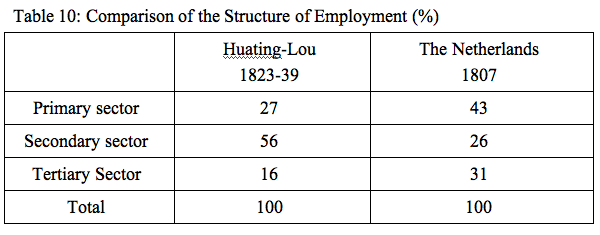
Second, the sectoral composition of the Huating-Lou economy is genuinely surprising (as indicated in table 1). We commonly think of China's Ming-Qing economy as largely rural and agricultural. But the primary sector, including agriculture and fisheries, amounts to only 31% of the local economy, while the secondary sector (manufactures and textiles) contribute 33% and the tertiary sector (commerce, service, government, etc.) contributes 36%. The prior expectation we might have had of the early modern Chinese economy as largely agricultural is flatly refuted for this region by the 1820s. This finding is corroborated by Li's analysis of the structure of employment in the region; only 27% of employment was in the primary sector, with 56% in the secondary and 16% in the tertiary sectors.

Third, Li points out that the composition of income is also somewhat surprising. Wages represented 61% of the Huating-Lou economy; rent 11%; interest 3%; profit 20%; and depreciation 6%. What is surprising about this estimate is the unexpectedly low percentage of all income that derived from rent -- contradicting the idea that the Chinese economy was a rent-dominated one. (Earlier work by Victor Lippit (Land Reform and Economic Development in China: A Study of Institutional Change and Development Finance) sought to estimate the total surplus created by the Chinese rural economy; he estimates 10.7% of income from rent, 3.4% of income from farm business profits, and 2.8% from rural interest payments.  See Understanding Peasant China: Case Studies in the Philosophy of Social Science, pp. 121-22, for more discussion.  Li's estimates of rent and interest are about the same as Lippit's, whereas Li's estimate of profits is substantially higher than Lippit's.)

All of this is highly interesting, though (as Li emphasizes throughout), it is based on only one small region during one limited time period.  So it will be very interesting to see whether it is possible to perform this kind of analysis for larger parts of the historical Chinese economy.

Estimating economic activity was one of the goals of this research.  The other was to establish a consistent basis for comparison across different parts of Eurasia.  Li takes up the comparison with the Netherlands that is made possible by the work mentioned above by Jan-Pieter Smits, Edwin Horlings, and Jan Luiten van Zanden (link). And indeed, the comparisons are very interesting.  Here is the comparison of the sectoral composition of Huating-Lou and the Netherlands:


And here is the comparison for the structure of employment:


The one comparison that Li does not highlight (in the English summary, anyway) is the GDP per capita comparison between Huating-Lou and the Netherlands.  This comparison raises some of the issues involved in a recent discussion here of the standard of living (post), since the Dutch analysis is denominated in guilders and the Chinese work is denominated in taels of silver.  Smits, Horlings and van Zanden estimate a Dutch population size of  2,163,092, implying a GNP per capita of 227 guilders per capita.  Recall that Li estimated a per capita GNP of 24 taels. 

So what is the conversion of tael to guilder? Here I have to go beyond my own specialized knowledge and speculate a bit, so this calculation shouldn't be taken uncritically.  The guilder was defined in 1840 as equivalent to 9.45 grams of fine silver (link).  A tael was equivalent to 37.3 grams of silver, according to Li. So in silver equivalents, the Dutch GDP per capita was 227*9.45 grams of silver, and the Chinese GDP per capita was 24*37.3 grams of silver -- 2,145 grams versus 895.2 grams.  By this estimate, the early nineteenth-century Dutch economy produced a silver equivalent per capita over two times that of the Chinese economy.  However, the purchasing power of silver was significantly greater in China than Europe; so this estimate overstates the disparity in real wage between the two regions.  In "Real Wages in Europe and Asia: A First Look at the Longterm Patterns" Robert Allen estimates the wage basket for China at 247.3 grams of silver, versus 579.7 grams of silver in England (link, pp. 180, 182).  If we took the wage basket as the basis of a cost-of-living deflator, then the disparity between the Netherlands and China essentially disappears.  The Dutch GDP per capita PPP-adjusted product is 3.7 against a 3.6 per capita PPP-adjusted product for China, using the wage basket as deflator.  This would indicate that the Dutch economy was marginally richer than the Chinese economy in the lower Yangzi region -- but not by much.

Li finishes this comparison by raising the question of traditional versus modern economies.  Both economies considered here contradict the assumptions of a "traditional" economy -- largely rural, largely agricultural, and largely stagnant.  Instead, these comparisons indicate a surprisingly urban, manufacturing- and service-based economy in the second decade of the nineteenth century, and Li argues that we can appropriately describe each of them as a "modern" economy.

Li's book is an important new contribution to Chinese economic history, and the historical GDP method seems to be a highly fruitful innovation. It is a really valuable new analytical perspective on the Chinese economy.  I hope the book will be translated into English as quickly as possible.

Thursday, December 2, 2010

Re-reading Chalmers Johnson


Chalmers Johnson, one of the key contributors to Asian studies since the early 1960s, died on November 20, 2010. (Here are several notices -- linklinklink.)  Johnson has been an important contributor to Asian studies since the appearance of his first book in 1962, Peasant Nationalism and Communist Power: The Emergence of Revolutionary China, 1937-1945, based on his doctoral dissertation at Berkeley.  The book created a long debate about the causes of the Chinese revolution -- patriotism or class? -- which shed new light on the nature of Communist mobilization.  

Johnson was a brilliant thinker who was exceptionally attuned to language -- both in his own writing and in the importance of making nuanced use of Chinese and Japanese sources in studying Asian history.  And he was a figure who seemed to relish controversy, from this early debate about the Revolution to his focus on American empire in the past half dozen years (Dismantling the Empire: America's Last Best Hope).  

Here is a posting on the debate about Johnson's theory of peasant nationalism and current thinking about the Chinese Revolution that I provided for ChinaBeat.


Chalmers Johnson, co-founder and president of the Japan Policy Research Institute at the University of San Francisco and long-time professor of political science at the University of California, Berkeley and University of California, San Diego, died on November 20, 2010. (Here are several notices -- linklinklink.) In the past ten years or so Johnson has become widely known for his critical books about American empire (Blowback: The Costs and Consequences of American Empire (2004), The Sorrows of Empire: Militarism, Secrecy, and the End of the Republic (2005), Nemesis: The Last Days of the American Republic(2008), and Dismantling the Empire: America's Last Best Hope (2010)). The bulk of his career, however, was devoted to the study of China and Japan, and this posting examines one of his most notable contributions to these areas.

His earliest contribution to China studies was his 1962 book, Peasant Nationalism and Communist Power: The Emergence of Revolutionary China, 1937-1945. The core of the book was written as a Ph.D. dissertation at Berkeley, making use of archives of secret Japanese wartime materials collected by Robert Scalapino. (Johnson describes the origins of the book in "Peasant Nationalism Revisited: The Biography of a Book"; link.) The book was one of the early efforts to provide a more systematic explanation of the success of the Chinese Communist Party in mobilizing mass support during the Anti-Japanese War. The book became one of the linchpins of later debates about the Chinese Revolution. As a political scientist, Johnson was mindful of the inherent unlikelihood of a successful revolution anywhere, and this seemed particularly true in China in the 1920s and 1930s. Large-scale mobilization is inherently difficult to sustain, and local discontents rarely escalate to national scale. (Lucien Bianco made this point about China, writing in Peasants Without the Party: Grass-Roots Movements in Twentieth-Century China that "The essential difference between chronic peasant agitation and revolutionary action is that the latter is deliberately offensive in nature, whereas the former resembles the defensive reaction of a beleaguered organism. If peasant agitation was chronic ... , it was because the occasions for such conduct were endemic in rural China" (4).)

Johnson's book is based almost entirely on secret Japanese archives, and Johnson takes special care to attempt to validate these sources as legitimate indications of the nature of events in China during these war years. He believed that the fact that these documents were "secret" gave them an evidentiary status they would lack if they had been produced for the sake of propaganda or political influence by the army or other officials; but rather than representing an effort to spin events in one direction or another, they were intended as "realistic appraisal of military and political developments in China by Japanese leaders" (x). So Johnson is emphatic in arguing that these secret wartime archives provide a valid window of knowledge into both Japanese and Chinese strategies and actions.

So what structural or institutional factor was present in China that permitted mass mobilization by the Communist Party during this period? According to Johnson, it was nationalist identity and a patriotic desire to resist the Japanese invaders on the part of millions of rural Chinese people. The Communist Party was able to offer itself as the most effective force available to achieve the patriotic goals of defeating the Japanese and restoring China's peace and security. The central thesis of the book, then, and the element that generated the greatest controversy, is Johnson's view that the Communists succeeded in the crucial period because they mobilized a mass following around patriotic resistance to the Japanese invaders.
On the basis of a study of wartime resistance in China, the view advanced here is that the Communist rise to power in China should be understood as a species of nationalist movement. (ix)
It is the thesis of this study that the rise to power of the CCP and YCP [Yugoslav Communist Party] in collaboration with the peasantry of the two countries can best be understood as a species of nationalism. (19-20)
Johnson's definition of nationalism is what he labels "functionalist". What he means by this, however, is not a Mertonian "structural-functional" analysis; rather, it is closer to a behavioral-causal analysis. "This study employs a functional definition of nationalism -- in other words, one which identifies specific physical pressures that by acting upon given political environments give rise to nationalist movements" (ix). He draws largely from Karl Deutsch's Nationalism And Social Communication: An Inquiry Into The Foundations of Nationality (1953) in laying out a definition of nationalism and mass mobilization. Johnson identifies social mobilization of the masses around a national myth as the heart of modern nationalism. This is what nationalism is, according to Johnson; and the causes that brought it about in China were Japanese invasion and subsequent harsh treatment of rural people, and skillful mobilization of the countryside by Communist political officers in enhancing a sense of shared cause.
In essence, the Party is seen as the leader of a war-energized, radical nationalist movement.... The Chinese masses, the peasants, were unified and politicized as a concomitant of the drastic restructuring of Chinese life that accompanied the Japanese conquest of north and east China.... This wartime awakening became the basis for a new order in China following Japan's collapse. (ix-x)
Since patriotic nationalist mobilization is primary, then radical mobilization around peasant interests must be secondary. So Johnson is particularly concerned to refute the idea that it was economic issues and class exploitation that led to peasant support. (Mark Selden's The Yenan Way in Revolutionary China (1971) was a central advocate of this position.) Johnson expressly rejects the idea that the Communist Party's overall strategy depended on a class appeal to poor peasants during these years. One key argument to this conclusion is the markedly different fortunes of the Communist movement in China in the 1920s versus the wartime years. The Communist movement in the 1920s was plainly based on a mobilization strategy around revolution and social change, and, according to Johnson, it failed in achieving mass following. The Japanese invasion and subsequent brutality in attempting to govern the rural areas, however, coincided with a massive increase in the movement's following in the countryside; and, according to Johnson, the mobilization rhetoric of Communist leaders of that period was about patriotic self-defense rather than social upheaval.
Although the Communists were in effective control of various small enclaves in the Chinese countryside from 1927 on, their painful efforts during that period to set up rural "soviets" were incomparably less successful than their activities during the blackest period of the Sino-Japanese War. (1)
During the Anti-Japanese War period the Party abandoned the radical land program altogether and carried out a policy designed to create maximum unity for national defense. All plans for agrarian reform were abrogated during the war while a mild policy of rent reduction and general rationalization of debts was carried out. (19)
Later historians have largely taken a critical view of this central theoretical argument. Some historians -- notably Donald Gillin in a 1964 review in the Journal of Asian Studies (link) -- have argued compellingly that Johnson mis-estimates the importance and persistence of class strategies during the period. (Johnson had harsh words for Gillin in his retrospective article in China Quarterly (link).)

Probably the most consistent line of response to Johnson's peasant nationalism theory in the intervening years is that it is too comprehensive and couched at too high a level. The concept of nationalism paints too broad a brush when applied to tens of millions of Chinese rural people in many different settings. Conditions varied across the many base areas where the CCP held power, and subsequent historians have concluded that patriotism and village self-defense played a highly variable role across China. As Odoric Wou writes, "In a recent article, Tony Saich called our attention to the fact that the Chinese Communist revolution was a series of 'local revolutions.' Unless we go deeply into the localities, carefully examining the social structure and networks, patterns of elite dominance, and local politics of these communities, it is not likely that we can obtain a clear picture of the actual process and dynamics of the Communist base building and the reasons behind the success in its revolutionary mobilization" (link). 

Subsequent historians such as Chen Yung-fa (Making Revolution: The Communist Movement in Eastern and Central China, 1937-1945), Odoric Wou (Mobilizing the Masses: Building Revolution in Henan), Pauline Keating (Two Revolutions: Village Reconstruction and the Cooperative Movement in Northern Shaanxi, 1934-1945), and others have argued instead for a more differentiated and local approach to the success of Communist mobilization in the 1937-1949 period. Tony Saich summarizes much of this consensus in these terms:
Writing on the Chinese revolution has always attracted proponents of the "Grand Theory." This is not surprising, for the revolution itself was on a grand scale in both time and space. New research has made the field more hesitant to put forward bold ideas to encapsulate the majestic sweep of the revolution and has contented itself with compiling details and hammering away at previously held explanations. The debate between those who argued that the Communist success was primarily a result of its nationalist appeal in the anti-Japanese war and those who stressed the CCP's capacity to mobilize the peasantry through its socio-economic programmes, while stimulating, has been left behind by recent research. There is now an infinitely more complex picture of the Party's policies and its relationship to the different social forces in China than was possible previously. (link)
Joseph Esherick puts some of the current understanding of the Chinese Revolution into a series of theses (link), and several are particularly important in the context of Chalmers Johnson's argument:
  1. The triumph of the CCP was the product of a series of contingent events.
  2. The revolution was produced by a conjuncture of domestic and global historical processes among which the worldwide depression and Japanese imperialism were particularly important.
  3. The larger structures of China's state and society did not make revolution inevitable, but they imposed significant constraints on the agents of revolution and counterrevolution.
  4. The CCP was a social construct of considerable internal complexity, not an organizational weapon of obedient apparatchiks commanded by the Party Center.
So the nationalist hypothesis has not prevailed as a comprehensive explanation of Communist success at mobilizing revolution. In fact, even the project of providing a single theoretical framework for explaining this success has largely been abandoned.

What is not often recognized, however, is the fact that Peasant Nationalism also contains a substantial empirical historical core that is valuable whether or not we accept the overriding nationalism interpretation.

First, Johnson provides a detailed accounting of Japanese military-political strategies and failures that could not have been conceived of without Johnson's deep and extended immersion in the Japanese secret archives. He makes sense of the very complex and confusing story of Japanese invasion and occupation of north and east China, with multiple military commands and a difference of opinion within high leadership about the best way of defeating Communist opposition.

Equally interesting and important is his lengthy narrative of Communist military and political strategies during the period. This narrative takes up almost half the book, and it is still one of the most detailed and clear expositions of this complex story. (There is also some detail on Guomindang strategies as well.) Johnson pieces together the complicated military movements of Communist armies in north and central China in a masterful way.


In short, Johnson's narrative of military and political developments of the Anti-Japanese War is an important permanent contribution.

So we might say that the theoretical framework of the book has run its course; whereas the empirical and historical findings continue to be an important source of knowledge about the period. And in an ironic way, this suits rather well Johnson's later polemics against rational choice theory and his insistence on the primacy of close, factual research in area studies. (These arguments are found in "A Disaster in the Making: Rational Choice and Asian Studies" (with E.B. Keehn) (link) and "Preconception vs. Observation, or the Contributions of Rational Choice Theory and Area Studies to Contemporary Political Science" (link).) Here is how he characterizes these issues in a 2005 interview with Hidenori Ijiri:
What we mean by areas studies, however, it seems to me, is simply empirical, inductive research about other cultures. Not research that is theoretically driven but driven by knowledge of the culture and a proficiency in the language. In that sense, it is mor einthe classical anthropological mode of trying to understand a culture that is alien to you by personally, inductively getting inside of it, reading the main classics in the field, being able to talk with felllow scholars in the area, and in some cases, doing field research in a particular topic for which your research may very well have theoretical implications. But such research was not driven by a theoretical issue at first. (link)
The more serious challenge to area studies -- one that I have been deeply involved in fighting against and that has affected above all my own field of political science -- is the influence of mathematical economics. The charge is that area studies are un-theoretical, that they do not partake of grand systems of theory. Moreover it is argued that the amount of time spent learning a language like Chinese or Japanese is a waste of time. According to this fad, what a good scholar needs is an education in abstract theory. If he understands theory he can study any place.... Today, political science departments have very elaborate models, often mathematical, and formal ones from which you can supposedly deduce outcomes.... A political science Ph.D. today has been increasingly defined in terms of an ability in rational choice theory, game theory, the manipulation of economic models, and the formal creation of models in which the mode of analysis is deductive rather than inductive. (link)
The central point here is that theory can only be a support for concrete historical and social research, not a substitute. But this is no less true in the study of Communist mobilization in China than in Japanese technology policies. And perhaps there is a larger point here as well: Chalmers Johnson did a great job of "area studies" in his Peasant Nationalism and Communist Power: The Emergence of Revolutionary China, 1937-1945in spite of his adherence to the single theoretical framework of nationalism.

Tuesday, September 28, 2010

Sociology in China


Social investigation has a history in China that extends into the Ming-Qing dynasties and earlier, in the form of reports by scholar-officials on local conditions. Scholars undertook to provide descriptions of agricultural conditions, farming methods, famines, drought and flooding, the conditions of the poor, banditry, and many other topics of interest to the state or potentially of value to the people. These reports often show great attention to detail and concern for veracity, and they provide important sources of data for contemporary historians. They do not constitute “scientific sociology,” any more than the writings of Mayhew or the findings of Parliamentary commissions constituted a British sociology in the 18th century. They fall in the category of careful fact-gathering, with some efforts at diagnosing causes of some of the phenomena identified. We may also refer to the tradition called “evidential research” (kaoju), which emphasized “empirically rigorous methods” by historians and linguists to gather evidence for reconstructing China’s early history.

Sociology as a science involves several more specific ideas over and above simple descriptive reportage of social behavior: the idea of empirically rigorous methods of data gathering and analysis, the idea of providing explanations of the phenomena that are discovered, the idea of formulating theories about unobservable social processes or mechanisms, and the idea of identifying some level of patterns or regularities among and across groups of phenomena.

So what were some of the main turning points in the development of modern sociology in Chinese academic institutions in the twentieth century? How did sociology first appear in China? What were the primary influences? What assumptions about social theory and social research methodology were important, at what periods in time? When did the institutions of academic sociology develop—departments, associations, and journals?

As a European intellectual development, sociology took its shape in the 19th century as a result of several important currents of thought: the development of empiricism or positivism as philosophical theories of human knowledge, the development of “classical sociological theories” of modern societies (Weber, Durkheim, Marx, Tocqueville, Simmel); and the refinement of the methods of social description and analysis associated with public policy and reform efforts. Durkheim’s theories of social solidarity and cohesion, Weber’s theory of rationality and norms as causes of large historical developments such as the emergence of capitalism, and Marx’s theory of class conflict as the historical cause of social change—these classical theories constituted a first generation of sociological theory that twentieth century sociologists worked with in their efforts to deal with complex sociological phenomena. New theories in the twentieth century acquired classical standing as well: Parsons’ structural-functionalism as a general theory of social organization, the anthropologists’ formulation of theories of culture and language, and the Chicago School’s blend of pragmatism and policy provided a reservoir of theoretical ideas in the context of which more specific sociological inquiries could be framed.

Early in the twentieth century there were several important early Chinese sociologists who studied these theories in the west and brought them back to Chinese universities. There was a “founding group” of sociologists who studied in the US, in Chicago, California, and other universities in the 1930s and who created significant pockets of social research in China. The primary fields were rural development, ethnic groups, labor issues, gender and family. These founders published in English and Chinese. Yan Fu (1853-1921) was one of China’s first scholars of sociology, and translated Herbert Spencer’s Study of Sociology into Chinese in 1903). Quite a few Chinese students received Wisconsin, Columbia, USC, Chicago PhDs in the 1920s and 30s, and one students received a PhD from the University of Michigan in 1936.

Following the Communist Revolution, sociology went through several serious periods of crisis. In the 1950s the “socialist” character of the revolution led officials in China to ideological objections to the science of sociology.  The view was that sociology had to do with addressing social problems.  But this is a socialist society, so how can we have social problems?  Therefore, we don’t need sociology.  Departments of sociology were disbanded in the universities.  A few went to the Labor Cadre School.  Others went to statistics departments.  Quantitative and statistical methods were acceptable; but sociological theory and applied research were not.  This was described as “bourgeois science.”

In 1956-57 there was an attempt by some professors to revive sociological research.  Prof. Ma Yinchu wrote an article addressed to Chairman Mao about population issues.  He advocated for research on this question, arguing that population increase could interfere with China’s economic future.  There was some openness to this research, and Chairman Mao invited open thinking and ideas.  There had been an important meeting of a group of social scientists to re-start sociological research.  All the participants in this meeting were identified as “rightist”.  Participants included Yuan, Chen, Ma, and Fei.  Yuan was identified as “ultra-rightist” because he had done some organizational work for this small informal group.  He was sent to Northeast China for “labor re-education” in 1957.

Some opinions that emerged during the apparent thaw in 1956 were critical of one-party rule. There was an elite of scholars and officials from pre-1949 who were critical of one-party system. An important turning point was Wang Shengquan's “Big Character Paper” in 1956 or 1957. He criticized Leninism as contrary to Marxist theory. Marx believed that socialism could only occur when the world had developed to the point of socialism; not “socialism in one country. Lenin and Stalin deviated from this belief. Wang said that Lenin was untrue to Marxism. He was consequently labeled “rightist”.

The brief emergence of critical opinions among social scientists in 1956 led to a crackdown on “Rightist thinking” and the squelching of emerging social research.  The emerging sociology and social science, social reform, political reform thinkers were all identified as rightists. Even criticism from the left—e.g. “The Party is not doing enough for peasants” was identified as rightist and counter-revolutionary.  In the anti-Rightist campaign in 1957 about 100,000 people were labeled as “rightist”.  There were quotas for institutions to identify a certain number of rightists among them.  The anti-Rightist Movement by the CCP/Propaganda Department crushed the re-emergence of social science research at this time.  The fear was that social research would turn to criticism and lead to calls for changing the political system.

The period of the Cultural Revolution was also an unpropitious period for sociology as a discipline.  The universities were closed for much of the period of 1966-76, and when they reopened, sociology remained a suspect discipline.  It was only in the early 1980s that sociology began to regain its place in the university and in the field of social-science research in China.  "In 1980 the Institute of Sociology under the Chinese Academy of Social Sciences was established with Fei Xiao-tong as director" (Zheng and Li, 461).

Important Chinese sociologists

A particular leader in Chinese sociology was Prof. Fei Xiaotong.  He was educated in the 1930s and did field research in Jiangsu and Yunnan in the 1930s-1940s.  He was the first president of the Sociological Society of China, and he was a leading figure in re-establishing sociology after 1979.  He became a party official in a “democratic party”.  He died in 2005. Prof. Fei was a major influence after the Cultural Revolution in reviving sociology in China. An important book in English translation is Peasant Life in China: a Field Study of Country Life in the Yangtze Valley, based on his field survey in a village in Jiangsu province in 1930s (Google Books link).  Later he did field research in Yunnan.  After 1979 his best work was field research on the rise and roles of small market towns after the collapse of the people’s communes, focusing on Jiangsu Province.  (See David Arkush, Fei Xiaotong and Sociology in Revolutionary China.)  Fei became the first President of the Sociological Society after the CR in 1979. Yuan became the second president. (Here are obituaries from the New York Times (link) and ChinaDaily (link).)

Chen Da took a PhD at Columbia and became a specialist on Chinese labor.  He was a prominent sociologist in the 30s and 40s.  He became a key influence on the development of sociology at Tsinghua University, becoming founding director of the General Census Center there in 1939.  After the revolution he was prohibited from research and teaching and was eventually assigned to the Labor Cadre School.  His areas of research included survey methodology and surveys of workers’ households.  (Here is a brief history of sociology at Tsinghua University; link.)

Another important figure is Yuan Fang. He was educated at Kumming at Southwest Union University, a university that was relocated during the anti-Japanese War. He was a student of Chen Da.  He taught quantitative methods at a time that this was dangerous; “bourgeois science”.  Some professors disapproved of the workshops he organized.  People who participated were told to “be critical from a Marx-Mao-Lenin point of view.” After the anti-Japanese War, he went to Tsinghua as professor. He then went to Peking University as chair of sociology in 1984.

Lei Jieqiong.  USC 1932.  She advocated for the five-city survey. Family and marriage.  After the Cultural Revolution she became Vice Mayor of Beijing, representing a “showcase democratic party.”  She was also a Peking University professor.  Here is a ChinaDaily article on the occasion of her 105th birthday.

Pan Guangdan.  Sociology/anthropology.  He studied ethnic groups.  He was a professor of Fei.  He was the first translator of Darwin into Chinese and became China's leading promoter of eugenics.

Yan Yangchu [James Yen].  Another renowned sociologist in the 1930s.  See Charles W. Hayford, To the People: James Yen and Village China (Google Books link).

Li Jinghan. Ph.D. from Chicago (?) in the late 1920s. Social survey methods.  Statistical study of household surveys.  Both rural and urban. Major report of fieldwork: Dingxian shehui gaikuang diaocha (a general social survey of Ding county); first published in 1934 and recently reprinted.

Wang Shengquan.  Chen and Yuan educated him.  His “Big Character Paper” in 1956 or 1957 was a precipitating incident leading to the Anti-Rightist Campaign.  He was sent to the Cadre School.

A chronology

A History of Chinese Sociology, by Zheng Hang-sheng and Li Ying-sheng (China Renmin University Press) includes a fairly detailed appendix listing "Major Events in Chinese Sociology." Here are a few significant events from the early twentieth century:
  • 1921 Xiamen University established the department of history and sociology -- first department of sociology in universities run by the Chinese
  • 1922 Yu Tian-xiu set up "Association of Chinese Sociology" and started Journal of Sociology
  • 1923 Shanghai started the department of sociology; stipulated that the teaching took the theoretical basis of Marxism and Leninism, i.e. historical materialism as its guide.
  • 1924 The Fund Board of Chinese Education and Culture was established in Beijing and the Department of Social Survey was led by Tao Meng-he and Li Jing-han.  Published a large number of findings reports, including Rural Families in the Suburbs of Beiping.
  • 1926 Li Da published Modern Sociology.
  • 1928 Chen Han-sheng conducted three large-scale surveys of rural areas in Hebei, Jiangsu and Guangdong Provinces through the early 1930s.
  • 1930 The department of sociology in Yanjing University established an experimental base at Qinghe Town, where Xu Shi-lian and Yang Kai-dao directed students to survey the population trend, families, bazars, organizations of village and town in Qinghe Town (Google Books link)
The entry for 1957 is laconic:
1957   Inspired by the principle, "let a hundred flowers blossom and a hundred schools of thought contend" set forth by the Central Committee of the CPC led by Mao Ze-dong, Fei Xiao-tong published an article A Couple of Words about Sociology in Wenhuibao.  Chen Da, Wu Jing-chao and other distinguished sociologists also expressed their opinions about the restoration and reconstruction of Chinese sociology at Chinese People's Political Consultative Conferences and in influential newspapers or journals in Beijing and Shanghai.  The opinions of the former sociologists evoked big repercussions and attracted the attention of the leaders in departments responsible for the work.  However, when the Anti-Rightist Campaign began, the opinions about restoring and reconstruction of sociology were criticized as part of the plot to restore capitalism, and a number of former sociologists were mistaken for rightists and were persecuted.  From then on, sociology became a restricted academic zone.
The next entry is 1979, 22 years later.

 
Design by Free Wordpress Themes | Bloggerized by Lasantha - Premium Blogger Templates