

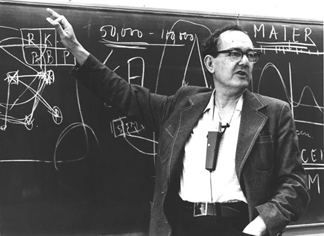
Herbert Simon was a remarkably fertile thinker in the social and "artificial" sciences (The Sciences of the Artificial - 3rd Edition
 (1969, first edition)). His most celebrated idea was the notion of "satisficing" rather than "optimizing" or "maximizing" in decision-making; he put forward a theory of ordinary decision-making that conformed more closely to the ways that actual people reason rather than the heroic abstractions of expected utility theory.
 Essentially the concept of satisficing takes the cost of collecting additional information into account as a decision maker searches for a solution to a problem -- where to eat for dinner, which university to attend, which product to emphasize in a company's short-term strategy. And the theory commends the idea that we are best served overall by accepting the "good-enough" solution rather than searching indefinitely for the best solution. Rather than attempting to inventory all possible choices available at a given point in time and assigning them utilities and probabilities, the satisficing theory recommends setting parameters for a problem of choice, and then selecting the first solution that comes along that satisfies these parameters. It means searching for a solution that is "good enough" rather than optimal.
And why not go for the optimal solution? Because the cost of collecting the additional information associated with a broader choice set may well exceed the total benefit of the current decision. This is obvious in the case of the decision of which restaurant to go to; slightly less obvious in the case of the decision of which university to attend; and perhaps flatly unpersuasive in the case of decisions where the outcome can influence life and death.
I've described the theory of satisficing in a little detail here for an unexpected reason: Simon took some interest in the art of autobiography, and it turns out that he interprets his own life as a series of satisficing decisions. His autobiography Models of My Life
 appeared in 1996, and it's an interesting narrative of the intellectual and personal choices that led Simon from Milwaukee to Pittsburgh and beyond.
 The idea is particularly apt for Simon's view about how a life unfolds. He rejects the idea that one's life has an overriding theme. He discusses the fact that the title of the book is a plural noun -- "Models of My Life".
There is a further reason for using the plural [models]. It is a denial -- a denial that a life, at least my life, has a central theme, a unifying thread running through it. True, there are themes (again the plural), some of the threads brighter or thicker or stronger than others. Perhaps clearest is the theme of the scientist and teacher, carrying on his persistent heuristic search, seeking the Holy Grail of truth about human decision making. In my case, even that thread is woven of finer strands: the political scientist, the organization theorist, the economist, the management scientist, the computer scientist, the psychologist, the philosopher of science. (xviii)Rather than one underlying theme that underlies a person's biography and career, there are multiple choices, directions, and emphases -- that add up to a woven lifetime of contribution when the choices work out well.
Simon accepts the implication that this vision of a life presents: that there is no single "self" underlying all these changes and choices:
Which of the wanderers through these different mazes will step forward at the call for the real Herbert Simon? All of them; for the "real" self is an illusion. We live each hour in context, different contexts for different hours.... We act out our lives within the mazes in which Nature and society place us. (xviii-xix)The analogy between daily decision-making and living a life is a direct one: instead of setting upon a course with very specific goals and objectives, and then taking the steps necessary to bring about the achievement of that system of goals, Simon is recommending a more local form of life decision-making. Build capacities, recognize opportunities, take risks, and build a life as a result of a series of local choices. It is a form of bounded rationality for living rather than an expression of a fully developed life plan. So we might say that Simon's "philosophy of living" is entirely consistent with his theory of bounded rationality.
There are a few real surprises in the book -- for example, a conversation between Simon and Jorge Luis Borges in Argentina in 1970. Simon was fascinated by Borges' use of the idea of a labyrinth in his novels, and wanted to find out from Borges how he was led to this family of metaphors. Simon himself was drawn to the idea of a series of choices as a maze -- incorporating the insight that there are always unexplored outcomes behind the avenues not taken. So a labyrinth is a good metaphor for choice within uncertainty and risk.
I have encountered many branches in the maze of my life's path, where I have followed now the left fork, now the right. The metaphor of the maze is irresistible to someone who has devoted his scientific career to understanding human choice. (xvii)Here is a snippet of the conversation between Simon and Borges as quoted in the book:
SIMON: I want to know how it was that the labyrinth entered into your field of vision, into your concepts, so that you incorporated in your stories.
BORGES: I remember having seen an engraving of the labyrinth in a French book -- when I was a boy. It was a circular building without doors but with many windows. I used to gaze at this engraving and think that if I brought a loupe close to it, it would reveal the Minotaur.
SIMON: Did you see it?
BORGES: Actually my eyesight was never good enough. Soon I discovered something of the complexity of life, as if it were a game. In this I am not referring to chess.
...
SIMON: What is the connection between the labyrinth of the Minotaur and your labyrinth, which calls for continual choice? Does the analogy go beyond the general concept?
BORGES: When I write, I don't think in terms of teaching. I think that my stories, in some way, are given to me, and my task is to narrate them. I neither search for implicit connotations nor start out with abstract ideas; I am not one who plays with symbols. But if there is some transcendental explanation of one of my stories, it is not for me to discover it, that is the task of the critics and the readers.And a final surprise -- it emerges from the conversation that Borges had read "a very interesting book" early in his life, Bertrand Russell's Introduction to Mathematical Philosophy
 -- not exactly the most predictable influence on the creator of magical realism. And Russell's mathematical logic was likewise a formative influence for Simon, at a comparably early age.
There is an interesting short section where Simon discusses one of the directions he did not take in his own personal career maze -- the step of trying to become a college president at Carnegie Mellon or elsewhere (262 ff.). Simon writes briefly about the reasons why this might have been a realistic aspiration for him -- a history of administrative competence at the department level and a stellar academic record. But he decided not to pursue the presidency at CMU:
However that may be, I did not seriously consider taking on the context. ... I have never regretted the decision, especially in view of Dick's stellar performance on the job, a performance made possible by a "deviousness" that our colleague Leland Hazard admiringly attributed to him, and that I surely did not possess. (263)
He adds that he didn't have the personality needed to cultivate the community of wealthy businessmen whose support would be essential to Carnegie: "In fact, the close association with the business community that is essential for effective performance as president of a university such as Carnegie Mellon would have been uncomfortable for me" (263).
But here is the way this discussion strikes me (as a person whose career did take him in that direction). Simon gives no evidence here of understanding even the most basic facts about this domain of choice: what the job of president actually is; what the qualities of personality and leadership are that would lead to success; and what the intellectual satisfactions might be in the event that he became a university president. He seems to be working from a very shallow stereotyped view of the job of university president. In other words, Simon had none of the information that would be needed to make an informed career choice about this option. And this suggests that his decision-making on this issue was narrowly bounded indeed -- driven by a few stereotyped assumptions that were probably a poor guide to the reality.
But here is the way this discussion strikes me (as a person whose career did take him in that direction). Simon gives no evidence here of understanding even the most basic facts about this domain of choice: what the job of president actually is; what the qualities of personality and leadership are that would lead to success; and what the intellectual satisfactions might be in the event that he became a university president. He seems to be working from a very shallow stereotyped view of the job of university president. In other words, Simon had none of the information that would be needed to make an informed career choice about this option. And this suggests that his decision-making on this issue was narrowly bounded indeed -- driven by a few stereotyped assumptions that were probably a poor guide to the reality.
(Here is a lecture by Herbert Simon on organizations, public administration, and markets:)
 Posted in:

 . Geertz highlights many of the categories mentioned here: exposure to a few influential figures in his undergraduate years, the experience of World War II, his exposure to Indonesia as a graduate student, ... Geertz's work is highly original; nonetheless, we can go some ways towards teasing out some of the ways that his mature perspectives were influenced by his educational and personal experiences. And likewise, Pogge's essay on Rawls's development as a child, youth, and adult sheds a very interesting light on Rawls's intellectual style as a mature philosopher.