Showing posts with label philosophy. Show all posts

Monday, December 12, 2011

Sociology of ideas: Richard Rorty


Where do new ideas and directions of thought come from?  Is it possible to set a context for important changes in intellectual culture, in the sciences or the humanities?  Can we give any explanation for the development of individual thinkers' thought?

These are the key questions that Neil Gross raises in his sociological biography of Richard Rorty in Richard Rorty: The Making of an American Philosopher (2009).  The book is excellent in every respect.  Gross has gone into thorough detail in discovering and incorporating correspondence with family and friends that allow him to reconstruct the micro setting within which the young Rorty took shape.  His exposition of the complex philosophical debates that set the stage for academic philosophy in the United States from the 1950s to the 1980s is effortless and accurate.  And he offers a very coherent interpretation of many of Rorty's most important ideas.  Any one of these achievements is noteworthy; together they are exceptional.

Gross is not interested in writing a traditional intellectual biography. Rather, he wants to advance the emerging field of "new sociology of ideas" through an extended case study of the development of a particularly important philosopher. The purpose of the book is to provide a careful and sociologically rich account of the ways in which a humanities discipline (philosophy) developed, through a crucial period (the 1940s through the 1980s).
My goal is to develop, on the basis of immersion in an empirical case, a new theory about the social influences on intellectual choice, particularly for humanists—that is, a theory about the social factors that lead them to fasten onto one idea, or set of ideas, rather than another, during turning points in their intellectual careers. (kindle location 95)
The argument I now want to make is that the developments considered in chapters 1–8 reflect not Rorty’s idiosyncratic and entirely contingent biographical experiences but the operation of more general social mechanisms and processes that shaped and structured his intellectual life and career. (kl 5904)
Here is how he describes the sociology of ideas:
Sociologists of ideas seek to uncover the relatively autonomous social logics and dynamics, the underlying mechanisms and processes, that shape and structure life in the various social settings intellectuals inhabit: academic departments, laboratories, disciplinary fields, scholarly networks, and so on. It is these mechanisms and processes, they claim, that—in interaction with the facts that form the material for reflection—do the most to explain the assumptions, theories, methodologies, interpretations of ambiguous data, and specific ideas to which thinkers come to cleave. (kl 499)
The goal is to provide a sociological interpretation of the development of thinkers and disciplines within the humanities (in deliberate analogy to current studies in the sociology of science).  Gross acknowledges but rejects earlier efforts at sociology of knowledge (Marx, Mannheim), as being reductionist to the thinker's location within a set of social structures.  Gross is more sympathetic to more recent contributions, including especially  the theories of Bourdieu (field) (Homo Academicus) and Randall Collins (interaction ritual chains) (The Sociology of Philosophies: A Global Theory of Intellectual Change).  These theories emphasize the incentives and advantages that lead strategically minded professionals in one direction or another within a discipline or field. But Gross argues that these theories too are insufficiently granular and don't provide a basis for accounting for the choices made by particular intellectuals.
One does not have to be a methodological individualist to recognize that meso- and macrolevel social phenomena are constituted out of the actions and interactions of individual persons and that understanding individual-level action—its nature and phenomenology and the conditions and constraints under which it unfolds—is helpful for constructing theories of higher order phenomena, even though the latter have emergent properties and cannot be completely reduced to the former. (kl 158)
To fill this gap he wants to offer a sociology of ideas that brings agency back in.  He introduces the idea of the role of the individual's "self-concept", which turns out to be a basis for the choices the young intellectual makes within the context of the strategy-setting realities of the field.  A self-concept is a set of values, purposes, and conceptions that the individual has acquired through a variety of social structures, and that continues to evolve through life.  Gross emphasizes the narrative character of a self-conception: it is expressed and embodied through the stories the individual tells him/herself and others about the development of his/her life.
The theory of intellectual self-concept can thus be restated as follows: Thinkers tell stories to themselves and others about who they are as intellectuals. They are then strongly motivated to do intellectual work that will, inter alia, help to express and bring together the disparate elements of these stories. Everything else being equal, they will gravitate toward ideas that make this kind of synthesis possible. (kl 6650)
...
There is good reason to believe that such stories or self-narratives are not epiphenomenal aspects of experience but influences on social action in their own right. Indeed, few notions have been as important in social psychology as those of self and self-concept. (551)
Simply stated, the theory of intellectual self-concept holds that intellectuals tell themselves and others stories about who they are qua intellectuals: about their distinctive interests, dispositions, values, capacities, and tastes. (kl 6487)
And Gross thinks that these stories are deeply influential, in terms of the choices that a developing intellectual makes at each stage of life.  In particular, he thinks that the academic's choices are often inflected by his/her self-conception to an extent that may override the strategic and prudential considerations that are highlighted by Bourdieu and Collins. Bourdieu and Collins offer "no attempt to think through how the quest for status and upward mobility in an intellectual field may intersect and sometimes compete with thinkers’ cognitive and affective interests in remaining true to narratives of intellectual selfhood that have become more or less stable features of their existence" (562). In his view, identity trumps interest--at least sometimes.

Here is how he applies this analysis to Rorty:
My central empirical thesis is that the shift in Rorty’s thought from technically oriented philosopher to free-ranging pragmatist reflected a shift from a career stage in which status considerations were central to one in which self-concept considerations became central. (576)
Or in other words, Rorty's early career is well explained by the Bourdieu-Collins theory, whereas his later shift towards pragmatism and more heterodox, pluralistic philosophy is explained by his self-concept.

In Gross's telling of the story, much of Richard Rorty's self-concept was set by the influences of his remarkable parents in childhood and adolescence, James Rorty and Winifred Raushenbush.  The parents were politically engaged literary and political intellectuals, and they created an environment of social and intellectual engagement that set aspects of Richard's self-concept that influenced several key choices in his life.  Gross's depiction of the social and intellectual commitments of James and Winifred, and the elite milieu in which they circulated, is detailed and striking. This "social capital" served Richard well in his course from the University of Chicago to Yale into his academic career.

Gross believes that the key turns in Rorty's development were these: first, the decision to do a masters thesis on Whitehead at Chicago; then his choice of Yale as a doctoral institution, with a Ph.D. dissertation on "The Concept of Potentiality" (a metaphysical subject); his shift towards analytic philosophy during his first several years of teaching at Wellesley; his deepening engagement with analytic philosophy in the early years at Princeton; his eventual critique of analytic philosophy in Philosophy and the Mirror of Nature; and his further alienation from analytic philosophy in the years that followed towards a contemporary pragmatism and a more pluralistic view of the domain of philosophical methods.  In other words, he began in an environment where pragmatism and substantive metaphysics were valued; he shifted to the more highly valued field of analytic philosophy during the years in which he was building his career and approaching tenure; and he returned to a more pluralistic view of philosophy in the years when his career was well established.

Rorty's turn to analytic philosophy makes sense in a Bourdieuian way. Gross describes his Wellesley-era and early Princeton philosophical writings in these terms:
They represent Rorty’s attempt to make contributions to analytic thought of a piece with those that other bright, young analytic philosophers of his generation were making. They were, in other words, part of Rorty’s efforts to position himself even more squarely within the mainstream philosophical establishment. (kl 4642)
Those observing Rorty’s career from afar might have interpreted this spate of analytic publications, coming on the heels of The Linguistic Turn, as evidence that Rorty had joined the ranks of the analytic community and saw his work as of a piece with that being done by other analysts. (kl 4853)
But eventually Rorty shifts his philosophical stance, towards a pluralistic and pragmatist set of ideas about philosophical method and subject matter.  Here is how Gross summarizes Rorty's turn to pragmatism:
On this understanding, a pragmatist is someone who holds three beliefs: first, that “there is no wholesale, epistemological way to direct, or criticize, or underwrite, the course of inquiry”; second, that “there is no . . . metaphysical difference between facts and values, nor any methodological difference between morality and science”; and third, that “there are no constraints on inquiry save conversational ones.” (kl 719)
As Rorty went about developing a historicist, therapeutic alternative to the analytic philosophy he saw being practiced by his Princeton colleagues and others, no one’s work was more important to him than that of Thomas Kuhn. (kl 5054)
And Gross dates Rorty's impulses towards pragmatism to a much earlier phase of his intellectual development than is usually done:
Far from it being the case, as some Rorty interpreters have claimed, that Rorty’s interest in pragmatism arose only after he made a break with analytic philosophy, his earliest work is characterized by a desire to harness pragmatist insights in the service of a revised conception of the analytic project. (kl 4037)
Rorty rode both of these intellectual waves, becoming caught up in the rigorism of the analytic paradigm in the 1960s and then emerging as a leading figure in the antirigorist movement of the 1970s and 1980s. (kl 7058)
The book repays a close reading, in that it sheds a lot of light on a key period in the development of American philosophy and it provides a cogent sociological theory of the factors that influenced this development.  It is really a remarkable book. It would be fascinating to see similar accounts of innovative thinkers such as Nelson Goodman, John Rawls, or (from literary studies) Stephen Greenblatt.  That's not likely to happen, however, so this book will probably remain a singular illustration of a powerful theory of the sociology of ideas.

Sunday, June 26, 2011

What is the philosophy of history?


When philosophers have written about “history”, they have often had different and even incompatible goals in mind. One tradition of philosophers, generally pre-twentieth century and generally from continental Europe, have wanted to contribute to answers to large questions about the nature of history as it presented itself over time as a compound of individuals, actions, nations, and civilizations: Does history have a direction? Does history have meaning? Is there a plan to history? Do civilizations rise and fall? Is materialism or idealism the better framework for understanding the movement of history? G. W. F. Hegel, for example, wanted to discover the underlying rationality within history. This approach to the study of history is often referred to as “speculative” or “substantive.”

A second group of philosophers, also largely continental, were inspired by the strong connections that exist between individual human life and expression, and large collective events and processes. The theory of hermeneutics attempts to provide an intellectual framework for analyzing and interpreting meaningful human expressions – poetry, actions, thoughts, and motives. Hermeneutic philosophers in the nineteenth and twentieth centuries extended this approach to efforts to understand large historical events and processes in similar terms. Wilhelm Dilthey was one of the early exponents of the hermeneutic approach to human affairs. Hermeneutic philosophy of history seeks to understand events, movements, and processes in terms of the meanings that they embody and the meaningful relations they bear to other historical events.

Another group of philosophers, often in the twentieth century and often English-speaking, have focused their attention on the nature of historical knowledge rather than the concrete events of history. Analytic philosophers have wanted to clarify the grounds of historical knowledge and explanation. Issues such as the nature of narrative, the role of general laws in historical explanations, and the objectivity or subjectivity of historical judgment have been taken up by Arthur Danto, Patrick Gardner, Carl Hempel, and others. This approach is sometimes referred to as “analytical”; more generally, we might say that it is epistemological and methodological.

New questions have emerged since World War II within the discourse of philosophy about “history” by philosophers, both analytical and continental. These new areas were stimulated, first, by the atrocities of the Holocaust, and the effort to make sense of this horrendous tear in the fabric of modern civilization. How are we to make sense of the Holocaust? How should we remember it? A second source of new thinking about history by contemporary philosophers is the linguistic and semantic turn that many of the human sciences took in the 1970s and 1980s (Rorty, 1967). A cohort of writers in the 1980s and 1990s undertook to approach history from the point of view of narrative and meaning. In some ways this was a return to the hermeneutic approach to human affairs of the nineteenth century; but it was also original in that it brought new thinking from the philosophy of language into the debate.

There is a valid but limited place for metaphysical research in the area of the philosophy of history. Fundamentally, we need to have a clearer specification of the meaning of key concepts that we use in analyzing and describing historical events and structures. Philosophers can help in probing and refining these concepts. These ontological questions are really about our conceptual schemes rather than about substantive historical facts. What presuppositions are we making when we divide history into epochs or regions? Does it make sense to refer to civilizations as a whole? So we need a more explicit theory of historical ontology, and the philosophy of history can help to provide such a theory. What we cannot hope to achieve is an apriori discovery of the reality of history – its meaning, direction, or foundational causes. This is not a limitation of our ability to discover historical truths, but rather a reflection of the fact that there are no general answers to these questions at all. Kant’s critique of substantive metaphysics is decisive here.

As this summary suggests, there are many unanswered questions that philosophers can usefully pose to the discipline and facts of history. For this reason it is timely to consider some new approaches to the philosophy of history. The past decade has seen several contributions that are difficult to classify according to the distinctions provided above. They are analytic but not reductionist; they pay attention to narrative but nonetheless attribute rational warrant to historical accounts; and they are respectful towards the actual practices of gifted historians, rather than assuming that the philosophy of history can proceed as a separate philosophical discourse. Significantly, new contributions to this subject come from philosophers, literary critics, anthropologists, and historians. Perhaps this is a clue for how the field might most productively move forward: by incorporating several philosophical perspectives, by raising new questions, and by reaching across the human sciences as well as philosophy to find some innovative new answers.

Monday, May 30, 2011

Philosophy of social science today


A sign of arrival for a sub-discipline is the appearance of a handbook for the field. By that criterion, the philosophy of social science has passed an important threshold with the appearance of Ian Jarvie and Jesus Zamora-Bonilla's SAGE Handbook of the Philosophy of Social Sciences. The 750-page volume offers 37 main articles, as well as an extensive reflective introduction by Ian Jarvie and an epilogue by Jesus Zamora-Bonilla. A majority of the contributors are European, confirming an impression that the most active research networks in this field are currently in Western Europe. Germany and the Scandinavian countries are particularly well represented.

Ian Jarvie's extensive introduction does a good job of setting the stage for the volume. He is in a unique position to offer this perspective, having served as editor of the key journal Philosophy of the Social Sciences for many years. He begins by noting the heterogeneity of the field:
As a set of problems, the philosophy of the social sciences is wide-ranging, untidy, inter-disciplinary and constantly being reconfigured in response to new problems thrown up by developments in the social sciences; in short, disorderly. (1)
The orientation to the philosophy of social science represented in this volume is largely grounded in the analytic philosophy tradition. By this I mean an emphasis on rationality, an interest in generalizations and laws, a commitment to empirical methods of inquiry, and an over-arching preference for conceptual clarity. (Paul Roth describes the analytic approach in his contribution to the volume; 103ff.) But David Teira also offers an interesting contribution on "Continental Philosophies of the Social Sciences." He begins the article by writing,
In my view, there is no such thing as a continental philosophy of the social sciences. There is, at least, no consensual definition of what is precisely continental in any philosophical approach. (81)
Among these approaches he highlights Marxist, phenomenological and Foucauldian philosophies and theories of the social sciences. His finding is one that I agree with -- that one of the particularly valuable aspects of the continental traditions is the fact that thinkers in this tradition have offered large, insightful conceptual schemes for thinking about social life -- whether historical materialism, ethnomethodology, or the rhetoric of power. He writes, "I guess that if continental philosophies seem attractive to many social scientists, it is because they offer the prospect of a somewhat radical reconstruction of current research practices" (96).

Particularly interesting for me were contributions by Alban Bouvier ("Individualism, Collective Agency and The "Micro-Macro Relation"), Daniel Steel ("Causality, Causal Models, and Social Mechanisms"), Joan de Marti and Yves Zenou ("Social Networks"), Peter Hedstrom and Petri Ylikoski ("Analytical Sociology"), Chris Mantzavinos ("Institutions"), and Jeroen Van Bouwel and Erik Weber ("Explanation in the Social Sciences").

What is particularly valuable in this collection is the fact that most of the essays are not dogmatic in their adherence to a "school" of philosophical thought. Instead, they get down to the serious business of understanding the social world, and understanding what is involved in achieving a scientific understanding of that world. Chris Mantzavinos's essay, "Institutions," is a good example of this intellectual pragmatism. His contribution is a careful study of the new institutionalism and the variety of theoretical challenges that the concept of an institution raises. The essay is very well grounded in the current sociology and political science literatures on institutions, and it goes on to make substantively interesting points about these debates. "Only a theory of institutions that increases our information about the structure of social reality can provide us with the means of reorienting this reality in a direction that we find desirable" (408-9).

Many of the contributors -- probably the majority -- have taken seriously what I think is a particularly fundamental requirement for productive work in the philosophy of an area of science. This is the need for the philosopher to take up the particular theories and controversies of some current research in the social sciences as a framework and stimulus to their philosophical analysis. The philosopher needs to gain a significant level of expertise in a particular field of social science if his or her work is likely to find traction with conceptual issues that really matter. The topics for the philosophy of social science should not derive from apriori speculation about society; instead, they should be selected on the basis of careful engagement with serious empirical and theoretical attempts to explain the social world.

This is the kind of book that would benefit from a simultaneous digital edition. An affordable Kindle edition would help; but more radically, an online, hypertexted and cross-linked version would be fantastic. It would be fascinating to see a concept map linking the articles by theme or keyword; it would be illuminating to see some analysis of the patterns of citation across the articles in the volume; and it would be great for the reader to be able to click to some of the references directly. (Jarvie provides something like a map of themes in his tables representing "Principal Problems in Philosophy of the Social Sciences" and "Problematics in 14 Selected Anthologies"; 7-8.)


Friday, January 28, 2011

The politics of cultural despair


The last century gave us far too many examples of the rise of extremism in mass societies -- both democratic and authoritarian.  Some of the political mechanisms of extremist seizure of power are well known -- paramilitary force, extremist organizations, demogogic leaders, hyper-heated rhetoric, appeals to nationalism and racism, and inflammatory mass media.  But it's also worth asking -- what is the cultural basis for the rise of various extremisms?  What factors in the ideas, thoughts, and emotions of a population have sometimes led to the rise of extremist states -- fascism, ethnic cleansing, murderous nationalism, or deranged communism such as the killing fields of Cambodia?  Does philosophy play a role in the rise of extremism?

For observers born since 1930 a natural place to raise this question is the rise of National Socialism in Germany.  How could a party dedicated to an explicit programme of racism, repression, and murder have gained mass support and control of the state in Germany?

A particularly important early effort to answer this question was Fritz Stern's pathbreaking The Politics of Cultural Despair: A Study in the Rise of the Germanic Ideology (1961), now fifty years old.  The book is a careful intellectual history; but it is more than that.  It is an effort to link a set of philosophical ideas to a series of political developments that involved increasingly wide circles of German citizens.  So it serves as one example of how we might think about the relationship between large cultural ideas and currents, and more specific developments in politics.

Stern opens the book with these words:
This is a study in the pathology of cultural criticism.  By analyzing the thought and influence of three leading critics of modern Germany, this study will demonstrate the dangers and dilemmas of a particular type of cultural despair.  Lagarde, Langbehn, and Moeller van den Bruck--their active lives spanning the years from the middle of the past century to the threshold of Hitler's Third Reich--attacked, often incisively and justly, the deficiencies of German culture and the German spirit.  But they were more than critics of Germany's cultural crisis; they were its symptoms and victims as well.  Unable to endure the ills which they diagnosed and which they had experienced in their own lives, they sought to become prophets who would point the way to a national rebirth.  Hence, they propounded all manner of reforms, ruthless and idealistic, nationalistic and utopian.  It was this leap from despair to utopia across all existing reality that gave their thought its fantastic quality. (1)
These three figures were important cultural voices in Germany, even though they were undistinguished within the academic world.  Paul de Lagarde (1827-1891), Julius Langbehn (1851-1907), and Arthur Moeller van den Bruck (1876-1925) were intellectual and cultural precursors for the ideology of National Socialism.  They were harsh, vitriolic critics of modern German social life; they were anti-Semites; and they were wedded to a discourse of passion and hatred as devices for influencing their readers.

The central focus of this cultural criticism was the fact of modernity -- liberalism, secularism, Manchesterism, consumptionism, and individualism.  These were conservative critics; they favored an earlier time that was more traditional, moral, hierarchical, and religious.  They preferred villages and towns to cities; they preferred cultivated thinkers to merchants and professionals, and they feared the rise of the proletariat.

By liberalism they meant to encompass several ideas: individualism, self-interest, parliamentary government, and glorification of commerce and the market.  And their criticisms were unswerving: they hoped to turn back all of the liberal democratic and industrial transformations that modern Europe was undergoing.
The movement did embody a paradox: its followers sought to destroy the despised present in order to recapture an idealized past in an imaginary future. They were disinherited conservatives, who had nothing to conserve, because the spiritual values of the past had largely been buried and the material remnants of conservative power did not interest them.  They sought a breakthrough to the past, and they longed for a new community in which old ideas and institutions would once again command universal allegiance. (7)
The conservative revolutionaries denounced every aspect of the capitalistic society and its putative materialism.  They railed against the spiritual emptiness of life in an urban, commercial civilization, and lamented the decline of intellect and virtue in a mass society.  They attacked the press as corrupt, the political parties as the agents of national dissension, and the new rulers as ineffectual mediocrities.  The bleaker their picture of the present, the more attractive seemed the past, and they indulged in nostalgic recollections of the uncorrupted life of earlier rural communities, when men were peasants and kings true rulers. (9-10)
In addition to their critique of a rising liberalism in Germany (and Europe more generally), these critics were also united in a virulent anti-Semitism.  Their denunciations of the Jews became a common thread in Nazi propaganda in the 1920s and 1930s.

Stern makes the important point that these three writers depended on the emotions and the passions rather than reason and argument to express themselves.  "All three wrote with great fervor and passion.  They condemned or prophesied, rather than exposited or argued, and all their writings showed that they despised the discourse of intellectuals, denied reason, and exalted intuition" (4).  Here is a particularly important observation of the nature of this cultural criticism that appears to be relevant in our own time as well.  Julien Benda, a liberal thinker, noted that political discourse "began to play the game of political passions.... Our age is indeed the age of the intellectual organization of political hatreds" (6).

Stern has two fundamental aims in this study.  First, he hopes that the study of these three cultural critics will illuminate an important current of history: Germany's drift towards extremism and anti-Semitism.
This study, then, takes up the origins, content, and impact of an ideology which not only resembles national socialism, but which the National Socialists themselves acknowledged as an essential part of their legacy.  But it will also point to another link, admittedly less tangible--to wit, that the Germanic critics in the peculiar tension between their lives and their ideological aspirations anticipate the type of malcontent who, in the 1920's, found a haven in the idealism of the Hitler movement.  ... We may not have sufficiently reckoned with the politically exploitable discontent which for so long has been embedded in German culture. (5)
But second, the book is interested in popular culture as well.  How did ordinary Germans fall prey to mobilization and propaganda based on nationalism, violence, and anti-Semitism?  Stern tries to show through a detailed study of the cultural framework expressed by these thinkers, that we can also attempt to reconstruct the modes of popular consciousness that percolated through German society in these decades.  These ultra-conservative currents helped to make even ordinary people susceptible to the efforts at mobilization that were directed towards them by the National Socialists.

Are there parallels in twentieth-century America?  Stern thought there were, in 1961.
Cultural pessimism has a strong appeal in America today.  As political conditions appear stable at home or irremediable abroad, American intellectuals have become concerned with the cultural problems of our society, and have substituted sociological or cultural analyses for political criticism. ...  There is a discontent in the Western world that does not stem from economic want or from the threat of war; rather it springs from dissatisfaction with life in an urban and industrialized culture -- a dissatisfaction that the three critics discussed in this book felt and fostered. (13, 14-15)
Two elements seem especially relevant in today's political culture: the willingness of some voices in the political sphere to engage in the emotional hyperbole and hatred that were the stock-in-trade of these German critics; and the extremist language surrounding the rejection of "liberalism" that is to be found in the airwaves today.  Today too we are confronted with a virulent rejection of many aspects of a "liberal" world, and an apparent yearning for an earlier (mythical) time when there was one defining moral-religious framework to which all of society subscribed.

One of the greatest failures of German liberals and academics in the 1920s and 1930s was their inability -- perhaps even their unwillingness -- to make the positive case for a modern, liberal society.  The values of justice, equality, citizenship, and mutual respect embodied through decent economic and political institutions need to be defended; and German thinkers fell short in this historical task in the early twentieth century.  It is certainly important for Americans in the early twenty-first century to be more successful in making this case.

(Here is Fritz Stern on Fora.tv:)

Tuesday, November 23, 2010

Hobbes in context


We often think of Hobbes as being an originator in English philosophy, a strikingly innovative thinker who burst on the scene with the first formulation of a social contract theory of government. And we sometimes think of his justification of absolute sovereignty as a fairly direct reaction to the disorders Britain experienced during its Civil War and Glorious Revolution.  Richard Tuck's Hobbes: A Very Short Introduction puts Hobbes into a much more nuanced position.

Fundamental to Tuck's approach as a historian of philosophy is to problematize the idea of "philosophy".  Rather than assuming that the subject matter and methodology of philosophy were fixed once and for all by some traditional authority -- perhaps Aristotle and Plato -- Tuck takes the position that thinkers have defined themselves in ways that have eventually come to be described as "philosophy," but that nonetheless cover a very wide range of intellectual approaches and concerns.  Here is a particularly striking set of ideas from Tuck's contextualization of Hobbes:
It is sometimes tempting to think that the heroes of the various histories of philosophy or ethics -- men as different as St Thomas Aquinas, Machiavelli, Luther, Hobbes, Kant, or Hegel -- were all in some sense engaged in a common enterprise, and would have recognized one another as fellow workers. But a moment's reflection reminds us that it is we who have made a unity of their task: from their own point of view, they belonged to very different ways of living and had very different tasks to perform. They would have seen themselves as intellectually kin to men who do not figure in these lists -- priests or scholars who had on the face of it no great philosophical interest. (1)
I think his point here is an important and insightful one: philosophy was reinvented in the Europe of the 16th and 17th centuries, and swerved dramatically away from ancient and medieval philosophy. It was a new project, motivated by different problems, assumptions, and goals.

Tuck gives a good deal of attention to Hobbes's biography, with the implication that these historical, social, and familial circumstances contributed to shaping the philosophical imagination of the maturing thinker.  The situation of service as tutor and secretary to the household of William Lord Cavendish that occupied Hobbes for most of his life plays an important role in his intellectual development.  It also provided him with direct access to some of the great intellectuals and scientists of France and Venice, including eventually Mersenne, Descartes, and Galileo.  

A central intellectual theme in the air during Hobbes's early development was that of humanist skepticism about empirical and ethical knowledge. 
The central feature of this literature was a pervasive scepticism about the validity of the moral principles by which an earlier generation had lived. (7)
The response of many of Lipsius's generation (he was born in 1547) was to give up strongly held and publicly defended beliefs of all kinds, and to retreat to a dispassionate and skeptical stance. (9) 
Tuck argues that Hobbes defined his thought in terms of an effort to create a new, though more modest, basis for knowledge in both empirical and ethical matters. In fact, Tuck leaves the impression that the philosophy of science is as important in Hobbes's work as the philosophy of politics. He was greatly influenced by the example and thinking of Galileo.  Galileo's Dialogue Concerning the Two Chief Systems of the World appeared in 1632, and during 1634 Hobbes purchased a copy of the book for Newcastle.  One of the key issues in the philosophical world was whether the senses deceive us; and Hobbes followed Descartes in holding that the observable features of the world (color, smell) should not be understood to directly correspond to real characteristics of the invisible reality of the object.  Hobbes was interested in optics and mathematics -- the areas of science that appeared to be most relevant to the question of the real features of the world.  And he sought to articulate a conception of knowledge according to which real properties in the world create phenomenal properties in the observer through "motions" (or causal processes).  

Another core theme in Hobbes's itinerary is a visceral opposition to government religion -- religious requirements embodied in the state.  Tuck shows with repeated examples why this issue was so important during the Civil War; the struggle between contending sides had very much to do with the scope of religious discipline to be imposed by the state.  Hobbes was opposed to religious law and mandates of belief, and therefore found himself in roughly the camp of the Tolerationists.
The ecclesiastical regime put into place by the new republic after 1649 was very close to what Hobbes seems to have wanted on general grounds, and which he may well have enthusiastically preferred to traditional episcopacy.  This is because, like almost all the most interesting 17th-century political theorists (including Grotius and Locke), he seems to have feared the moral and intellectual disciplines of Presbyterian Calvinism far more than anything else. (39)
Hobbes's primary object in arguing like this was to elevate the power of the sovereign over the churches -- bands of fanatics (in his eyes) who wished to enforce absurd opinions upon their fellow citizens, and whose activities were primarily responsible for the civil wars of Europe.  They could only be controlled if the soverign was empowered to determine public doctrine and silence disputes. (85)
Tuck argues that Hobbes's earliest and most important influence on Hobbes in the area of moral and political philosophy was Hugo Grotius and his book, The Laws of War and Peace.  Tuck describes this influence in these terms:
[Grotius] could play the same role for him as Galileo's Dialogues did for all members of the Mersenne circle, as a represntation for them of the kind of science which was to be put on their new, post-sceptical foundations. (25)
Tuck summarizes Grotius's core theory in two fundamental principles: "All men would agree that everyone has a fundamental right to preserve themselves, and wanton or unnecessary injury to another person is unjustifiable" (26).  Tuck finds that these principles have counterparts in Hobbes's arguments in Leviathan.

So Tuck seems to be putting forward several important strands of interpretation that run against the grain of the customary telling of Hobbes's philosophy: first, that his philosophy of science and sensation plays a larger role than we might have thought; and second, that his most famous theory, the theory of unlimited sovereignty, has rather specific roots in Hobbes's immediate intellectual context (Grotius) and political environment (struggles over the extent of religious legislation).  It is not the result of a purely abstract reflection on the situation of rational persons in a state of nature, but rather a complex argument that intertwines with England's own political tensions in mid-seventeenth century.

Steven Pincus's 1688: The First Modern Revolution is a nice complement to this line of thought, in that it offers a fundamentally new reading of the Glorious Revolution of 1688-89.  Here is how Pincus describes his project:
England's Glorious Revolution of 1688-89 holds a special place in our understanding of the modern world and the revolutions that had a hand in shaping it. For the better part of three centuries scholars and public intellectuals identified England's Revolution of 1688-89 as a defining moment in England's exceptional history. Political philosophers have associated it with the origins of liberalism. Sociologists have contrasted it with the French, Russian, and Chinese revolutions.  Historians have pointed to the Revolution as confirming the unusual nature of the English state. Scholars of literature and culture highlight the Revolution of 1688-89 as an important moment in defining English common sense and moderation.  All of these interpretations derive their power from a deeply held and widely repeated narrative of England's Revolution of 1688-89.  Unfortunately, that narrative is wrong. (Introduction)
(Two articles in the Stanford Encyclopedia of Philosophy on Hobbes's philosophy are worth reading (linklink).)

Friday, October 8, 2010

French philosophy?


Is there such a thing as "French philosophy"? Or is philosophy a purely universal discipline, raising the same abstract questions no matter whether the philosopher is Chinese, English, French, or Brazilian? One way to address this question is to consider the collective intellectual practice of "philosophy" from the point of view of sociology -- that is to say, historically and empirically.

Jean-Louis Fabiani's book Qu'est-ce qu'un philosophe français? (which was released in France this week) addresses this question from the point of view of sociology, and it provides a fascinating and innovative approach to the history of philosophy. (Here is a link to Fabiani's academic bio.) Fabiani was a student of Bourdieu, and he approaches philosophy in something like the way that other sociologists have approached the study of science: as a socially situated intellectual activity which is amenable to sociological analysis and explication. The fact that it is intellectual implies that there is an internal logic to the development of the discourse; organized thinking moves it forward. And the fact it is situated implies that philosophy is conditioned and motivated by social circumstances external to the philosophical community.

Fabiani attempts to steer a highly original course between the idea that social context determines the content of a specific philosophical tradition, and the idea that philosophy develops wholly and solely according to its own internal intellectual logic. Crude sociology of knowledge falls in the first camp, and traditional history of philosophy often appears to fall in the second camp. Fabiani takes an approach that allows both for social influence on philosophy as well as critical, rigorous logical analysis and thought wielding its influence.

Here is a description that Fabiani provides of philosophy as an object of sociological study. (The passages quoted here are drawn from a pre-publication translation Fabiani provided in a visit this month to the University of Michigan.)
Philosophy is never limited to a collection of texts, knitted together by the threads of tradition. It also includes material objects, spaces and social practices. It includes all types of reception, including the less orthodox. As with any other type of work, philosophical texts imply different types of appropriation in space and time, and exist only through the successive pacts of reception that constitute them as valued objects in a particular culture.
He asks the questions, what is a sociology of philosophy and why is it needed? And here are some of his answers:
I wish to analyze philosophy just as what we now call science studies have analyzed processes and controversies in the various scientific disciplines. Science studies have questioned the great epistemological divide which reserved the study of contextual elements for sociologists (institutions, organizations, strategies, etc.) and removed the assertions, demonstrations and the quest for evidence from their purview (except if they are crudely determinist and seek to explain concepts entirely by contexts, to put it simply).
...
What could be interesting about a socio-historical analysis of philosophy? First, we have to suspend our belief -- at least for a while, because it is the habitual battleground of the activity -- in the existence of an abstract and universal frame for the philosophical debates, this the result of a venerable scholarly tradition. The « relocalization » of philosophical interactions is necessary in order to see that philosophical texts are also performances, not only embodiments and products of lifestyles but also their sources.
...
Studying philosophy by means of sociological methods would appear to be one of the most important challenges for the social sciences today. « The queen of disciplines,» as it is called in France (or the crown--or crowning as I once described it years ago) has long resisted any attempt at objectivation.
...
Although the most general objection to the ascription of social determinants in the shaping of social thought are now superannuated, the explanatory power of theories applied to the field of intellectual production still remains quite limited. The modes of categorization applied to products and to individual intellectual strategies are too crude and their use too poorly controlled; we no longer take for granted that society as such can be read (at least in a cryptic language) through symbolic production.
So what is in play when we ask whether philosophy (or any other intellectual discipline) is conditioned by its historical and social context?  We might say that a national tradition of philosophy could be characterized according to several different criteria: topics, styles of thought, modes of validation, and lineage of predecessors. For example, British philosophy defined itself in terms of several core ideas -- the role of the senses in the acquisition and validation of knowledge, for example; and Hume, Locke, and Berkeley deployed recognizable forms of argument and styles of reasoning as well.  Hume's treatises look and feel quite a bit different from Descartes' meditations.  Here is a way of conceptualizing the situation of philosophical research and discovery:


The diagram is intended to be a way of visualizing a philosophy research tradition at a moment in time. The unit of production, the philosophy research group, is steeped in a conventional specification of the important topics; it is skilled in a specific set of modes of argument; it holds out a set of exemplary philosophical works from the history of the discipline as currently understood; it operates in a space that may include other research groups pursuing different topics and methods; and it functions within a set of institutions -- graduate programs, journals, tenure processes, associations, prizes -- that train, valorize, and rank various individuals and their products.  Each aspect of these "internal" features is amenable to concrete historical and sociological investigation; we can seek to trace out the institutions, discover the order and rationale of the topics, etc.

 External to these factors are circumstances in history and current social life (World War I, the Holocaust, the Civil Rights movement), and intellectual currents from outside the discipline (Freudianism, for example), that exercise influence on the development of philosophical positions and frameworks. The social context draws attention to (or away from) certain topics; context also sometimes provides institutional constraints that favor or disfavor some positions.  (For example, McCarthyism and the Cold War created constraints and incentives that greatly deformed the course of research in the humanities and the social sciences.)  The intellectual activities of the current research groups lead to a degree of development of the ideas, positions, and schools of philosophy at a given moment in time. So the received setting, external environment, and application of modes of invention and argument drive forward new philosophical content, and the institutions of the profession attach credibility/lack of credibility and prestige/scorn to the results.

The diagram indicates as well several ways in which a philosophical tradition might possess a distinctive, national character. The list of valued topics may differ across national traditions; likewise the styles of reasoning and modes of argument; and different traditions may valorize very different bodies of predecessors as well. So it is fairly evident that Fabiani's question warrants a "yes" -- there are distinguishing characteristics or signatures across traditions of philosophy. And even when the topics and questions appear similar -- the focus on the conditions of knowledge in common between British and French philosophy in the 17th century, for example-- the styles of thinking, modes of reasoning, and examples of good solutions still differ widely.

Should we think of these differences as defining distinct paradigms of philosophy? I'm inclined to use a different term -- perhaps "research tradition" -- to suggest a high degree of variation within a national tradition of philosophy. Like other areas of humanities production, it seems to me that the standards and exemplars that hold together "analytic philosophy" or "hermeneutic philosophy" are much looser and less prescriptive than their counterparts in the natural sciences. So the term "paradigm" does not fit the framing of philosophy in context very well.

Fabiani's work rewards study and bears an interesting relation to other efforts to discover distinctive features of French intellectual life (the distinctiveness of French sociology (link), the development of French anthropology (link)).  Johan Heilbron's work is relevant to these topics as well (The Rise Of The Social Sciences And The Formation Of Modernity). Here is the table of contents of Fabiani's current book:

Première partie
L’institution d’une discipline

Chapitre premier – La philosophie en classe
Chapitre 2 – Carrières et concepts
Chapitre 3 – Les moments et les crises

Deuxième partie
Une philosophie nationale?
Chapitre 4 – Le rempart de la raison
Chapitre 5 – Le spiritualisme français
Chapitre 6 – Transferts conceptuels

Troisième partie
Art, religion, science et philosophie
Chapitre 7 – La religion ddans les limites de la simple raison?
Chapitre 8 – Aux frontiers de la science
Chapitre 9 – Le philosophe artiste et la tentation prophétique

(The photo above is of Alexandre Kojève.  It is relevant to the current topic because of Kojève's complex philosophical heritage -- Russia, Germany, and eventually the leading explicateur of Hegel in post-war France.)

Wednesday, May 5, 2010

Mental models for the social world

What is involved in being prepared to understand what is going on around you?

In a sense this is Kant's fundamental question in the Critique of Pure Reason: what intellectual resources (concepts, categories, frameworks) does a cognitive agent need in order to make sense of the contents of consciousness, the fleeting experiences and sensations that life brings us? And his answer is pretty well known: we need concepts of fixed objects in space and time, subject to causal laws.  The stream of experiences we have is organized around a set of persistent objects located in time and space with specific causal properties. Space, time, cause, and object are the fundamental categories of cognition when it comes to understanding the natural world. This line of thought leads to an esoteric philosophical idea, the notion of transcendental metaphysics. (P. F. Strawson's work on Kant is particularly helpful; The Bounds of Sense: An Essay on Kant's Critique of Pure Reason.)

But we can ask essentially the same kind of question about the ordinary person's ability to make sense of the social world around him or her. Each person is exposed to a dense stream of experiences of the social world, at various levels. We have ordinary interactions -- with friends, bus drivers, postal carriers, students -- and we want to interpret the behavior that we observe. We read news reports and tweets about happenings in the wider world -- riots in Athens, suicide attacks in Pakistan, business statements about future sales, ... -- and we want to know what these moments mean, how they hang together, and what might have caused them.  In short, we need to have a set of mental resources that permit us to organize these experiences into a representation of a coherent social reality.

So is it possible to provide a transcendental metaphysics for ordinary social experience? Can we begin to list the kinds of concepts we need to have in order to cognize the social world?

We might say that a very basic building block of social cognition is a set of scripts or schemas into which we are prepared to fit our observations and experiences. Suppose we observe two people approach each other on the street, exchange words, bow heads slightly, and part. This interaction between two strangers might be categorized as "courtesy" during a chance meeting. But it might be construed in other ways as well: ironic insults, sexual innuendo, or condescension from superior to inferior. Each of these is an alternative interpretive frame, a way of conceptualizing and "seeing" a complex series of behaviors.  So the scripts or frames that we bring to the observations impose a form of organization on the observations.

Or take the current rioting in Greece: we might construct these masses of collective behavior as rationally directed economic protest, righteous resistance, or opportunistic anarchism. Each alternative has different implications, and each corresponds to a somewhat different set of background assumptions about how social interactions unfold. Each corresponds to a different social metaphysic.  Different observers bring a different set of assumptions about how the social world works to their observations. And these frameworks lead to different constructions of the events.

Or consider the question of the social "things" around which we organize our social perceptions: nations, financial markets, cities, parties, and ideologies, for example. How much arbitrariness is there in the ontological schemes into which we organize the world? Could we have done just as well at making sense of our experience with a substantially different ontology? Is there a most basic ontology that underlies each of these and is a scheme that cannot be dispensed with?

We might try a "fundamental" ontology along these lines: we must identify individuals as purposive, intentional agents; we must recognize relations among individuals -- giving us social networks, knowledge transmission, and groups; and we must recognize social processes with causal powers, constituted by individuals within specific social relations. And we must recognize the situation of consciousness -- beliefs, desires, values, and ideologies. And, we might hypothesize, we can build up all other more specific social entities out of aggregations of these simple things.

This is one possible way of formalizing a social ontology.  But there are others.  For example, we might give priority to relations rather than individuals; or we might give priority to processes rather than structures.  So it is hard to justify the notion that there is a single uniquely best way of conceptualizing the realm of the social.

An interesting collateral question has to do with the possibility of systemic error: is it possible that our metaphysical presuppositions about the social world sometimes lead us to construe our social observations in ways that systematically misrepresent reality? For example, would a "metaphysics of suspicion" (the idea that people generally conceal their true motives) lead us to a worldview along the lines of Jerry Fletcher, the central character in Conspiracy Theory?

Several things seem likely. First, there is no single and unique set of ontological "simples" for the social world. Rather, there are likely to be multiple starting points, all of which can result in a satisfactory account of the social world. So there is no transcendental metaphysics for the social world -- including the candidate sketched above.

Second, it seems that the unavoidable necessity of having a set of causal, semantic, and process schemata does not guarantee correctness. Our schemata may systematically mislead us.  So the schemata themselves amount to a large empirical hypothesis; they may be superseded by other schemata that serve better to organize our experiences.  The schemata are not determined by either apriori or empirical considerations.  And therefore our social cognitions are always a work in progress, and our conceptual frameworks are more like a paradigm than an ineluctable conceptual foundation.

Tuesday, April 6, 2010

Teaching philosophy


What is it that we expect students to learn when we teach philosophy? Is philosophy an arcane and charmingly useless vestige of a nineteenth-century university education?  Or does it have something crucial to add to the liberal education of the twenty-first century -- whether in the arts and sciences or in pre-professional schools?

Philosophers would probably answer this question in a wide variety of ways.  In my own case, I have several high-level goals in mind when I approach a new group of undergraduate students in philosophy.  I hope to help them to develop in several ways:
  • to gain a set of intellectual skills: analysis, reasoning, clarity of thinking and exposition, open-mindedness and a readiness to try to see a problem from multiple points of view
  • to learn some of the developed approaches to "philosophical" problems: knowledge, ethical behavior, individual rights, social justice, the authority of the state, the nature of rationality, the meaning of human life
  • to gain an engaged involvement in some great thinkers and their theories and reasoning in detail
  • to gain some meaningful acquaintance with some important philosophical theories (utilitarianism, empiricism, mind-body materialism, ordinary language philosophy ...)
  • to gain an ability to see the connections between philosophical reasoning and real human problems -- scientific knowledge, addressing poverty or racism, resolving conflicts of value or conflicts of interest or desire, ...
Most of these goals have to do with developing intellectual capacity -- imagination, reasoning, analytical ability, critical capacity to probe behind ordinary assumptions -- more than gaining specific bits of knowledge about the history of philosophy.  Students are exposed to pieces of philosophical traditions that result in exam questions such as these: What was Anselm's ontological argument?  What was Russell's paradox?  What were the higher pleasures according to J. S. Mill?  But the real learning goal isn't that the student should have the ability to draft a short Wikipedia entry on one of these topics.  Rather, the goal is that he/she has enough of a set of analytical and critical skills so that she can pick up a philosophical problem; explore and develop the problem with insight and imagination; consider a variety of ways of addressing the problem; and put forward a philosophical argument that attempts to resolve the problem.  The student needs to learn how to think -- philosophically, imaginatively, and critically.

It is true, of course, that being able to formulate and resolve a philosophical problem requires a degree of acquaintance with the systems and theories that previous generations of philosophers have brought to bear on the problems they raise.  So it is important to have grappled seriously with Anselm, Russell, or Mill.  And this means taking seriously the positions these philosophers and others advanced and the intellectual frameworks within which they reasoned.  So a degree of knowledge of some of the fields and traditions of philosophy is an important intellectual attainment for a philosophy student.  But the goal of pursuing this knowledge is not so that the student can become a mini-expert on Anselm or Russell; rather, the goal is to broaden the set of intellectual frameworks and reference points on the basis of which the student's philosophical imagination can address new problems.

This approach addresses one of the large dichotomies that we have to face in designing a university curriculum: the split between "intellectual skills and capacities" and "mastery of content".  My position puts primary emphasis on the former over the latter.  One might ask, in good philosophical fashion, why we might want to make this choice?  My own reason has to do with the highest goal I think universities ought to pursue: to help their students to gain a rich range of skills, tools, and intellectual resources on the basis of which they can address the widest range of problems they will face in their civic and professional lives.  When a philosophy student graduates, attends law school or business school, and enters the world of professional activity, he/she may not be able to reproduce specific arguments from the course she took in epistemology or the philosophy of science.  But what we hope is that the challenge of working with those arguments as an undergraduate, challenging and dissecting the assumptions the philosopher made, and considering alternative solutions to the problem, will have given him/her a broad intellectual range and acuity, and a flexible and imaginative ability to think through a set of issues.  And, we would hope, these skills are highly transportable, from the context of philosophy to the practical intellectual challenges of being a good doctor, lawyer, or engineer.  Ultimately the intellectual capacities of imagination, analytical ability, critical insight, and intellectual rigor are the best and most enduring attainments of a good liberal education.

This goal has to do with intellectual capacity and imagination.  But we have another and equally important goal as well in designing a university education or a philosophy course.  This is the goal of helping our students become engaged and morally motivated members of the organizations and communities to which they belong.  We would hope that our students have cultivated an ability to think independently and seriously about the issues of social justice and personal conduct that arise in the society that they are helping to constitute; and we would hope that they have acquired some of the components of personal seriousness that lead them to act with conviction on the basis of their moral ideas.  The transition from narcissism to engagement is not an automatic or inevitable one, and a suitable learning environment in the university can have a large impact on this process of personal development.  So my hope in my own philosophy classroom is that students will have an opportunity to explore and challenge their own moral ideas; to come to see how the contemporary world measures up with respect to those ideas; and to see that their own engagement in issues of community, justice, and social progress can make a meaningful difference in the state of their world.

Some of this process of critical self discovery can happen in the classroom.  But some of it is best stimulated by the other activities that can help students get engaged in the important social issues of their day -- poverty alleviation, literacy, racial disparities, etc.  Involvement in organizations such as Habitat for Humanity or Amnesty International can give students a genuine understanding of the needs their world presents to them, and the difference that their engagement can make.  And the teamwork that unavoidably accompanies all these activities gives a concrete illustration to the student of the value of collaboration.

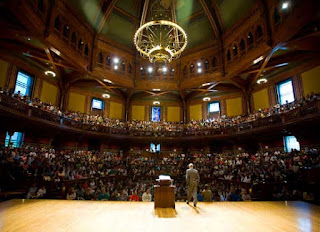
This line of thought converges with one of the common refrains of current thinking about pedagogy: the idea of the student as an "active learner."  As Socrates and Habermas illustrate in the images above, a very large part of teaching philosophy is the challenge of getting the student to think for himself/herself.  The student needs to take on the intellectual challenge as a serious one; and he/she needs to expend the real mental effort required to understand and deal with the problem.  This can't be distilled into an artful lecture by the professor; rather, it seems to require dialogue and intellectual exchange.  The student needs to be engaged in the debate; and he or she needs to be brought to see the stakes of the issue.  (In spite of the vast lecture hall that Michael Sandel confronts in the third image above, he too is capable of engaging and challenging the students in his classroom.  Here is a video of a lecture from his Harvard course on justice.)

Sunday, March 21, 2010

Influences and arguments


Lately I've been writing about the influences that can be discerned in the theories of John Rawls.  Rawls was a "social contract theorist"; to what extent were his theories shaped and framed by his reading of the great contract theorists such as Locke, Rousseau, or Kant?  He was also influenced by the history of economic thought; so is it possible to find parallels or echoes of the thought systems of Adam Smith or Karl Marx in Rawls's thinking?  And to what extent were there more local influences in the 1940s and 1950s that created fairly specific directions and characteristics in Rawls's thinking?

This is an interesting question in application to one particular philosopher.  But it also raises a more general question: where do philosophical theories come from?  To what extent is it the case that a given philosopher is working within a "micro-tradition" -- a particular and specific field of influence -- and to what extent is the thinker "original", bringing forward new ideas on a topic?  And once a fundamental topic has been established for a thinker -- e.g., "What defines the principles of justice for a property-owning democracy?" -- to what extent does the theory then develop autonomously according to the arguments and analysis of the philosopher?

This way of formulating the problem invokes several related ideas: influence and tradition; originality and creativity; and orderly, logical development of a position or theory.  

I suppose that there are many instances of philosophers who fall mostly in the "influence" part of the map: their philosophical work largely takes the form of carefully working out the ideas of their influencers.  (This might be part of the legacy of Rawls; I suppose there has been quite an ocean of philosophical work dedicated to specifying more exactly what "primary goods" are, or how "reflective equilibrium" works.)  This might be described as "normal science" -- taking the foundations of a field of study as being unquestioned, and then attempting to work out the details more exactly.

There are also some good examples of philosophers who were largely driven by the "logical analysis" part of the map: formulate a good, difficult question, and then spend the rest of one's career working out analytically sound answers to the problems this question spawns.  "Naturalized epistemology" might fall in this sector; we might say that the philosophers who have tried to give a biological interpretation of the conditions of knowledge are taking one fundamental question -- how do biological organisms arrive at knowledge of their environment? -- and attempt to apply the findings of cognitive science and evolutionary biology to the issues that arise.  Kant's philosophy also seems to have this character: once having chosen the topics "What can we know metaphysically?" or "What creates moral duty?", his mind seems to have proceeded analytically and logically, without correction or stimulus from a contemporary literature.

And what about originality?  Are there examples of philosophers who have largely invented a set of questions and approaches that defined a new philosophy for a given domain?  Wittgenstein is commonly recognized as a highly original philosopher; but certainly his theories were embedded in a tradition of philosophy.  Several things are apparently true about Wittgenstein when it comes to influence and argument.  (a) Many of his ideas and assumptions in the Tractatus Logico-Philosophicus derived from careful readings of Frege and Russell; (b) his insights and assertions in Philosophical Investigations were responsive to a surrounding set of ideas about language, behavior, and meaning, but his solutions and theories still strike one as being highly original; and (c) for certain themes and problems he continued to work carefully to move his position forward through analytical discovery and inference.  So Wittgenstein seems to illustrate all three dimensions of philosophical theory formation and knowledge construction.

Several things seem to be true about the formation of the theories and perspectives of individual philosophers:
  • They are introduced into a fairly specific "philosophical research community" through graduate education that provides paradigm examples of philosophical questions and issues and prescriptive advice about the nature of philosophical argument and analysis.
  • They are introduced to their field at a particular moment in social history: World War II, the Holocaust, the Vietnam War, the civil rights period, 9-11; and historical events and shifts have an influence on the formation of their thought.
  • "Originality" can take the form of arriving at new questions ("How is group mentality possible?"); new methods of analysis (Frege-Russell's formal deductivism as a solution to the question of the nature of mathematical truth); or new substantive approaches to philosophical theory (Kant's Copernican Revolution in thought).
An interesting contribution to this set of topics is an innovative series of volumes posing "5 Questions" to philosophers in a variety of fields (link).  A recent volume is Philosophy of the Social Sciences: 5 Questions,  edited by Diego Rios and Christoph Schmidt-Petri.  Contemporary philosophers were asked to respond to five important questions about their approaches to the field of the philosophy of social science.  The format offers the beginning of a triangulation among "beginnings," "fundamental assumptions," and "future directions" for each of these philosophers.  The questions that were provided to the philosophers are these:
  1. How did you get interested in the philosophical aspects of the social sciences?
  2. Which social sciences do you consider particularly interesting or challenging from a philosophical point of view?
  3. How do you conceive the relation between the social sciences and the natural sciences?
  4. What is the most important contribution that philosophy has made to the social sciences?
  5. Which topics in the philosophy of social science will, and which should, receive more attention than in the past?
Contributors include David Bloor, Raymond Boudon, Mario Bunge, Nancy Cartwright, Margaret Gilbert, Daniel Hausman, Harold Kincaid, Daniel Little, Steven Lukes, David Papineau, Philip Pettit, Alexander Rosenberg, David-Hillel Ruben, John Searle, and Raimo Tuomela.  This list includes quite a few of the people who have helped to shape current thinking in this sub-discipline of philosophy; so it is very interesting to have a chance to see what they have to say about some of the original influences on their thinking about the social sciences, as well as their own definitions of the frameworks they have arrived at.  I found it very interesting to think seriously about these questions in my own case, because it forces one to reflect on the ideas, events, and ideologies that led one to choose one set of topics and approaches rather than another.  I would have added a sixth question for each of the contributors: "What are the most basic ideas that you have come to in the course of your studies of the social sciences?"

What I would like to see is a next step conducted by a gifted sociologist of the professions, who would attempt to map out the streams of influence and contribution that are documented within the essays in this volume.  Andrew Abbott's careful analysis of the currents of thought constituting the discipline of sociology in the 1960s and 1970s is a good case in point (Chaos of Disciplines).  Another good example is William Sewell's attempt to provide a geography of the discipline of social history in the 1960s (Logics of History: Social Theory and Social Transformation).

Thursday, August 6, 2009

A cognitivist philosophy of history


Many of the posts here have raised issues about the philosophy of history. Here is a bit of a synthesis of many of those prior observations.

Fundamentally, we have unfolded a conception of historical explanation that derives from the central idea of situated human action; the idea, as Marx put the point in 1850, that “men make their own history, but not in circumstances of their own choosing.” In other words, historical explanation fundamentally involves identifying the features of agency and structure in the presence of which the great and minor events of history have transpired. Fundamentally historians are faced with the challenge of making sense of the choices that actors have made in bringing about the historical processes that interest us, given their motives and the constraints created by social institutions and structures.

Formulating ideas about agency is therefore key for historians, and we have seen a wide variety of theories of agency in prior posts: Robert Darnton’s ethnographic study of the book-makers’ apprentices; interpretations of historically specific mentalités; attributions of rational or materialist motivations to participants in riots and rebellions; interpretations of religious commitments; and so forth, throughout the almost endless variety of forms that human agency takes. This is the aspect of historical imagination that corresponds roughly to the “hermeneutic” or interpretive strand of historical thinking: what did these historical actors want? How did they think about the world? The topic of mentalités is important; to explain historical outcomes, we must have a theory of the states of mind of the actors who make history and endure it.

Arriving at better understandings of the metaphysics of social structures is a second key focus of the philosophy of history being developed here. How do structures influence and constrain human action? How are structures embodied in the actions and thoughts of individuals? What are the microfoundations of social structures? It is crucial to avoid reifying social structures – attributing to “the state” or “the proletariat” a causal and ontological presence that transcends the individuals who constitute it. But it is also true that there are coherent and defensible ways of formulating conceptions of extended social structures that do not reify them, and that nonetheless provide them with an important and potent source of historical causal force. Once embedded in barracks, police stations, businesses, social networks, and command structures, the military structure of the Burmese junta creates a highly coercive set of social constraints within which Burmese citizens must act. So the fact that each structure is necessarily embodied in the actions, thoughts, and motives of a population of people does not imply that the structure lacks “autonomous” causal effectiveness to influence agents’ behavior.

This philosophy of history also emphasizes that it is very important for historians to arrive at deeper understandings of the metaphysics of social causation. This means, first, understanding the complete inadequacy of traditional positivist interpretations of causation: “causation is no more than regularity”. This Humean view does not serve the natural sciences well, and it certainly does not help us when it comes to social causation. So it is necessary to explore in a fair amount of detail a model of causation that fits with what we know about the actual workings of social processes. The model that I favor is “causal realism”; it holds that the task of arriving at a causal explanation comes down to discovering one or more causal mechanisms linking antecedent to outcome. This approach conforms well to the actual practice of historians constructing narratives. And it is supported by a careful analysis of the metaphysics of social causation as well. The microfoundational approach argued elsewhere holds that social causation proceeds through the behavior of individuals making choices within structures. But whether or not one accepts the microfoundational approach, it is necessary for historians to have a better idea of what they mean when they judge that “X caused Y.”

A fourth important idea that for this philosophy of history is the fact of historical contingency. Historical events are the result of the conjunction of separate strands of causation, each of which contains its own inherent contingency. And coincidence, accident, and unanticipated actions by participants and bystanders all lead to a deepening of the contingency of historical outcomes. However, the fact that social outcomes have a high degree of contingency is entirely consistent with the idea that the idea that a social order embodies a broad collection of causal processes and mechanisms. These causal mechanisms are a valid subject of study – even though they do not contribute to a deterministic causal order.

Further, we have observed repeatedly that social phenomena are heterogeneous and plastic. Institutions change over time in response to the actions and intentions of participants (plasticity); and generally similar institutions are nonetheless significantly different in their mid-level characteristics and dynamics (heterogeneity). Cities illustrate both characteristics. The institutional regimes through which a given city manages an important urban problem – handling the provisioning of clean water, let us say – change over time; this illustrates plasticity. And different cities have very different internal functional organizations, all serving to fulfill roughly the same set of urban functions but in very different ways (heterogeneity). It is important for historians and historical social scientists to keep these fundamental ontological facts about the social world in mind as they attempt to conceptualize the past. Otherwise we are likely to produce stylized and repetitive interpretations of the institutions and actions of the past, overlooking the important ways in which those institutions differed from each other and from contemporary equivalents.

The related ideas of meso-history and comparative history conform well to all these recommendations. By paying attention to the mid-level processes and institutions of a given time period, the historian is drawn into the distinguishing features as well as the common features of these institutions. (How did French absolutism really work, when it came to collecting taxes, raising armies, and managing a bureaucracy?) And by engaging in careful comparison across complex cases, the historian is brought to recognize the facts of institutional variation and, sometimes, commonality. (How did proto-industrial handicraft production work in Amsterdam and Suzhou; what were the similarities as well as differences of these pre-modern economic institutions?) Likewise, several discussions above have illustrated the explanatory value that derives from the study of meso-level social institutions and organizations – for example, the transportation system that exists in a given region. Further, meso-history and comparative history lead the historian to have a more practical recognition of the contingency and path dependency of mid-level economic, political, or social institutions. It is difficult to maintain that there is only one way of managing a fiscal system or growing a pre-modern industrial economy, when one’s research lays bare the similarities and differences that existed in different settings in France or Japan.

Turning to questions about evidence and objectivity, this philosophy of history offers support for the idea that historical inquiry is an empirically rigorous endeavor. Skeptics sometimes make easy statements such as “the past is unknowable,” “historical interpretations are inherently subjective,” and “all historical statements are the result of the historian’s bias.” But close examination of serious examples of historical research and debate demonstrate that historians engage in detailed historical research involving different kinds of historical evidence and theories from the social sciences, and arrive at well-grounded hypotheses about circumstances in the past. Questions like these turn out to have answers in which we can have a fair degree of confidence: “What was the typical annual food budget for an agricultural worker in England’s midlands in 1700?”, “Why did Parisian artisans support mobilization against the monarchy in 1848?”, “Did the Chinese Cultural Revolution involve deliberate strategies of mass killing?” It will sometimes turn out that there just is not enough historical evidence available to answer a given question, but this is surprisingly uncommon. Debates exist over the interpretation of the facts; but often enough, further research suffices to narrow the range of debate for the next generation. So we have found many reasons to be optimistic about the objectivity and truthfulness of historical knowledge.

This philosophy of history does not consider every problem that arises in the doing of history. I focus instead on the knowledge enterprise: what is involved in knowing (some of) the facts about the past? And what is involved in arriving at satisfactory explanations of these facts? There are other goals that historians have in doing their work, from illustrating a moral point, to entertaining a reading audience with surprising stories about those who came before. But many of the most interesting historical writings fall squarely within the “cognitivist” approach, and their examples support an interpretation of historical knowledge that is evidence-based, rigorous, and post-positivist. On this interpretation, history is a kind of social science, sharing commitments to evidence, rigorous reasoning, and critical use of theory in arriving at true statements about the world. And this is a lofty aspiration for historians and philosophers.

 
Design by Free Wordpress Themes | Bloggerized by Lasantha - Premium Blogger Templates