Showing posts with label economic development. Show all posts

Wednesday, November 30, 2011

David Graeber's reflections on money, debt, and violence


David Graeber's Debt: The First 5,000 Years has hit a chord with a lot of people who are concerned about rising inequalities in the United States and elsewhere.  Graeber is an economic anthropologist, a discipline that pays close attention to the ways that material arrangements worked in detail in pre-state societies. One of the great works in this field is Marshall Sahlins' book, Stone Age Economics, which paid very close ethnographic attention to how the social arrangements worked in hunter-gatherer societies when it came to gathering and consuming food and other necessities of life. (My main recollection is that Sahlins found that hunter-gatherers worked much shorter days than their successors, the farmers, and had much more time to enjoy the finer things of life, including stories and jokes.)  Graeber is also described as one of the intellectual sources of the Occupy Wall Street movement, and anti-globalization activism has been an important part of his life for a long time.  (Here is a story in Bloomberg that gives a lot of interesting background.)

The book is difficult to characterize.  It's about debt and money through history, but it's really not a work in economic history.  It offers a lot of ethnographic detail about borrowing, lending, gifting, and reciprocating, but it's not really a work of anthropology.  And it offers morally valenced language to describe debt and credit, but it's not really a polemical critique of the present financial system.  It is certainly an engaging, interesting, and thought-provoking book, and Graeber appears to know a great deal about the social and institutional histories of the main civilizations of Eurasia.

One line of thought is perfectly clear in the book: Graeber wants to demolish the myth of the truck-and-barter origins of money.  This is the standard story within classical and neoclassical economics. But Graeber thinks it is a complete fiction.  He regards this as a just-so story that doesn't make any sense ethnographically, and has never been observed in real pre-state societies.
The story, then, is everywhere. It is the founding myth of our system of economic relations. It is so deeply established in common sense, even in places like Madagascar, that most people on earth couldn't imagine any other way that money could possibly have come about.
The problem is there's no evidence that it ever happened, and an enormous amount of evidence suggesting that it did not. (28)
Graeber's case for this position seems to be a sound one.  But why exactly does it matter?  It seems to be a bit analogous to literal-minded social contract arguments: that the state is legitimate because it descends from a primordial agreement among all citizens to create its authority.  But discrediting the origins story doesn't really tell us anything about the functioning system.  We have an economic system today that coordinates activity through money and credit, and it doesn't really matter very much if we know exactly how it came about.  I think that Graeber is focused on the issue because he thinks the myth helps to convey the view that the contemporary economist's view of human activity -- self-serving actions designed to maximize one's own utility -- is in fact an historical universal, applying to pre-modern and non-western social settings as well as to the New Orleans cotton exchange.
It's money that had made it possible for us to imagine ourselves in the way economists encourage us to do: as a collection of individuals and nations whose main business is swapping things. (44)
Graeber's view, by contrast, is that most human activity doesn't conform to this model; that the gift relation and the practice of open-ended reciprocity are much more characteristic of the human condition.

There are many startling facts and descriptions that Graeber produces as he tells his story of the development of the ideologies of money, credit, and debt.  One of the most interesting to me has to do with The Wonderful Wizard of Oz.
L. Frank Baum's book The Wonderful Wizard of Oz, which appeared in 1900, is widely recognized to be a parable for the Populist campaign of William Jennings Bryan, who twice ran for president on the Free Silver platform -- vowing to replace the gold standard with a bimetallic system that would allow the free creation of silver money alongside gold. ... According to the Populist reading, the Wicked Witches of the East and West represent the East and West Coast bankers (promoters of and benefactors from the tight money supply), the Scarecrow represented the farmers (who didn't have the brains to avoid the debt trap), the Tin Woodsman was the industrial proletariat (who didn't have the heart to act in solidarity with the farmers), the Cowardly Lion represented the political class (who didn't have the courage to intervene). ... "Oz" is of course the standard abbreviation for "ounce." (52)
(This is roughly as startling to me as an interpretation of Star Wars as an extended allegory on Reaganism (intervention in Nicaragua, scary military officers in the background, etc.). This doesn't quite work, though, since Star Wars appeared in 1977, three years before Reagan's first election as president.)

One of Graeber's recurring themes is that money and debt are reciprocals of each other.  He tells many stories about IOU's being passed around within a community: John promises to give X to Alice; Alice passes on the IOU to Robbie in exchange for a beer; Robbie takes the IOU to the nail shop and exchanges it for a pound of nails from Bert; and Bert eventually comes back to John to redeem the IOU. In this circuit, the statement of debt serves as a basis for folk currency within a local society.  But Graeber argues that the establishment of Bank of England resulted in bank notes that were no more or less than IOU's from the state (49).

Another theme that comes into the book is the close connection that Graeber draws between money and currency, and violence and war.  He argues that trust and extended credit arrangements work very well during periods of peace; whereas a period of extended warfare puts a premium on the portability and anonymity of precious metals.  So warfare pushes societies (and monarchs) towards the use of currency made out of precious metals.  He goes further: monarchs needed to pay their armies, in Europe, central Asia, and East Asia; and precious metals (coins) work best for the heavily armed and footloose soldiers who made up those armies.
As a result, while credit systems tend to dominate in periods of relative social peace, or across networks of trust (whether created by states or, in most periods, transnational institutions like merchant guilds or communities of faith), in periods characterized by widespread war and plunder, they tend to be replaced by precious metal. (213)
And:
The Atlantic Slave Trade as a whole was a gigantic network of credit arrangements. Ship-owners based in Liverpool or Bristol would acquire goods on easy credit terms from local wholesalers, expecting to make good by selling slaves (also on credit) to planters int he Antilles and America, with commission agents in the city of London ultimately financing the affair through the profits of the sugar and tobacco trade. (149)
Graeber has a preferred alternative to a society based on barter, market exchange, debt, warfare, slavery, and peonage.  It is what he calls a "human economy":
This is why I developed the concept of human economies: ones in which what is considered really important about human beings is the fact that they are each a unique nexus of relations with others -- therefore, that no one could ever be considered exactly equivalent to anything or anyone else.  In a human economy, money is not a way of buying or trading human beings, but a way of expressing just how much one cannot do so. (207)
An intriguing, and somewhat perplexing, part of Graeber's analysis is his effort to link the value systems of Eurasia's great civilizations to the social creation of money, credit, and debt.  A central thrust here is his analysis of the "Axial Age" -- the period from 800 bc to 600 ad when there was great creativity in the emergence of new spiritual leaders and movements.  There was, simultaneously, extensive warfare; and there was the simultaneous invention of currency in several widely separated places.  He illustrates this nexus with the case of China:
The golden age of Chinese philosophy was the period of chaos that preceded unification [during the Warring States period], and this followed the typical Axial Age pattern: the same fractured political landscape, the same rise of trained, professional armies and the creation of coined money largely in order to pay them. We also see the same government policies designed to encourage the development of markets, chattel slavery on a scale not seen before or since in Chinese history, the appearance of itinerant philosophers and religious visionaries, battling intellectual schools, and eventually, attempts by political leaders to transform the new philosophies into religions of state. (235)
So what is the connection he wants to draw between value systems, social violence, and money?  It is unclear to me; somehow Graeber weaves together a fascinating narrative involving each of these. He does think there is a connection, but it's difficult to see what is thought to be causal in the story.
In fact, some of the historical connections are so uncannily close that they are very hard to explain any other way. Let me give an example. After the first coins were minted around 600 bc in the kingdom of Lydia, the practice quickly spread to Ionia, the Greek cities of the adjacent coast. The greatest of these was the great walled metropolis of Miletus, which also appears to have been the first Greek city to strike its own coins.  It was Ionia, too, that provided the bulk of the Greek mercenaries active in the Mediterranean at the time, with Miletus their effective headquarters. Miletus was also the commercial center of the region, and perhaps, the first city in the world where everyday market transactions came to be carried out primarily in coins instead of credit. Greek philosophy, in turn, begins with three men: Thales, of Miletus (c. 624 bc- c546 bc), "Anaximander, of Miletus (c. 610 bc- c546 bc), and Anaximenes, of Miletus (c. 585 bc- c525 bc) -- in other words, men who were living in that city at exactly the time that coinage was first introduced. (244)
He pulls out "materialism" as a thread in the philosophical systems that emerged in the Axial Age -- China as well as Greece -- and suggests an analogy between the idea of an abstract fundamental physical substance that is the substrate of everything physical, and the idea of an abstract unit of measure of all commodities, money (245); but it's hard to see a consistent and compelling idea here about the intertwining development of philosophy and economics.  Here is the closest he comes to a statement of the nature of the connection he finds:
What we see then is a strange kind of back-and-forth, attack and riposte, whereby the market, the state, war, and religion all continually separate and merge with one another. (248)
Where does it all lead?  After a walk through the Middle Ages (major improvement in quality of life over the Axial Age, according to Graeber), we get to capitalism:
Starting from our baseline date of 1700, then, what we see at the dawn of modern capitalism is a gigantic financial apparatus of credit and debt that operates -- in practical effect -- to pump more and more labor out of just about everyone with whom it comes into contact, and as a result produces an endlessly expanding volume of material goods. (346)
Does he bring this parable to a practical piece of advice?  He does, actually:
In this book I have largely avoided making concrete proposals, but let me end with one. It seems to me that we are long overdue for some kind of Biblical-style Jubilee: one that would affect both international debt and consumer debt. It would be salutary not just because it would relieve so much genuine human suffering, but also because it would be our way of reminding ourselves that money is not ineffable, that paying one's debts is not the essence of morality, that all these things are human arrangements and that if democracy is to mean anything, it is the ability to all agree to arrange things in a different way. (390)
As I mentioned at the start, Graeber is also an activist who has been strongly involved in anti-globalization protests in the past fifteen years.  His Direct Action: An Ethnography is an interesting cross-over book bringing together his anthropologist's training and his activist experience; it is an ethnography of the anarchist activism movement as he has experienced it.  I'll discuss this work in a future post.

Here are two interviews with Graeber that give a pretty good idea of his style and critical views about the present (link, link).  Both are very interesting to listen to.

Saturday, November 5, 2011

Beijing Forum 2011

I'm attending the Beijing Forum 2011 this week, and it's a superb international conference. Much of the conference took place at Peking University. Over three hundred international scholars were invited to participate, and there are dozens of interesting conversations going on at any one time.  The goal is to stimulate productive dialog among scholars from many nations about the issues of modernity and tradition we currently face, and the setting works. I've had very interesting discussions with scholars from Thailand, China, Angola, Laos, and Mexico, and it is very interesting to get the different perspectives that we all bring.

The focus is on academic perspectives and dialogues around the overarching theme of "The Harmony of Civilizations and Prosperity for All." This year's organizing theme is "Tradition and Modernity, Transition and Transformation." There are seven themes for the Forum's discussions this year:
  • Change and Constancy: Historical Perspectives on the Way to Social Transformation
  • Economic Growth in the Context of Globalization: Opportunities, Challenges and Perspectives
  • Inheritance and Innovation in Education
  • Transformation and Stability: Achievements and Challenges in Developing Countries
  • Artistic Heritage and Cultural Innovation
  • Urban Transformation and the Future of Mankind
  • Deliberative Democracy and Social Harmony
Each group contains a distinguished selection of academics from around the world, heavily focused on European, American, and Asian scholars. (There were only six scholars from sub-Saharan  Africa, and  only two participants from Latin America.)

My paper, "Justice Matters in Global Economic Development," was included in the Economic Growth theme. I argued five basic points: We generally agree about the basics of a just society. The current state of the world badly contradicts those values (poverty, inequality, abuse and coercion). Amartya Sen's writings provide a powerful basis for those commonsense ideas about justice. The greatest impediment to improving justice is the untrammeled power private and state interests have vis-a-vis the poor. And injustice matters because it causes serious social problems. So states need to strive to reduce injustice.

I didn't really have a good sense of how the argument was received by the participants, but there was a fairly clear split between "laissez-faire" growth advocates and economists who took inequalities of income and health very seriously.  I assume the latter group was more receptive than the former.

The academic question I received during the formal discussion period came from an American economist. He pointed out that China's 10% annual growth since the 1990s has greatly improved the standard of living for a hundred million people in coastal China, and created job opportunities for tens of millions of migrant workers. He wanted to know if I was seriously advocating a slower rate of growth as the price of greater justice. The question reflects the assumptions of many of the economists in the session: state policies aimed at enhancing equality are highly destructive to economic growth. So, by inference, preferring economic justice is harmful for a society.

My response, in a nutshell, was "yes".  Economic development involves choices. And it is possible that a strategy with a  lower growth rate would do a better job of bringing all of China up together, rather than creating a broadening gap between rural poor and affluent urban people.  I am indeed arguing that it would be best to choose the second strategy.  (This might take the form of investing a larger percentage of China's formidable savings and reserves in substantially enhanced public goods for the rural poor -- education, healthcare, and retirement.)

What is equally important, is that the power differential between poor people and propertied interests in China today almost guarantees that the poor will lose out. Property confiscations by businesses and municipal development authorities are a good example. (Coincidentally, the Thai urban planning expert I talked with said this is precisely the case in and around Bangkok, and the Angola urban planner made similar comments about Angolan farmers and the residual white settlers.) So injustice is as much about power as it is about exploitation. And this means that legal and institutional reforms are needed if China's inequalities are to be reduced.

It was striking to me that the thrust of my talk seemed to be most resonant with the Peking University students in the room. A cluster of them came over to talk about the implications of these ideas for China during the break.  These young people seemed genuinely concerned about how China might address some of the large issues of social inequality that have arisen since the economic reforms began in the 1980s. (In fact, even some officials I've talked with here in China believe that more serious attention to justice issues is needed in China's future -- for example, with regard to China's rural poor and to migrant workers and their families.)

(The talk is included as a page on the list at right. I plan to post the bilingual PP as well.)

Saturday, October 1, 2011

Sen on well-being


In 1985 Amartya Sen published a very short book entitled Commodities and Capabilities. The book was reissued by Oxford after Sen received his Nobel Prize in Economic Sciences.

The topic is at the core of Sen's economic and philosophical work. Most basically, he is asking Aristotle's question -- what is happiness? -- and is putting forward an answer that combines analysis of economic behavior with philosophical analysis of action and purpose in human life. Economists from Mill to Samuelson sought to understand economic choices in terms of subjective utilities and unanalyzed sets of preferences. A consistent theme was that economics can't be concerned with the content or validity of the individual's utility function or preference ordering. Rather, economics is about the rules by which rational agents design their actions to maximize utility or preference satisfaction. Economic rationality has to do with the choice of means, not ends.

This approach to action also unfolded into the formal theory of social choice. Given that citizens have a set of preferences about social outcomes, what rational procedures can be designed to aggregate these preferences into a single coherent social choice preference ordering.  Essentially the underlying idea is that the social good is secured when we succeed in aggregating citizens' preferences onto a single social preference ranking.  And this is where Kenneth Arrow's famous impossibility theorem comes in: given a small set of reasonable constraints on social choice, there is no social choice procedure that is both complete and transitive (Social Choice and Individual Values, Second edition). Sen's first major book (1970) gave a different formal exposition to this set of arguments (Collective choice and social welfare).

One of Sen's most fundamental contributions in economics is to question the theory of subjective utility and revealed preference. He thinks that we can give a substantive, not formal, account of wellbeing that permits us to analyze the individual's behavior and choices in a more meaningful way.  He writes here:
It is fair to say that formal economics has not been very interested in the plurality of focus in judging a person's states and interests. In fact, often enough the very richness of the subject matter has been seen as an embarrassment. There is a powerful tradition in economic analysis that tries to eschew the distinctions and make do with one simple measure of a person's interest and its fulfilment.  That measure is often called 'utility'. (1)
He wants to complicate the issue by drawing distinctions -- that is, by breaking down the austere abstractions about choice that are most comfortable to the economists:
I would distinguish broadly between two ways of seeing a person's interests and their fulfilment, and I shall call them respectively 'well-being' and 'advantage'. 'Well-being' is concerned with a person's achievement: how 'well' is his or her 'being'? 'Advantage' refers to the real opportunities that the person has, especially compared with others. The opportunities are not judged only by the results achieved, and therefore not just by the level of well-being achieved. It is possible for a person to have genuine advantage and still to 'muff' them.  Or to sacrifice one's own well-being for other goals, and not to make full use of one's freedom to achieve a high level of well-being.  The notion of advantage deals with a person's real opportunities compared with others. The freedom to achieve well-being is closer to the notion of advantage than well-being itself. (3)
This discussion announces his important distinction between capabilities and functionings; functionings are the realized form that capabilities take when they are fully cultivated.  "A functioning is an achievement of a person: what he or she manages to do or to be" (7).  It is worth noticing that the idea of freedom comes into this formulation in a fundamental way -- fifteen years before freedom becomes central to his thinking about the good of economic development in Development as Freedom.

Sen's argument next moves into another topic that has been characteristic of his thinking throughout his career, the relationship between two or three central components of "satisfaction" or "well-being".  There is subjective satisfaction -- the degree to which the individual has accomplished a large portion of his/her preferences.  There is the role of commodities and material things in the composition of individual satisfaction -- the bundle of stuff that the individual can call upon in attempting to satisfy basic needs and desires, from grain and clean water to iPads and access to the Internet.  And there is the "fit" between the individual's material circumstances and his/her ability to fulfill capabilities and complete an autonomous plan of life.

The key idea expressed in this monograph and subsequently in Sen's work is that well-being is the aggregation of the individual's collection of functionings.  "It is possible to argue that the well-being of a person is best seen as an index of the person's functionings" (17).
On what does the claim of functionings to reflect well-being rest? Basically, the claim builds on the straightforward fact that how well a person is must be a matter of what kind of life he or she is living, and what the person is succeeding in 'doing' or 'being'. (19)
And Sen thinks about this formulation in formal terms: the person's functionings are represented as a vector of qualitatively distinct characteristics, and one of the central problems is to assign relative values to the components of the package.
The primary specification of a person's well-being is in terms of a functioning vector bi. It can be converted into a scalar measure of well-being only through a real-valued 'valuation function' vi(.), mapping functioning vectors into numerical representations of well-being. (33)
Sen's approach is appealing largely because it replaces "utility" with a more granular conception of "functionings".  This permits more concrete discussion of the individual's life activities and, as Sen argues here, a better way of assessing his/her overall well-being.

What has turned out to be enormously important in Sen's framework of capabilities and functionings is its relevance to the topic of economic development.  We want economic development to lead to an overall improvement in human happiness.  But how should such a goal be assessed and measured?  By offering a concrete theory of functionings, Sen lays a basis for attempting to empirically measure changes in functionings over time.  Literacy, for example, is an important functioning for the human being.  Extremely poor societies invest very little in formal education, and literacy in the population is low.  We can make a very concrete argument that a given strategy of development is improving human well-being if we can demonstrate that it is leading to a higher level of attainment of literacy.  Health itself is a complex functioning for the human being; here too, it is possible to measure progress in health achievements in different societies.  So the functionings approach provides a concrete way of trying to assess progress in economic development processes.  The approach is a great improvement over the "average GDP" approach, since Sen demonstrates in numerous places that average income implies something about access to commodities, but it has only a weak connection to the functionings that the population is able to realize.

The Human Development Index championed by the United Nations Development Programme takes advantage of this insight.  HDI includes three measures: life expectancy, literacy, and per capita GDP (link).  And a very powerful argument can be made that societies that make the most progress in improving their HDI levels have made more progress in improving human well-being than those that increase GDP but fail to improve factors like literacy and health.  It will not surprise the reader to learn that Sen's writings and advocacy played a crucial role in the design of the HDI.

Thursday, July 28, 2011

Civil society in a globalizing world


An important component of western political theory since Locke and Rousseau is the notion of civil society—the idea of a society in which members have a variety of cross-cutting activities and associations, and where the state is not the sole source of social power. On this conception, a civil society is one that is characterized by multiple associations, free activities and choices by individuals, and a framework of law that assures rights and liberties for all citizens. It is a society with multiple forms of power and influence, minimizing the potential for exploitation and domination by powerful elites or the state. And it is a society in which citizens have developed a sense of mutual respect and consideration for each other. The fact of civil association serves to enhance the strength of collective identities among citizens, by building new loyalties and affiliations. Citizenship and unity are built through association with other citizens and the knowledge that they can pursue their interests and values through their associations (Robert Putnam, Better Together: Restoring the American CommunityBowling Alone: The Collapse and Revival of American Community). But we can emphasize as well the importance of civil associations as a counterweight to the power of the state. Citizens have greater security when they can be confident that the state cannot act against their interests with impunity.

What is involved in sustaining a civil society? What are the conditions that enhance civility within a community? There are several factors that are particularly important. There is solidarity—some degree of shared identity among the individuals who make up the society as groups with interests in common. There is a sense of justice—confidence that the basic institutions are fair to all. There is confidence in the future, that one’s children will have reasonable (and improved) life prospects. There is a sense of dignity—of being treated with human dignity, of being assigned equal human worth. And there is a need for stable, fair, and predictable institutions that give citizens the confidence that they can pursue activities, form associations, and engage in civil discourse without fear. When these conditions are satisfied we can have the greatest confidence in the stability and flourishing of a civil society.

Several of these features fall within the concept of what John Rawls calls a well-ordered society. Rawls introduced the concept of a well-ordered society in A Theory of Justice. It is the conception of society “as a fair system of cooperation over time from one generation to the next, where those engaged in cooperation are viewed as free and equal citizens and normal cooperating members of society over a complete life” (Justice as Fairness: A Restatement : 4). Citizens within a well-ordered society respect one another; they have confidence that their most basic interests are fairly treated; and they have confidence that the basic institutions of society permit them fair access and permit them to pursue their conceptions of the good. A well-ordered society is thus a powerful and pervasive foundation for a stable society, and justice is an important causal factor in sustaining and reproducing a society. The underlying hypothesis is that shared moral values, including particularly the values, that determine the terms of social interaction, create the grounds of stability in a society. And profound disagreement about these values creates the possibility of serious conflict. (Here are a few earlier postings on Rawls's views in this area; link, link).

These ideas find their most common application in the context of local or national communities. How does this concept pertain to the idea of a world society? Is there any meaning we can assign to the notion of a global civil society? Or does this concept apply only to connected populations engaged in face-to-face interactions with each other? Is a global civil society feasible? This would be a world in which all persons recognize and respect the human reality and worth of all others—near and far. It is a world in which people are tied together through cross-cutting civil associations—local, national, and international.  These may include labor organizations, women’s organizations, environmental organizations, or religious groups. It is a world in which persons share a sense of justice—they share a basic agreement on the essential fairness of the institutions that govern their lives. And it is a world in which all people have grounds for hope for the future—that there are opportunities for them to improve their lives, that they will have fair access to these opportunities, and that their children will have better lives than they themselves have had. Such a world has every prospect of sustaining stable, peaceful, and civil social life—both local and international.

How does a theory of global justice relate to this vision (The Paradox Of Wealth And Poverty: Mapping The Ethical Dilemmas Of Global Development)? The connections are profound. Justice requires an urgent commitment to ending poverty throughout the world. It requires a commitment to democracy and human rights—and the effective legal institutions that can secure both. It entails adherence to the values of fairness and human equality, and the importance of reshaping international institutions with these values in mind. And these are precisely the values that are needed to establish the basis of peaceful civil society. If these values are genuinely and deeply embedded in our planning for the future—and if the people of the developing world become convinced that these are real, guiding priorities for the people and governments of the wealthy world—then the potential bonds of international civility will be established. And at the country level the positive institutions of law, democracy, and economic opportunity will reinforce the values of civility and mutual respect.

So the important values that pertain to just global development are arguably critical to a decent future for humanity. A world order that is not grounded in a permanent commitment to human dignity and justice is not only disqualified from the perspective of morality. It is likely to be an increasingly unstable and violent arena for deep and desperate conflict. So for our own sakes and for the sake of future generations we need to commit ourselves in practical and enduring ways to the establishment of global justice, an end to poverty, and the extension of effective democratic and human rights to all persons in all countries.

Three specific points are particularly central. First, poverty is not simply a problem for the poor or for poor countries. Rather, it is a problem for the world, and one that we must confront with determination and resources. This means that we need to develop plans that have a likelihood of success for poverty alleviation; we need to work toward the political consensus that will be needed in order to carry these plans out; and we need to exercise our democratic rights and voices so as to bring about the large commitment of resources that will be needed.  The Millenium Development Goals place this as the first priority (link).

Second, the equality of worth of all persons is an essential moral fact. All persons are equally deserving of attention. And much follows from this fact. The extreme inequalities of life prospects between citizens of the north and the south are inconsistent with this principle. The persistence of anti-democratic and authoritarian regimes throughout the developing world is inconsistent with the equal rights and worth of the citizens who suffer under those regimes. And the inequalities of voice that are present in current international institutions represent an affront to the moral equality of all persons who are affected by those institutions.

Finally, democracy and human rights are critical. It is only through effective democratic institutions for government and decision-making that the interests and concerns of citizens will be aggregated into just policies and progressive social institutions. Democratic institutions permit all citizens to influence the policies that affect the terms of their lives, and they represent a meaningful obstacle to the emergence of exploitation and domination of the powerless by elites.

Are there examples of international settings that embody some of the features of a global civil society? The European Union, and the pan-European institutions and identities that the EU is in the process of forging, offer a promising example of a system that can bring about a just international order. Here we find fledgling experiments in the creation of solidarities that transcend language, religion, nation, or place. And we find an emerging discourse of solidarity that may provide the political basis that will be needed to bring about global justice (and the international transfer of resources and knowledge that this will require). There is a measure of “global thinking” among European citizens that offers a basis for optimism about the feasibility of an engaged world citizenry. OECD institutions have already gone a long way in the direction of giving meaningful priority to the needs of developing countries. The OECD and the Development Assistance Committee represent effective and broadly supported institutional agents of change within the processes of economic development. And surveys of European public opinion suggest an emerging and strengthening public support for global justice (link, link).

Finally, what does the concept of a global civil society imply for the durability of national or cultural identities? Can the Brazilian, Sikh, or Muslim at the same time be a member of a global civil society? This question can be posed at virtually every level of scale—village, region, nation, or global system. And the answer is everywhere the same. One can be both cosmopolitan and Muslim, both Brazilian Catholic and citizen of the world (Martha Nussbaum and Josh Cohen, For Love of Country?), (Charles Taylor, The Ethics of Authenticity). In other words, this conception of a just global civil society does not presuppose a process of homogenization of world cultures. Instead, it presumes the development of a cross-cultural consensus about the importance of civility as a necessary context for the many cultural, religious, or national differences that will persist and that constitute one of the positive engines of creativity that are available to the world’s people.

Thursday, January 6, 2011

Historical GDP estimates for early modern China


Li Bozhong is one of China's most influential economic historians, and he is undoubtedly the most internationally connected.  Much of his work in the past several decades has been devoted to constructing a detailed economic history of the lower Yangzi Delta (for example, Agricultural Development in Jiangnan, 1620-1850).  His findings have been crucial empirical contributions to the "involution" debate (link, link, link) about whether the Chinese economy was stagnant and significantly less productive than the European economy.  Thanks to his research we now have a much more informed understanding of the economic dynamics of the Lower Yangzi region in the early modern period (1620-1850).  And his research largely supports the "no involution, significant productivity growth" interpretation.  (Ken Pomeranz has a nice review of Agricultural Development in Jiangnan, 1620-1850 here.)

Li's most recent book has now appeared in Chinese, and it takes an important step forward in terms of methodology.  (The cover and title are included above.  The book includes an extended summary in English, which allows non-Chinese speakers to get the highlights of method and findings.)  The important step that Li introduces here is a first effort to apply the methodology of historical national accounts to China. Essentially this method allows the researcher to use the discipline of GDP accounting to arrive at systemic and internally validated estimates of economic activity in a region over a period of time.  (Jan-Pieter Smits, Edwin Horlings, and Jan Luiten van Zanden provide an extensive and detailed description of the method in "Dutch GNP and its Components, 1800-19193" (link).  Olle Kranz describes the method in application to Sweden here.)

Li's current book is a massive effort (over 600 pages), but it is itself only a pilot project for a more ambitious study to come in future years.  Li has selected one limited district within his previous area of study in the lower Yangzi Delta (Huating-Lou), and attempts to apply the method of historical GDP to this limited region for a single period of time (1823-29).  His goal is to determine whether the discipline and method of historical GDP can shed new light on the scattered economic statistics and materials that more traditional economic histories have assembled.  The results are highly interesting, and they challenge several key assumptions that have been made about the early Qing economy.

Li hopes for two advantages from this approach.  The first is that it provides a unified framework within which to organize and validate existing economic data.  "Because the methods of the GDP study are quite elaborate and standardized, they can provide a coherent macroeconomic framework covering the whole economy" (603).  And the second is to provide a consistent basis for comparison with other historical regions where the same methods have been utilized.  This means that the kinds of comparisons suggested by recent work in Eurasian economic and demographic history will be enhanced as other scholars apply the methodology to European regions.

Huating-Lou is roughly a single county, Songjiang County, with an area of 870 square kilometers and a population in 1816 of 563,052.  (From the maps it appears that the county falls squarely within the current city of Shanghai.)  So the area covered by Li's study is a microcosm of the larger economic region in which it is lodged; Jiangnan had a population of roughly 36 million in the mid nineteenth century.  Li makes use of the same kinds of data sources he has used in earlier works: gazetteers, agricultural handbooks, and modern field investigations of the region (in particular, the Japanese South Manchurian Railway Company studies from 1937-41). Essentially Li proceeds by transforming the variety of data provided by these sources into a uniformly formatted table of national accounts.


The method involves attempting to estimate the magnitude of economic activity in several sectors by assessing production, expenditure, and income. The idea is that the data for these three aspects of the economy are fairly independent; but they should be expected to lead to similar estimates of overall economic activity. (If production estimates indicate a region is producing 10 million yuan of goods, but income estimates indicate only 2 million yuan of income, we can be assured that there is an important data inconsistency.) The method involves making use of the System of Historical National Accounts to provide a unified framework for collecting and presenting the economic data. (See also a paper by Frits Bos describing the use of national accounts as a tool for economic history (link).)

Here is a description of this method as implemented by Luiten van Zanden and colleagues for the Netherlands (link):
Our main method is to gather specific information on annual output and added value in each of the most important economic branches, following the System of National Accounts (SNA) used in contemporary economic-statistical research. The starting point is the production approach; the branches that are being reconstructed include agriculture, herring fisheries, peat extraction, production of textiles, sugar and paper, to name but a few. Weights will be derived from a reconstruction of the structure of the labour force in three moments in time: 1510/14, 1670/80 and around 1800. Combined, the chronological series and the data on the structure of the labour force will serve as a basis for estimating developments in the level and structure of national income.
Li's results are fascinating. First, he finds that production, income, and expenditure estimates for Huating-Lou in 1823-29 all converge on an estimate of about 13.5 million taels of silver. The production estimate is 13.5 million taels, the income estimate is 13.3 million taels, and the expenditure estimate is 13.9 million taels.  So the three systems of accounting all point to approximately the same level of economic activity.  This amounts to an estimate of GDP per capita of about 24 taels of silver.


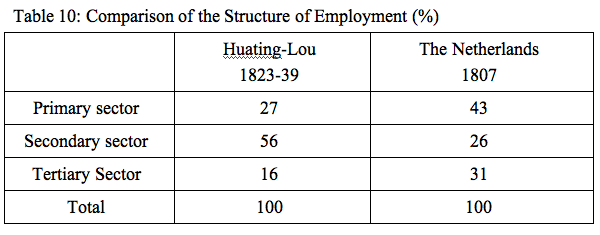
Second, the sectoral composition of the Huating-Lou economy is genuinely surprising (as indicated in table 1). We commonly think of China's Ming-Qing economy as largely rural and agricultural. But the primary sector, including agriculture and fisheries, amounts to only 31% of the local economy, while the secondary sector (manufactures and textiles) contribute 33% and the tertiary sector (commerce, service, government, etc.) contributes 36%. The prior expectation we might have had of the early modern Chinese economy as largely agricultural is flatly refuted for this region by the 1820s. This finding is corroborated by Li's analysis of the structure of employment in the region; only 27% of employment was in the primary sector, with 56% in the secondary and 16% in the tertiary sectors.

Third, Li points out that the composition of income is also somewhat surprising. Wages represented 61% of the Huating-Lou economy; rent 11%; interest 3%; profit 20%; and depreciation 6%. What is surprising about this estimate is the unexpectedly low percentage of all income that derived from rent -- contradicting the idea that the Chinese economy was a rent-dominated one. (Earlier work by Victor Lippit (Land Reform and Economic Development in China: A Study of Institutional Change and Development Finance) sought to estimate the total surplus created by the Chinese rural economy; he estimates 10.7% of income from rent, 3.4% of income from farm business profits, and 2.8% from rural interest payments.  See Understanding Peasant China: Case Studies in the Philosophy of Social Science, pp. 121-22, for more discussion.  Li's estimates of rent and interest are about the same as Lippit's, whereas Li's estimate of profits is substantially higher than Lippit's.)

All of this is highly interesting, though (as Li emphasizes throughout), it is based on only one small region during one limited time period.  So it will be very interesting to see whether it is possible to perform this kind of analysis for larger parts of the historical Chinese economy.

Estimating economic activity was one of the goals of this research.  The other was to establish a consistent basis for comparison across different parts of Eurasia.  Li takes up the comparison with the Netherlands that is made possible by the work mentioned above by Jan-Pieter Smits, Edwin Horlings, and Jan Luiten van Zanden (link). And indeed, the comparisons are very interesting.  Here is the comparison of the sectoral composition of Huating-Lou and the Netherlands:


And here is the comparison for the structure of employment:


The one comparison that Li does not highlight (in the English summary, anyway) is the GDP per capita comparison between Huating-Lou and the Netherlands.  This comparison raises some of the issues involved in a recent discussion here of the standard of living (post), since the Dutch analysis is denominated in guilders and the Chinese work is denominated in taels of silver.  Smits, Horlings and van Zanden estimate a Dutch population size of  2,163,092, implying a GNP per capita of 227 guilders per capita.  Recall that Li estimated a per capita GNP of 24 taels. 

So what is the conversion of tael to guilder? Here I have to go beyond my own specialized knowledge and speculate a bit, so this calculation shouldn't be taken uncritically.  The guilder was defined in 1840 as equivalent to 9.45 grams of fine silver (link).  A tael was equivalent to 37.3 grams of silver, according to Li. So in silver equivalents, the Dutch GDP per capita was 227*9.45 grams of silver, and the Chinese GDP per capita was 24*37.3 grams of silver -- 2,145 grams versus 895.2 grams.  By this estimate, the early nineteenth-century Dutch economy produced a silver equivalent per capita over two times that of the Chinese economy.  However, the purchasing power of silver was significantly greater in China than Europe; so this estimate overstates the disparity in real wage between the two regions.  In "Real Wages in Europe and Asia: A First Look at the Longterm Patterns" Robert Allen estimates the wage basket for China at 247.3 grams of silver, versus 579.7 grams of silver in England (link, pp. 180, 182).  If we took the wage basket as the basis of a cost-of-living deflator, then the disparity between the Netherlands and China essentially disappears.  The Dutch GDP per capita PPP-adjusted product is 3.7 against a 3.6 per capita PPP-adjusted product for China, using the wage basket as deflator.  This would indicate that the Dutch economy was marginally richer than the Chinese economy in the lower Yangzi region -- but not by much.

Li finishes this comparison by raising the question of traditional versus modern economies.  Both economies considered here contradict the assumptions of a "traditional" economy -- largely rural, largely agricultural, and largely stagnant.  Instead, these comparisons indicate a surprisingly urban, manufacturing- and service-based economy in the second decade of the nineteenth century, and Li argues that we can appropriately describe each of them as a "modern" economy.

Li's book is an important new contribution to Chinese economic history, and the historical GDP method seems to be a highly fruitful innovation. It is a really valuable new analytical perspective on the Chinese economy.  I hope the book will be translated into English as quickly as possible.

Thursday, December 30, 2010

The standard of living across time and space


A very basic question for historians is how to measure and compare the standard of living experienced by people in different historical settings. Is it possible to arrive at credible estimates of the standard of living in the Roman Empire, medieval Burgundy, nineteenth-century Britain, and twentieth-century Illinois? Can we say with any confidence that Romans had a higher (or lower) standard of living than a twelfth-century Burgundian?

One part of the problem is conceptual. What do we mean by the standard of living? Is there a specific set of characteristics that are constitutive of the standard of living -- say, nutrition, income, access to health remedies and education, quality of housing, personal security? And how should we take account of the unequal distribution of these characteristics across a given population? Should we be content with an estimate of an average level of nutrition -- even though this may reflect a misleading impression of the circumstances of the poorest segment of society? Should we hope to be able to arrive at an estimate of the standard of living of certain typical social actors -- landless workers, skilled laborers, merchants?

The second major problem we must confront is the availability and quality of historical data about wages, prices, and consumption. The series of wages and prices that are available in different countries are, of course, incomplete. And, more importantly, the commodities that satisfy basic nutritional needs are different in different countries and regions. So it is necessary to make assumptions about the nutritional equivalents in different cultures before we can begin to arrive at estimates of relative standard of living.

Different approaches to these problems have been offered in the past fifty years. One logical approach is to consider a list of "necessities of life" and to estimate the degree to which these necessities are available to people of various stations in various times and places. Nutrition, housing, and clothing are close to the core for much of the history of humanity, and for much of that time, these goods have been available largely through the market at a price. So a standard approach has been to define a wage basket; measure the prices of the goods in the basket; and measure the typical earnings of people in historical settings of interest. This allows us to calculate the subsistence rate -- the percentage of the population whose income is more than sufficient to purchase the items in the wage basket. What this leaves out is "self production" (for peasant farmers, for example) and state provision. Another logical approach is to look at the human results -- the overall health status of people at various times and places. This can be estimated by contemporary data -- height, longevity, and age information collected by the military, for example -- or by analysis of skeletal evidence centuries later. (Amartya Sen's The Standard of Livingreviews many of the complexities of defining the standard of living and offers his own rationale in terms of capabilities and functionings.)

An important step forward is now possible in our ability to estimate and compare historical living standards, thanks to the research by an international group of scholars in Living Standards in the Past: New Perspectives on Well-Being in Asia and Europe, edited by Robert Allen, Tommy Bengtsson and Martin Dribe. The introduction to the volume by Allen, Bengtsson, and Dribe does a great job of providing an overview of the issues. All the essays are first-rate, and particularly noteworthy are contributions by Kenneth Pomeranz, Li Bozhong, and Robert Allen. (Here is a link to the table of contents of the volume, which gives an idea of the breadth and rigor of the research.)

This group has concentrated their efforts around the current controversy about European and Asian growth patterns in the early modern period. This has several parts: first, careful comparison to determine whether there was a significant difference in the standard of living between Europe and Asia (as held by Smith, Malthus, and Marx); and second, to attempt to determine the timing and causes of differences as they emerged. The editors describe the group's purposes in the introduction in these terms:
How did the standard of living in Europe and Asia compare in the seventeenth and eighteenth centuries? (Kindle loc 230)
The main concern of this book is to assess when the gap between the East and the West emerged and to not only take economic perspectives into consideration but social and demographic ones as well. (Kindle loc 159)
The researchers bring three methodologies to bear on these questions: economic analysis of prices and wages to estimate the real wage; demographic analysis of biometric features such as height, longevity, and fertility to estimate relative standard of living; and historical population analysis to observe the severity of adaptation (mortality, fertility, migration) created in a population by shortterm economic stress, including especially food prices. Here the reasoning is that a population that is close to the edge of subsistence in normal times may be expected to have higher mortality, lower fertility, and greater out-migration than a population with a more comfortable standard of living. So demographic change can be used as an indirect measurement of a population's standard of living. Using these three reasonably independent instruments of observation, it is reasonable to expect that we will gain a fairly accurate idea of the standard of living in a region and how it compares to other regions. The last approach is probably the most innovative:
There were demographic responses ... to high food prices. In the worst case, high prices caused death for those unable to buy enough to eat. In less extreme situations, people resorted to demographic strategies in response to high food prices. These included postponed marriages, migration, and delayed births. Studies of the correlation of death, migration, marriage, and childbearing with food prices, therefore, provide a new approach to the measurement of the standard of living. When aggregate data show that high food prices raised mortality or reduced fertility, one can conclude that the bulk of the population had a low standard of living. (Kindle loc 288)
Cameron Campbell and James Lee make use of this approach in their contribution, "Living standards in Liaoing, 1749-1909: Evidence from demographic outcomes," to assess the standard of living of the bulk of the population in Liaoning in northeast China. They find that the mortality and fertility responses to changes in rice prices essentially disappeared in the north and south of Liaoning in 1780-1850 -- which leads them to infer that the standard of living and nutrition had risen over the past century. (James Lee and others return to this kind of reasoning in Prudence and Pressure: Reproduction and Human Agency in Europe and Asia, 1700-1900, by Noriko Tsuya, Wang Feng, George Alter, and James Lee.)

Robert Allen attempts to establish something like an empirical baseline for the real wage in different parts of Europe and Asia in his contribution, "Real wages in Europe and Asia: A first look at the long-term patterns". He compiles a large dataset of wage data for a number of European cities, and he makes careful inferences about comparable data for India, Japan, and China.
Wages reveal the standard of living if they are compared to the price of consumer goods. This is the interpretation that matters in assessing the prosperity of Asia vis-a-vis Europe. Provided low Asian wages were matched by low consumer goods prices, the standard of living of workers could have been the same at both ends of Eurasia even though Asian manufacturers had a competitive advantage in the textile industry. (Introduction to "Real Wages")
Allen notes that it is necessary to make a number of adjustments in order to estimate the cost of a wage basket in Asia, because of large differences in diet. Allen stipulates 143 kgs/year of rice for the Asian basket versus 208 kgs/year of bread in the European basket. And he converts prices and wages into silver to permit comparison of prices across Europe and Asia. Here is one of Allen's summary graphs comparing laborers' real wages in Japan (farm), Kyoto, England (farm), Oxford, and London.

The graph indicates a significant premium for laborers' wages in London, whereas Japanese and English farm wages are fairly similar throughout most of the period. And it indicates a "take-off" for London laborers' wage beginning in the mid-nineteenth century -- not paralleled by a similar take-off in Kyoto.

Here are Allen's conclusions:
The wage comparisons undertaken in this paper support several important conclusions about living standards in pre-industrial Europe and Asia.
First, wages expressed in grams of silver were lower in China and India than in Europe. The views of the eighteenth century observers cited by Parthasarathi are confirmed. This is important since it was the proximate cause of Asia’s competitive advantage in textiles and luxury manufactures and was, thus, the basis for Asian-European trade in the early modern period. Why these differentials persisted for hundreds of years is an important question in international and monetary economics that must be addressed to explain the dynamics of the world economy in this period.
Second, low Asian silver wages were matched by low Asian prices with the result that living standards in Asia were similar to those in many parts of Europe. Farm workers in Europe and urban workers in central and southern Europe did not enjoy higher living standards than their counterparts in Asia.
Third, some parts of Europe did generate higher real wages than we find in Asia. When real wages were at their peak following the Black Death, most Europeans had a higher standard of living. But this was a transitory condition for most of the continent. High wages persisted only in the commercial centres of the northwest – London and the Low Countries generally. During the eighteenth century, the provincial towns of England were drawn into the same high wage orbit, but agriculture was left behind. This dynamic, urban economy was the engine of growth in early modern Europe, and Asia appears to have had no counterpart. It is possible, of course, that a more extensive Asian database would reveal a parallel: the absence of information on urban Chinese wages is particularly troubling in this regard. However, neither the Japanese cities nor the capital of the Moghul Empire had particularly high wages. The evidence at hand suggests that Asia lacked Europe’s engine of growth. (Conclusion of "Real Wages")
Contributions by Kenneth Pomeranz and Li Bozhong take up the issue of the supposed backwardness and stagnation of the Chinese rural economy at the beginning of the eighteenth century. In The Great Divergence: China, Europe, and the Making of the Modern World Economy Pomeranz argued that England and the Yangzi Delta region had roughly comparable levels of productivity and similar levels of standard of living for poor people (laborers and peasants). In his contribution to this volume he pushes this argument forward with more empirical analysis of the standard of living in China. He attempts to handle the "commensurability" problem mentioned above by converting subsistence food commodities to calorie equivalents. He finds that Chinese data for seventeenth century laborers indicate a daily diet of 2,800 calories for adults in the eighteenth century (Kindle loc 532).
Overall, then, the food component of the standard of living seems generally comparable in eighteenth-century China and Europe, and in the most advanced regions of both. (Kindle loc 626)
So Pomeranz's research here broadly confirms the view he advanced in The Great Divergence, that the standards of living in comparable regions of Europe and China were roughly the same; and he also confirms a significant decline in the standard of living for the bulk of the Chinese population in the nineteenth century.

Li Bozhong takes up the stagnation issue from a different point of view, a careful consideration of farm labor productivity in the Lower Yangzi region. This extends his important work in Agricultural Development in Jiangnan, 1620-1850. And his central finding is an important one as refutation of the standard involution interpretation of China's economic history; he finds that agricultural productivity rose from 1620 to 1850.
The central theme of this chapter is that labour productivity on farms did improve in Jiangnan between 1620 and 1850. The region of Jiangnan, located in east China and consisting of eight late Imperial Chinese prefectures in the Yangzi Delta, has been the most economically and culturally advanced area in China for centuries. ... In some sense, this region is the best 'window' through which we can clearly see economic changes in China before the arrival of the modern west. (Kindle loc 1038)
The issue of productivity is key to an assessment of the standard of living, because flat or declining productivity in a region with a rising population implies a falling standard of living -- the general "theorem" of Malthus. So Pomeranz's finding would be difficult to support if we were forced to conclude that agricultural productivity was constant or falling. But Li's careful and data-rich analysis indicates, to the contrary, that there was substantial gain in productivity from the Ming to the mid-Qing.
The 'trinity pattern' is the optimal pattern in the Jiangnan peasant economy because under this pattern higher yields per mu can be achieved with lower inputs. As I point out above, in the early seventeenth century, a farm ran, on average, 15 mu of cultivated land with a multi-cropping index of 140%, the second crop being wheat. The yield per mu was 1.7 shi for rice and 1 shi for wheat. If all the 15 mu of land were planted in rice, this farm would harvest 26 shi of rice and 6 shi of wheat, together equivalent to 30 shi of rice. In contrast, in the mid-nineteenth century, the average farm size was 9 mu with a multi-cropping index of 170&. Per mu yield was 2.5 shi of rice and 1 shi of wheat. Farm output was 23 shi of rice and 6 shi of wheat, totalling 27 she of rice, 10% below the early seventeenth-century figures. However, if we calculate labor productivity according to the number of workers, output per worker would be 15 shi of rice in the early seventeenth century and 27 shi of rice in the mid-nineteenth century respectively. That is, the figure for the late Ming period is only 55% of the mid-Qing figure. (Kindle loc 1160)
So labor productivity had risen significantly from 1650 to 1850. Li's conclusion is clear:
Since labour productivity and the standard of living are inseparably linked, the rise in farm labour productivity in Jiangnan implies an increase in the peasants' standard of living. ... There is little doubt, therefore, that real incomes of peasants did improve considerably in Jiangnan at this time. Second, the quality of the peasants' diet also improvied in Jiangnan during the period. Fang Xing suggested that ordinary Jiangnan peasants ate more fish, meat, and tofu, drank more tea and wine, and consumed more sugar than ever before. ... The improved standard of living can also be seen in the increase in consumption, not only of 'ordinary goods' like cotton cloth, but also of 'luxury goods' such as silk, wine, tobacco, and opium. (Kindle loc 1221)
What is most valuable about this project is the empirical grip it provides on these important questions: What have been the dynamics of the standard of living across Eurasia from the middle ages to the twentieth century? And, eventually, what economic and demographic forces account for the inflection points and persistent differences in different regions that are documented? And, as all the contributors agree, one of the key discoveries is the fact of variation at every level, from regions of England to regions of Europe to the ends of Eurasia.
The contributions of this book show the highly complex and diverse pattern of the standard of living in the pre-industrial period. The general picture emerging from these studies is not one of a great divergence between East and West during this period, but instead one of considerable similarities. These similarities not only pertain to economic aspects of standard of living but also to demography and the sensitivity to economic fluctuations. In addition to these similarities, there were also pronounced differences within the East and within the West -- differences that in many cases were larger than the differences between Europe and Asia. This clearly highlights the importance of analysing several dimensions of the standard of living, as well as the danger of neglecting regional, social, and household specific differences when assessing the level of well-being in the past. (Kindle loc 455)

Wednesday, December 1, 2010

Marx on a global wage


What is the longterm tendency in the wage for relatively unskilled labor?  In the United States we've been thinking about this problem in the past three decades in the context of "outsourcing" and the flight of manufacturing jobs to low-wage countries. Moderate- and high-wage industrial jobs have left the country in large numbers.  In the 1970s and 1980s apparel manufacture largely left the US for Latin America and Asia, and in the 1990s and 2000s heavy manufacturing jobs (in the auto industry in particular) were widely perceived to have fled to Asia.

What are the effects of these global shifts in manufacturing for the wage in all countries?  It turns out that Karl Marx had some remarkably prescient ideas about this question in the 1860s that still seem important today.  Here are some markedly current observations from Marx's Capital (link) on the wage in a competitive international context:
A writer of the 18th century, often quoted already, the author of the "Essay on Trade and Commerce," only betrays the innermost secret soul of English capitalism, when he declares the historic mission of England to be the forcing down of English wages to the level of the French and the Dutch. [37] With other things he says naively: "But if our poor" (technical term for labourers) "will live luxuriously ... then labour must, of course, be dear.... When it is considered what luxuries the manufacturing populace consume, such as brandy, gin, tea, sugar, foreign fruit, strong beer, printed linens, snuff, tobacco, etc." [38] He quotes the work of a Northamptonshire manufacturer, who, with eyes squinting heavenward moans: "Labour is one-third cheaper in France than in England; for their poor work hard, and fare hard, as to their food and clothing. Their chief diet is bread, fruit, herbs, roots, and dried fish; for they very seldom eat flesh; and when wheat is dear, they eat very little bread." [39] "To which may be added," our essayist goes on, "that their drink is either water or other small liquors, so that they spend very little money.... These things are very difficult to be brought about; but they are not impracticable, since they have been effected both in France and in Holland." [40] (Capital I, chap. 24)
And the footnote amplifies:
[40] Today, thanks to the competition on the world-market, established since then, we have advanced much further. "If China," says Mr. Stapleton, M.P., to his constituents, "should become a great manufacturing country, I do not see how the manufacturing population of Europe could sustain the contest without descending to the level of their competitors." (Times, Sept. 3, 1873, p. 8.) The wished-for goal of English capital is no longer Continental wages but Chinese.
In other words, Marx's view in 1867 was that there is an inevitable competitive pressure on British firms (high wages) to seek out manufacturing locations in other countries where labor costs are lower; and, of course, this movement brings competitive downward pressures on the domestic manufacturing wage.  So the British manufacturing wage falls as low-wage European competitors (eventually Chinese competitors) are able to produce commodities at lower unit cost.  This has a long-term global result: the unskilled manufacturing labor market becomes global, and the wage approaches a global equilibrium that is significantly lower than the present.

One thing is striking about this observation in 1867 is the reference to China.  Mr. Stapleton's observations in 1873 were highly speculative; China was a century from becoming a great manufacturing country.  But Marx's eye was focused on the long-term patterns; and he (and Mr. Stapleton) correctly noted the inherent logic of global competition for low-wage labor.  The long-term result, apparently unavoidably, is that production processes that involve low-skill labor will be involved in a rapid race to the bottom, leading to an equilibrium wage across nations that is barely sufficient for subsistence.

Another major force operating on the level of the wage for unskilled labor that Marx emphasizes is the rapid introduction of technology and innovations enhancing labor productivity -- leading to a reduction in the demand for labor and putting more downward pressure on the wage.  Writing after the American Civil War about English cotton manufacture, he writes:
The instrument of labour strikes down the labourer. This direct antagonism between the two comes out most strongly, whenever newly introduced machinery competes with handicrafts or manufactures, handed down from former times. But even in Modern Industry the continual improvement of machinery, and the development of the automatic system, has an analogous effect. "The object of improved machinery is to diminish manual labour, to provide for the performance of a process or the completion of a link in a manufacture by the aid of an iron instead of the human apparatus." [119] "The adaptation of power to machinery heretofore moved by hand, is almost of daily occurrence ... the minor improvements in machinery having for their object economy of power, the production of better work, the turning off more work in the same time, or in supplying the place of a child, a female, or a man, are constant, and although sometimes apparently of no great moment, have somewhat important results." [120] "Whenever a process requires peculiar dexterity and steadiness of hand, it is withdrawn, as soon as possible, from the cunning workman, who is prone to irregularities of many kinds, and it is t)laced in charge of a peculiar mechanism, so self-regulating that a child can superintend it." [121] "On the automatic plan skilled labour gets progressively superseded." [122] "The effect of improvements in machinery, not merely in superseding the necessity for the employment of the same quantity of adult labour as before, in order to produce a given result, but in substituting one description of human labour for another, the less skilled for the more skilled, juvenile for adult, female for male, causes a fresh disturbance in the rate of wages." [123] "The effect of substituting the self-acting mule for the common mule, is to discharge the greater part of the men spinners, and to retain adolescents and children." [124] The extraordinary power of expansion of the factory system owing to accumulated practical experience, to the mechanical means at hand, and to constant technical progress, was proved to us by the giant strides of that system under the pressure of a shortened working-day. But who, in 1860, the Zenith year of the English cotton industry, would have dreamt of the galloping improvements in machinery, and the corresponding displacement of working people, called into being during the following 3 years, under the stimulus of the American Civil War? A couple of examples from the Reports of the Inspectors of Factories will suffice on this point. A Manchester manufacturer states: "We formerly had 75 carding engines, now we have 12, doing the same quantity of work.... We are doing with fewer hands by 14, at a saving in wages of £10 a-week. Our estimated saving in waste is about 10% in the quantity of cotton consumed." "In another fine-spinning mill in Manchester, I was informed that through increased speed and the adoption of some self-acting processes, a reduction had been made, in number, of a fourth in one department, and of above half in another, and that the introduction of the combing machine in place of the second carding, had considerably reduced, the number of hands formerly employed in the carding-room." Another spinning-mill is estimated to effect a saving of labour of 10%. The Messrs. Gilmour, spinners at Manchester, state: "In our blowing-room department we consider our expense with new machinery is fully one-third less in wages and hands ... in the jack-frame and drawing-frame room, about one-third less in expense, and likewise one-third less in hands; in the spinningroom about one-third less in expenses. But this is not all; when our yarn goes to the manufacturers, it is so much better by the application of our new machinery, that they will produce a greater quantity of cloth, and cheaper than from the yarn produced by old machinery." [125] Mr. Redgrave further remarks in the same Report: "The reduction of hands against increased production is, in fact, constantly taking place, in woollen mills the reduction commenced some time since, and is continuing; a few days since, the master of a school in the neighbourhood of Rochdale said to me, that the great falling off in the girls' school is not only caused by the distress, but by the changes of machinery in the woollen mills, in consequence of which a reduction of 70 short-timers had taken place." [126]
(Capital I, Chapter 15)
The note is important as well:
[126] l. c., p. 109. The rapid improvement of machinery, during the crisis, allowed the English manufacturers, immediately after the termination of the American Civil War, and almost in no time, to glut the markets of the world again. Cloth,' during the last six months of 1866, was almost unsaleable. Thereupon began the consignment of goods to India and China, thus naturally making the glut more intense. At the beginning of 1867 the manufacturers resorted to their usual way out of the difficulty, viz., reducing wages 5 per cent. The workpeople resisted, and said that the only remedy was to work short time, 4 days a week; and their theory was the correct one. After holding out for some time, the self-elected captains of industry had to make up their minds to short time, with reduced wages in some places, and in others without. 
So is there any way out for the worker?  Is there any scenario where ordinary working people can earn a moderate to high wage and corresponding standard of living?  There is, through education and skill.  The only way of maintaining a high wage for workers is on the basis of a given workforce possessing the ability to accomplish production tasks on the basis of non-generalized knowledge and skill.  When labor is a commodity that is interchangeable in Karnataka, Guangdong, and Detroit, the wage will approach something like a low-level equilibrium.  But when workers are able to add exceptional value to the process through their skills, talents, and knowledge, they will share in that productivity in the form of higher wages and a higher standard of living.

This observation converges with several themes already discussed in earlier postings: the attractiveness of the "high-skill" alternative to mass manufacturing that is highlighted by Chuck Sabel (link), and the current urgency that we should all feel about making sure that all young people have the opportunity to complete a tertiary degree (link).


Design by Free Wordpress Themes | Bloggerized by Lasantha - Premium Blogger Templates