Friday, January 16, 2009

Unintended consequences


International relations studies offer plentiful examples of the phenomenon of unintended consequences -- for example, wars that break out unexpectedly because of actions taken by states to achieve their security, or financial crises that erupt because of steps taken to avert them. (The recent military escalations in Pakistan and India raise the specter of unintended consequences in the form of military conflict between the two states.) But technology development, city planning, and economic development policy all offer examples of the occurrence of unintended consequences deriving from complex plans as well.

Putting the concept schematically -- an actor foresees an objective to be gained or an outcome to be avoided. The actor creates a plan of action designed to achieve the objective or avert the undesired outcome. The plan is based on a theory of the causal and social processes that govern the domain in question and the actions that other parties may take. The plan of action, however, also creates an unforeseen or unintended series of developments that lead to a result that is contrary to the actor's original intentions.

It's worth thinking about this concept a bit. An unintended consequence is different than simply an undesired outcome; a train wreck or a volcano is not an unintended consequence, but rather simply an unfortunate event. Rather, the concept fits into the framework of intention and purposive action. An unintended consequence is a result that came about because of deliberate actions and policies that were set in train at an earlier time -- so an unintended consequence is the result of deliberate action. But the outcome is not one of the goals to which the plan or action was directed; it is "unintended". In other words, analysis of the concept of unintended consequences fits into what we might call the "philosophy of complex action and planning." (Unlikely as this sub-specialty of philosophy might sound, here's a good example of a work in this field by Michael Bratman, Intention, Plans, and Practical Reason. Robert Merton wrote about the phenomenon of unintended consequences quite a bit, based on his analysis of the relationships between policy and social science knowledge, in Social Theory and Social Structure.)

But there is also an element of paradox in our normal uses of the concept of an unintended consequence -- the suggestion that plans of action often contain elements that work out to defeat them. The very effort to bring about X creates a dynamic that frustrates the achievement of X. This is suggested by the phrase, the "law of unintended consequences." (I think this is what Hegel refers to as the cunning of reason.)

There is an important parallel between unintended and unforeseen consequences, but they are not the same. A harmful outcome may have occurred precisely because because it was unforeseen -- it might have been easily averted if the planner had been aware of it as a possible consequence. An example might be the results of the inadvertent distribution of a contaminant in the packaging of a food product. But it is also possible that an undesired outcome is both unintended but also fully foreseen. An example of this possibility is the decision of state legislators to raise the speed limit to 70 mph. Good and reliable safety statistics make it readily apparent that the accident rate will rise. Nonetheless the officials may reason that the increase in efficiency and convenience more than offsets the harm of the increase in the accident rate. In this case the harmful result is unintended but foreseen. (This is the kind of situation where cost-benefit analysis is brought to bear.)

Is it essential to the idea of unintended consequences that the outcome in question be harmful or undesirable? Or is the category of "beneficial unintended consequence" a coherent one? There does seem to be an implication that the unintended consequence is one that the actor would have avoided if possible, so a beneficial unintended consequence violates this implicature. But I suppose we could imagine a situation like this: a city planner sets out to design a park that will give teenagers a place to play safely, increase the "green" footprint of the city, and draw more families to the central city. Suppose the plan is implemented and each goal is achieved. But it is also observed that the rate of rat infestation in surrounding neighborhoods falls dramatically -- because the park creates habitat for voracious rat predators. This is an unintended but beneficial consequence. And full knowledge of this dynamic would not lead the planner to revise the plan to remove this feature.

The category of "unintended but foreseen consequences" is easy to handle from the point of view of rational planning. The planner should design the plan so as to minimize avoidable bad consequences; then do a cost-benefit analysis to assess whether the value of the intended consequences outweighs the harms associated with the unintended consequences.

The category of consequences of a plan that are currently unforeseen is more difficult to handle from the point of view of rational decision-making. Good planning requires that the planner make energetic efforts to canvass the consequences the plan may give rise to. But of course it isn't possible to discover all possible consequences of a line of action; so the possibility always exists that there will be persistent unforeseen negative consequences of the plan. The most we can ask, it would seem, is that the planner should exercise due diligence in exploring the most likely collateral consequences of the plan. And we might also want the planner to incorporate some sort of plan for "soft landings" in cases where unforeseen negative consequences do arise.

Finally, is there a "law of unintended consequences", along the lines of something like this:
"No matter how careful one is in estimating the probable consequences of a line of action, there is a high likelihood that the action will produce harmful unanticipated consequences that negate the purpose of the action."
No; this statement might be called "reverse teleology" or negative functionalism, and certainly goes further than empirical experience or logic would support. The problem with this statement is the inclusion of the modifier "high likelihood". Rather, what we can say is this:
"No matter how careful one is in estimating the probable consequences of a line of action, there is the residual possibility that the action will produce harmful unanticipated consequences that negate the purpose of the action."
And this statement amounts to a simple, prudent observation of theoretical modesty: we can't know all the possible results of an action undertaken. Does the possibility that any plan may have unintended harmful consequences imply that we should not act? Certainly not; rather, it implies that we should be as ingenious as possible in trying to anticipate at least the most likely consequences of the contemplated actions. And it suggests the wisdom of action plans that make allowances for soft landings rather than catastrophic failures.

(Writers about the morality of war make quite a bit about the moral significance of consequences of action that are unintended but foreseen. Some ethicists refer to the principle of double effect, and assert that moral responsibility attaches differently to intended versus unintended but foreseen consequences. The principles of military necessity and proportionality come into the discussion at this point. There is an interesting back-and-forth about the doctrine of double effect in the theory of just war in relation to Gaza on Crooked Timber and Punditry.)

Thursday, January 15, 2009

Predictions

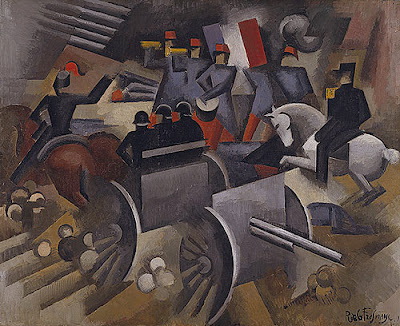
Image: Artillery, 1911. Roger de La Fresnaye. Metropolitan Museum, New York

In general I'm skeptical about the ability of the social sciences to offer predictions about future social developments. (In this respect I follow some of the instincts of Oskar Morgenstern in On the Accuracy of Economic Observations.) We have a hard time answering questions like these:
  • How much will the first installment of TARP improve the availability of credit within three months?
  • Will the introduction of UN peacekeeping units reduce ethnic killings in the Congo?
  • Will the introduction of small high schools improve student performance in Chicago?
  • Will China develop towards more democratic political institutions in the next twenty years?
  • Will American cities witness another round of race riots in the next twenty years?
However, the situation isn't entirely negative, and there certainly are some social situations for which we can offer predictions in at least a probabilistic form. Here are some examples:
  • The unemployment rate in Michigan will exceed 10% sometime in the next six months.
  • Coalition casualties in the Afghanistan war will be greater in 2009 than in 2008.
  • Illinois Governor Blogojevich will leave office within six months.
  • Germany will be the world leader in solar energy research by 2020 (link).
  • The Chinese government will act strategically to prevent emergence of regional independent labor organizations.
It is worth exploring the logic and function of prediction for a few lines. Fundamentally, it seems that prediction is related to the effort to forecast the effects of interventions, the trajectory of existing trends, and the likely strategies of powerful social actors. We often want to know what will be the net effect of introducing X into the social environment. (For example, what effect on economic development would result from a region's succeeding in increasing the high school graduation rate from 50% to 75%?) We may find it useful to project into the future some social trends that can be observed in the present. (Demographers' prediction that the United States will be a "majority-minority" population by 2042 falls in this category (link).) And we can often do quite a bit of rigorous reasoning about the likely actions of leaders, policy makers, and other powerful actors given what we know about their objectives and their beliefs. (We can try to forecast the outcome of the current impasse between Russia and Ukraine over natural gas by analyzing the strategic interests of both sets of decision-makers and the constraints to which they must respond.)

So the question is, what kinds of predictions can we make in the social realm? And what circumstances limit our ability to predict?

Predictions about social phenomena are based on a couple of basic modes of reasoning:
  • extrapolation of current trends
  • modeling of causal hypotheses about social mechanisms and structures
  • reasoning about strategic actions likely to be taken by actors
  • derivation of future states of a system from a set of laws
And predictions can be presented in a range of levels of precision, specificity, and confidence:
  • prediction of a single event or outcome: the selected social system will be in state X at time T.
  • prediction of the range within which a variable will fall: the selected social variable will fall within a range Q ±20%.
  • prediction of the range of outcome scenarios that are most likely: "Given current level of unrest, rebellion 60%, everyday resistance 30%, resolution 10%"
  • prediction of the direction of change: the variable of interest will increase/decrease over the specified time period
  • prediction of the distribution of properties over a group of events/outcomes. X percent of interventions will show improvement of variable Y.
Here are some particular obstacles to reliable predictions in the social realm:
  • unquantifiable causal hypotheses -- "small schools improve student performance". How large is the effect? How does it weigh in relation to other possible causal factors?
  • indeterminate interaction effects -- how will school policy changes interact with rising unemployment to jointly influence school attendance and performance?
  • open causal fields. What other currently unrecognized causal factors are in play?
  • the occurrence of unpredictable exogenous events or processes (outbreak of disease)
  • ceteris paribus conditions. These are frequently unsatisfied.
So where does all this leave us with respect to social predictions? A few points seem relatively clear.

Specific prediction of singular events and outcomes seems particularly difficult: the collapse of the Soviet Union, China's decision to cross the Yalu River in the Korean War, or the onset of the Great Depression were all surprises to the experts.

Projection of stable trends into the near future seems most defensible -- though of course we can give many examples of discontinuities in previously stable trends. Projection of trends over medium- and long-term is more uncertain -- given the likelihood of intervening changes of structure, behavior, and environment that will alter the trends over the extended time.

Predictions of limited social outcomes, couched in terms of a range of possibilities attached to estimates of probabilities and based on analysis of known causal and strategic processes, also appear defensible. The degree of confidence we can have in such predictions is limited by the possibility of unrecognized intervening causes and processes.

The idea of forecasting the total state of a social system given information about the current state of the system and a set of laws of change is entirely indefensible. This is unattainable; societies are not systems of variables linked by precise laws of transition.

Sunday, January 11, 2009

A better social ontology


I believe that the social sciences need to be framed out of consideration of a better understanding of the nature of the social—a better social ontology. The social world is not a system of law-governed processes; it is instead a mix of different sorts of institutions, forms of human behavior, natural and environmental constraints, and contingent events. The entities that make up the social world at a given time and place have no particular ontological stability; they do not fall into “natural kinds”; and there is no reason to expect deep similarity across a number of ostensibly similar institutions – states, for example, or labor unions. (W. V. O. Quine’s metaphor of the bushes shaped to look like elephants comes to mind here; Word and Object.)

So the rule for the social world is – heterogeneity, contingency, and plasticity. And the metaphysics associated with classical thinking about the natural world – laws of nature, common, unchanging structures, and predictable processes of change – do not provide appropriate metaphors for our understandings and expectations of the social world. Nor do they suggest the right kinds of social science theories and constructs.

Instead of naturalism, I suggest an approach to social science theorizing that emphasizes agency, contingency, and plasticity in the makeup of social facts. It recognizes that there is a degree of pattern in social life – but emphasizes that these patterns fall far short of the regularities associated with laws of nature. It emphasizes contingency of social processes and outcomes. It insists upon the importance and legitimacy of eclectic use of social theories: the processes are heterogeneous, and therefore it is appropriate to appeal to different types of social theories as we explain social processes. It emphasizes the importance of path-dependence in social outcomes. It suggests that the most valid scientific statements in the social sciences have to do with the discovery of concrete social-causal mechanisms, through which some types of social outcomes come about.

And finally, this approach highlights what I call “methodological localism”: the view that the foundation of social action and outcome is the local, socially-located and socially constructed individual person. The individual is socially constructed, in that her modes of behavior, thought, and reasoning are created through a specific set of prior social interactions. And her actions are socially situated, in the sense that they are responsive to the institutional setting in which she chooses to act. Purposive individuals, embodied with powers and constraints, pursue their goals in specific institutional settings; and regularities of social outcome often result.

How does this perspective fit with current work in the social sciences? There are several current fields of social research that are particularly well suited to this approach. One is the field of comparative historical sociology, in its use of fairly detailed studies of similar cases in order to identify common causal mechanisms. Kathleen Thelen’s astute studies of different institutions of skill formation in Germany, UK, US, and Japan are an excellent case in point; she asks the twin questions, what causal processes give stability to a set of institutions? And what causal processes lead to a process of transformation in those institutions? The research methods of comparative historical sociology, then, are particularly well suited to the ontology of contingency, plasticity, and causal mechanisms (How Institutions Evolve: The Political Economy of Skills in Germany, Britain, the United States, and Japan).

Ethnography gives us a different angle on this same ontology. Ethnographers can give us insight into culturally specific mentalities—the “socially constructed individuals”. And they can give concrete analysis of the institutions that both shape individuals and are in turn shaped by them. More generally, qualitative research methods can offer a basis for discovery of some of the features of agency, mentality, and culture within the context of which important social processes take place. A good current example is Leslie Salzinger's Genders in Production: Making Workers in Mexico's Global Factories, a study of the social construction of femininity in the factories of the maquiladoras. C. K. Lee's sociology of Chinese factory protests is also a model of a study that combines qualitative and quantitative methods; Against the Law: Labor Protests in China's Rustbelt and Sunbelt.

The new institutionalism is a third theoretical perspective on social analysis and explanation. This approach postulates the causal reality of institutions; it highlights the point that differences across institutions lead to substantial differences in behavior; and it provides a basis for explanations of various social outcomes. The rules of liability governing the predations of cattle in East Africa or Shasta County, California, create very different patterns of behavior in cattle owners and other land owners in the various settings. (Mary Brinton and Victor Nee, The New Institutionalism in Sociology; Jean Ensminger, Making a Market: The Institutional Transformation of an African Society.) It is characteristic of the new institutionalism that researchers in this tradition generally avoid reifying large social institutions and look instead at the more proximate and variable institutions within which people live and act.

What kind of social science research and theory corresponds to these assumptions about social ontology? Here are some chief features--
  • They make use of eclectic multiple theories and don't expect a unified social theory that explains everything
  • They are modest in their expectations about social generalizations
  • They look for causal mechanisms as a basis for social explanation
  • They anticipate heterogeneity and plasticity of social entities
  • They are prepared to use eclectic methodologies -- quantitative, comparative, case-study, ethnographic -- to discover the mechanisms and mentalities that underlie social change
We need a better sociology for the twenty-first century. If social scientists continue to be captivated by the scientific prestige of positivism and quantitative social science to the exclusion of other perspectives, they will be led to social science research that looks quite different from what would result from a view that emphasizes contingency and causal mechanisms. And if there are strong, engaging, and empirically rigorous examples of other ways of conducting social research that can come into broad exposure in the social sciences—then there is a greater probability of emergence of a genuinely innovative and imaginative approach to the problem of social knowledge.

Saturday, January 10, 2009

Social agency and rational choice


One of the reasons that rational choice theory (RC) is appealing is that it is an agent-centered approach to social explanation: explain the social outcome on the basis of an analysis of the beliefs, intentions, and circumstances of the individual agents who make up the social setting. What rational choice theory adds to this description is a specification of the decision-making processes that are attributed to the individual agent -- typically, that the agent has a consistent set of preferences among accessible alternatives and that he/she chooses in such a way as to maximize the satisfaction of this set of preferences. This can be paraphrased as a "utility-maximizing" model of decision-making.

Many objections have been offered against rational-choice theory as a basis for social explanation -- for example, that it overlooks social motivations, that it presupposes egoism, that it over-simplifies the logic of practical reasoning, or that it fails to correspond to typical human behavior. (See Green and Shapiro, Pathologies of Rational Choice Theory: A Critique of Applications in Political Science, for a developed set of critiques.)

Two points are worth underlining here. First, rational-choice theory has a major theoretical advantage precisely because it is an agent-centered framework. RC theory is one possible way of articulating a set of hypotheses about how individuals reason and act. This is a major advantage in comparison to explanatory frameworks that essentially assume programmed behavior on the part of participants in a social event. Moreover, the assumption of preference-satisfaction lines up pretty well with a somewhat broader conception of human action in terms of goal-directedness and purposiveness. If we believe that individuals have goals and purposes that underlie their choices and actions, then it is an appealing simplification to represent their actions as the outcome of deliberation about goals, strategies, and circumstances. In other words, RC theory can be seen as a specification of a philosophical idea of human action that is at least as old as Aristotle: the idea of individuals as deliberative, purposive agents. And this is in fact a credible and empirically defensible theory of action.

But a second point is equally important: RC theory and its model of utility maximization is only one out of a range of possible specifications of the idea of deliberation and purposiveness. There are important alternative specifications that can be offered. For example, we might say, along with Kant, that individuals possess a set of moral rules as well as a set of specific goals, and that they deliberate among possible choices of action on the basis of both considerations. How do the various possible actions conform to the moral rules? And how do they do from the point of view of accomplishing my goals? This process of reasoning is "deontological" -- that is, it cannot be subsumed under a simple model of maximizing rationality. It is, nonetheless, an intelligible interpretation of what rational human decision-making involves. (Mark Johnson's Moral Imagination: Implications of Cognitive Science for Ethics is interesting in its effort to bring cognitive science into dialogue with ethical theory.)

Another possible interpretation of the basic idea of deliberativeness that diverges from RC theory is one that illustrates some themes that Amartya Sen (On Ethics and Economics), James Scott (The Moral Economy of the Peasant: Rebellion and Subsistence in Southeast Asia), and Doug McAdam (Political Process and the Development of Black Insurgency, 1930 -1970) have emphasized: that real human social behavior is a complex mix of commitments, loyalties, emotions, solidarities -- as well as purposes and goals. So a theory of action that isolates "goal-directedness" and its associated framework of utility maximizing, is one that already overlooks a set of motivational factors that are crucial to explaining real social behavior. It is as if we imagined modeling wine-tasting judgments by experts but "erased" their sense of smell. Given that smell is a crucial ingredient of the experience of tasting wine, our reduced theory won't do a very good job of explaining discrimination across samples by the experts.

Instead, when we undertake to explain an individual's action in the context of a spontaneous rent strike, we need to ask a series of questions: what does he/she expect to get out of the action? What loyalties does he/she have to the organization or other participants? What principles does he/she endorse that are relevant to the context of proposed action? What forms of social identity does he/she embody, and how are these strands relevant to the decision to participate or not? How do the emotions created by the words and actions of others influence one's behavior?

What makes RC theory useful in spite of these complexities of actual motivation is the fact that there are many important situations of choice where other sources and structures of motivation are of minimal importance. When a person chooses a new toaster, it is likely enough that solidarity, emotion, principle, and identity drop away, and the choice is based on perceived value and price. So the market in toasters behaves pretty much as neoclassical economics predicts. But the market for shoes is probably more complicated: emotion, status, style, identity, and a preference for "fair-trade" products may influence one person to buy the more expensive and less functional pair of shoes, while another person will go for the good buy. Likewise, the decision to join AARP is likely to be a fairly simple calculation -- what are the side benefits of membership, how much importance do I attribute to being part of an organization that represents the public good of people over 50, and how much can I gain from there being a successful AARP? This is simple in comparison to the situation of a rent strike or a street demonstration, where one's face-to-face relations with other potential participants may have a very large impact on the decision to participate or not.

So we might say that RC theory represents a special case of the more general category of deliberative action, which is itself a sub-category of intentional action. And RC theory will be most successful in generating explanations in social circumstances where the other sources of social motivation are largely silent -- for example, anonymous market transactions, isolated decisions about participation or non-participation in collective action, and decisions about portfolio investments.

What we really need is a more developed and adequate theory of social agency -- a better account of how the various factors mentioned above fit together into one scheme of deliberation and decision-making. This might be called a full theory of practical rationality. And it would be a more general specification of the situation of agent-based social action than RC is able to provide.

Thursday, January 8, 2009

Economic history analyzed


The history of a region or people encompasses a multitude of aspects of social life: culture, religion, political institutions, social movements, environmental change, technology, population—and the circumstances and processes of economic change that the region undergoes. One does not need to be a reductionist in order to observe that the economic circumstances a society experiences, and the processes of change that these circumstances undergo, have a profound influence on other aspects of social and cultural change. Improved agricultural productivity can support population growth; it can enhance the coercive power of state institutions; and it can make possible the flourishing of intricate institutions of religion and education. Likewise, the constraints created by slow or negative economic productivity growth in a region can stifle the development of other important social processes. So economic history, as a discipline within history more broadly, is a crucially important field of historical inquiry.

Yet the foundations of the discipline of economic history are controversial. Economic historians do not yet agree on the role of mathematical economic theory within their discipline, or the relationships that should obtain between quantitative and qualitative data, or the role of social theories of causal factors in explaining economic change, or the connections that should be established between economic historical research and other fields of social or cultural history.

What is the intellectual task of an “economic history” of a region or country? To start, we might say that it is to provide an evidence-based description of the main economic characteristics of the country or region over a defined period of time: the kinds and levels of agricultural and manufacturing products that are produced, the technologies and institutions through which production and distribution occurs, the size of the population, and the level of material well-being that is experienced by the population. And, second, the task of economic history is to arrive at causal hypotheses that may serve as explanations of some of the patterns of economic change that are discovered.

Consider the variety of questions that need to be addressed by an economic history of a region or country:
  • Demography. What was the absolute population size and distribution at various time points during the period? What were the trends of population growth during the peri¬od? How much urbanization occurred during the period?
  • Inputs and technology. How much land was under cultivation? What crops and products were in production? What fertilizer technologies were in use? How much irrigation was available, and what was the trend of extension of land and irrigation?
  • Property relations and control of labor. What forms of tenancy and land ownership were in place? How were these arrangements changing during the time period? What forms of labor control were in use? Was there a tendency of change in the conditions and extent of wage labor?
  • Productivity. What was the absolute size of the production of central commodities—rice, wheat, cotton? What were the factor productivities for land, labor, capital, or animal power? What trends existed in these quantities?
  • Prices and market conditions. How much agricultural activity took place within functioning markets for crops, grain, textiles, and handicraft goods? What were the prices of these goods over time? How sensitive were farmers to changing market conditions?
  • Human welfare. What were the income levels and food security of various groups: landless workers, smallholding peasants, tenants and other groups? How extensive were income inequalities within the economy? Where were economic surpluses going? What was the trend of real welfare and inequalities?
  • Causal factors. What are the causal relationships that obtain between various large factors: technology, social relations, property systems, state, demographic regimes, and international relations?
Explanation requires a theory of underlying causal mechanisms. What theoretical resources are available to the economic historian to explain patterns and singularities of economic change? It is evident that economic outcomes are the result of human behavior within the context of environmental circumstances and institutional settings. Human behavior, however, is not rigidly segregated into “economic,” “cultural,” and “social” behavior; rather, behavioral outcomes are influenced by all these kinds of factors. So economic history cannot be restricted to the theories associated with neoclassical economics. Rather, the economic historian needs to examine the economic phenomena under study within the broader social and environmental context in which this behavior takes place. And that means that the economic historian must be as much a social historian, a sociologist, or an ethnographer as he is an economist; he needs to pay as much attention to the social and political context of economic trends as he does to the mathematics of equilibrium or the idealized workings of a market.

Marc Bloch’s history of medieval French agriculture (1931) offers a good illustration of the value of a broadly contextualized approach to a region’s economic history (French Rural History: An Essay on Its Basic Characteristics). Bloch surveys the main social institutions and technologies that were in use, and attempts to explain some of the large patterns that became evident (for example, field shape and the geographical diffusion of the wheeled plough). Bloch’s explanation invokes such varied factors as the nature of the soils across France, the availability and timing of technical innovations in the design of the plough, and the nature of village communities in different parts of France. And he makes ingenious use of a wide range of historical sources to permit him to come to assessments of various economic and institutional facts.

Well-developed social theories give us a basis for demonstrating how various factors could be causally relevant. It is then the task of empirical, historical, and theoretical research to arrive at justified conclusions about causation. But theories don't provide scripts for "necessary" processes of economic development. In fact, it is entirely possible that different combinations of causal factors are of primary importance in different historical settings. Historical change is conjunctural and contingent. The general point is that institutions and circumstances matter, and that institutional arrangements in different times and places may impose limits or opportunities that discourage or favor some pathways of development over others. Instead of expecting one grand course of development, we ought to expect a shifting fabric of contingent, fluctuating path-dependent processes.

Two current economic historians whose work I particularly admire are Bozhong Li, whose careful and deep empirical studies of the economic history of the lower Yangzi delta provide a foundation for a much more finegrained economic history of China (Agricultural Development in Jiangnan, 1620-1850, link); and Robert Allen, whose careful studies of the English farm economy and the standard of living in the early modern period are a paradigm of excellent empirical and analytical work in economic history (link, link).

(There is more on this topic on my research webpage, including Epistemological Issues in Economic History and Eurasian Historical Comparisons.)

Monday, January 5, 2009

Technology and culture

Photo: Charles Sheeler, "Power, wheels", 1939; MFA, Boston

Technology is sometimes thought of as a domain with a logic of its own -- an inevitable trend towards the development of the most efficient artifacts, given the potential represented by a novel scientific or technical insight. The most important shift that has occurred in the ways in which historians conceptualize the history of technology in the past thirty years is the clear recognition that technology is a social product, all the way down. And, as a corollary, historians of technology have increasingly come to recognize the deep contingency that characterizes the development of specific instances or families of technologies.

Thomas Hughes is one of the most important and prolific historians of technology of his generation. His most recent book, Human-Built World: How to Think about Technology and Culture, is well worth reading. It looks at "technology" from a very broad perspective and asks how this dimension of civilization has affected our cultures in the past two centuries. The twentieth-century city, for example, could not have existed without the inventions of electricity, steel buildings, elevators, railroads, and modern waste-treatment technologies. So technology "created" the modern city. But it is also clear that life in the twentieth-century city was transformative for the several generations of rural people who migrated to them. And the literature, art, values, and social consciousness of people in the twentieth century have surely been affected by these new technology systems.

This level of analysis stands at the most generic perspective: how does technology influence culture? (And perhaps, how does culture influence technology?) What Hughes has demonstrated in so much of his work, though, is the fact that the most interesting questions about the "technology-society" interface can be framed at a much more disaggregated level. Consider some of the connections he suggests in his earlier book on the history of electric power (Networks of Power: Electrification in Western Society, 1880-1930):
  • Invention (by individuals with a very specific educational and cultural background)
  • Concrete development of the artifacts within a laboratory (involving specific social relationships among various experts and workers)
  • "Selling" the innovation to municipal authorities (for lighting and traction) and to industrial capitalists (for power)
  • Finding investors and sources of finance for large capital investments in electricity
  • Building out the infrastructure for delivery of electric power
  • Government regulation of industry practices
  • Development of an extended research capability addressing technology problems
Each part of this complex story involves processes that are highly contingent and highly intertwined with social, economic, and political relationships. And the ultimate shape of the technology is the result of decisions and pressures exerted throughout the web of relationships through which the technology took shape. But here is an important point: there is no moment in this story where it is possible to put "technology" on one side and "social context" on the other. Instead, the technology and the society develop together.

Hughes also explores some of the ways in which the culture of the machine has influenced architecture, art, and literature. He discusses photography by Charles Sheeler (whose famous series on the Rouge plant defined an industrial aesthetic), artists Carl Grossberg and Marcel Duchamp, and architects such as Peter Behren. The central theme here is the idea that industrial-technological developments caused significant cultural change in Europe and America. Hughes's examples are mostly drawn from "high" culture; but historians of popular culture too have focused on the impact of technologies such as the railroad, the automobile, or the cigarette on American popular culture. See Deborah Clarke's Driving Women: Fiction and Automobile Culture in Twentieth-Century America for a discussion of the effect of automotive culture. And Pam Pennock's examination of the effects of alcohol and tobacco advertising on American culture in Advertising Sin And Sickness: The Politics of Alcohol And Tobacco Marketing, 1950-1990 is also relevant.

Hughes doesn't consider here the other line of influence that is possible between culture and technology: how prevailing aesthetic and cultural preferences influence the development of a technology. This has been an important theme in the line of interpretation referred to as the "social construction of technology" (SCOT). Wiebe Bijker makes the case for the social construction of mundane technologies such as bicycles in Of Bicycles, Bakelites, and Bulbs: Toward a Theory of Sociotechnical Change. And automobile historian Gijs Moms argues in The Electric Vehicle: Technology and Expectations in the Automobile Age that the choice between electric and internal combustion vehicles in the early twentieth century turned on aesthetic and lifestyle preferences rather than technical or economic efficiency. (Here is a nice short discussion of SCOT.) This too is a more disaggregated approach to the question. It proceeds on the idea that we can learn a great deal by examining the "micro" processes in culture and society that influence the development of a technology.

It seems to me that the conceptual framework of "assemblages theory" would be useful in discussing the history of technology. (See Manuel DeLanda's A New Philosophy of Society: Assemblage Theory And Social Complexity for a review of the theory, and Nick Srnicek's blog at accursedshare, which makes frequent use of the framework.) The framework is useful here because technology is a social phenomenon that extends from one's own kitchen and household to the cities of Chicago or Berlin, to the global internet and the international system of manufacturing and design. And similar processes of shaping and conditioning occur at the micro, meso, and macro levels. In other words -- perhaps we can understand "technology" at the molar level, as a complex composition of activities and processes at many levels closer to the socially constructed individual. And the value-added provided by the sociology and history of technology is precisely this: to shed light on the mechanisms at work at all levels that have an influence on the aggregate direction and shape of the resulting technology.

Since we're thinking about "technology and culture" -- it's worth noting that Technology and Culture is the world's leading journal for the history of technology, emanating from the Society for the History of Technology (SHOT, established in 1958). The journal has played a significant role in the definition of the discipline over the past thirty years or so and is an outstanding source for anyone interested in the questions posed here.

Friday, January 2, 2009

Applied philosophy of history


The philosophy of history is difficult to classify. Should we think of it in analogy with the philosophy of physics or economics -- essentially a careful analysis of the modes of research and inference used within an empirical discipline? Or should we think of it in analogy with the philosophy of nature or the philosophy of technology -- essentially an effort to use constructive philosophical methods to attempt to discover important features of the object of study (nature or technology)? The former approach makes the philosophical study a sort of high-level methodology critique, while the latter makes it more of an effort at old-fashioned metaphysics. Hegel's philosophy of history falls in the latter category, while twentieth-century analytic treatments of historical explanation fall in the former category (Hempel, Danto).

In the case of history the distinction also parallels the ambiguity between two meanings of "history": an organized body of knowledge about the past versus the totality of events and processes that have unfolded over time -- history as knowledge versus history as substantive happenings.

So we might say that there are two divergent starting points for a philosophy of history: How do we know and explain the past? And what are the nature and dynamics of historical reality? And philosophers interested in one of these questions are unlikely to be interested in the other. The analytic philosopher who pursues the epistemological questions is likely to believe that philosophy simply and categorically lacks a basis for discovering apriori truths about the external world; substantive metaphysics is not possible. And the philosopher like Hegel or Ricoeur who believes the important questions about history are the substantive ones, is likely to be impatient with a purely analytic and epistemic approach.

It is time for philosophers to take a fresh look at the issues raised by history in all its facets. We need some new approaches to the philosophy of history. And this suggests that we need to get beyond the dichotomy between analytic and substantive approaches to the problems. Fortunately, there seems to be ample intellectual space for us to do so. And many of the challenging "new" questions for the philosophy of history cross over the distinction between epistemology and metaphysics.

Take for example the problem of providing a more adequate treatment of concepts that are often taken for granted in historical discourse: e.g. structure, mentality, class, event, or revolution. Each of these concepts raises problems that philosophers can help to address. The twin problems of disaggregation and reification arise in each instance. What is a historical structure such as "the fiscal system of the ancien regime" composed of? What errors are we led to by asserting things like "the Revolution in the west was less about economic interests and more about local political competition"? What do we need to provide as foundation if we want to refer to the "artisanal mentality of Parisian workers"? In each instance there is a productive space in which the philosopher and the working historian can arrive at a deeper and more adequate conceptual scheme in terms of which to analyze the historical reality under consideration. And it is worth noticing that this work is not purely analytical; it is also substantive, in the sense that it is shedding new light on real historical phenomena. We might describe this work as falling in the domain of substantive historical ontology.

Or think about the potential value of a philosopher's reflections on the range of ways in which talented historians frame their results: Albert Soboul's methodical exposition of the meso-level class identities and interests of the groups contending in 1789 (A Short History of the French Revolution, 1789-1799), Simon Schama's discontinuous exposition of elements of European history around the theme of landscapes (Landscape And Memory), Philip Kuhn's exposition of the cultural-emotional climate of late Imperial China through the lens of a witchcraft scare (Soulstealers: The Chinese Sorcery Scare of 1768). To what extent do these choices about exposition and framework inflect upon the substantive historical findings? How does Peter Perdue's shift of focus from Ming-Qing China to the shifting power relationships in central Asia between Russia, China, and the Mongol empire change our perspective on Chinese diplomacy and warcraft (China Marches West: The Qing Conquest of Central Eurasia)? The philosophical work to be done here is analytical; but it is also illuminating and progressive, in the sense that it lays the basis for a better understanding of the relationship between the historian and the historical domain under scrutiny.

These examples suggest a third possible starting point for the new philosophy of history: what are some of the core historical concepts that enter into good examples of historical writing and thinking, and what kinds of puzzles and presuppositions do these concepts bring with them? And what can we discover about historical explanation and knowledge by carefully observing the work of talented, innovative historians?

One thing seems clear from this last formulation: the philosopher needs to formulate topics and problems in close proximity to the historical research of talented historians. In this respect it seems right to regard the philosophy of history as an "applied" field. In this way the philosopher avoids the hazard of a uselessly apriori approach to the philosophical study of history. And it suggests yet another way of bridging the divide between analytic and substantive knowledge-building in the philosophy of history: by establishing close and mutually insightful partnerships between philosophers and historians.

 
Design by Free Wordpress Themes | Bloggerized by Lasantha - Premium Blogger Templates