Monday, April 19, 2010

Ideal types, values, and selectivity


I've never really understood why the exposition of one of Max Weber's most important methodological ideas, his theory of ideal types, occurs in the context of an essay that is primarily about the role of values in the social sciences.  This is his essay, "'Objectivity' in Social Science and Social Policy" in The Methodology of The Social Sciences.  The central thrust of the essay is to attempt to spell out the ways that objectivity and truth relate to partisanship and values within the course of social science research and teaching.  And Weber draws a sharp distinction between what can be known and demonstrated (empirical facts and causal relationships) and what can be internally tested for consistency but not demonstrated (fundamental value commitments).  Here is how Weber puts the point early in the essay:
What has been the meaning of the value-judgments found in the pages of the Archiv regarding legislative and administrative measures, or practical recommendations for such measures? What are the standards governing these judgments?  What is the validity of the value-judgments which are uttered by the critic, for instance, or on which a writer recommending a policy founds his arguments for that policy?  In what sense, if the criterion of scientific knowledge is to be found in the "objective" validity of its results, has he remained within the sphere of scientific discussion? We will first present our own attitude on this question in order later to deal with the broader one: in what sense are there in general "objectively valid truths" in those disciplines concerned with social and cultural phenomena? (50-51)
The theory of ideal types is an important contribution to the specification of the nature of concepts in the human and historical sciences.  But why is this subject particularly relevant in the context of a discussion of values and social policy?

One reason for the conjoining of ideal types and values is the unavoidable fact of selectivity in the social sciences.  Weber makes the point repeatedly in this essay that there is an infinite depth to social phenomena -- even to a single phenomenon or event -- and therefore it is necessary to select a finite representation of the object of study if we want to approach a problem scientifically.  But how do we select a specific aspect of a phenomenon for study?  We do so on the basis of a judgment of what aspects are important -- and this is a value judgment, either directly or indirectly.  In a very specific sense, our interests (material and intellectual) guide the formation of our social-science research projects.  "The quality of an event as a 'social-economic' event is not something which it possesses 'objectively.' It is rather conditioned by the orientation of our cognitive interest, as it arises from the specific cultural significance which we attribute to the particular event in a given case" (64).  And a few pages later: "Social economic problems do not exist everywhere that an economic event plays a role as cause or effect -- since problems arise only where the significance of those factors is problematical and can be precisely determined only through the application of the methods of social-economics" (66).

Or in other words: what constitutes an economic situation as a "problem" is the fact that it has consequences that intersect with things we care about -- or our fundamental scheme of values.  So the subject matter of "social-economics" is doubly dependent on our interests: our cognitive interests in how things work, and our practical interests in how to promote "good" outcomes and avoid "bad" outcomes.

This is where the issue moves into connection with the theory of ideal types.  Weber makes it clear that he regards the formulation of a scientific research topic as being generated by a set of interests -- cognitive and practical.  And this is where the idea of an ideal type is relevant.  Because an ideal type is a selective, one-sided representation of an aspect of social life.  Here is the foundational description that Weber offers in conjunction with the idea of a "commodity-market":
This conceptual pattern brings together certain relationships and events of historical life into a complex, which is conceived as an internally consistent system.  Substantively, this construct is itself like a utopia which has been arrived at by the analytical accentuation of certain elements of reality.  Its relationship to the empirical data consists solely in the fact that where market-conditioned relationships of the type referred to by the abstract construct are discovered or suspected to exist in reality to some extent, we can make the characteristic features of this relationship pragmatically clear and understandable by reference to an ideal-type.  It is not a description of reality but it aims to give unambiguous means of expression to such a description.  It is thus the "idea" of the historically given modern society, based on an exchange economy, which is developed for us by quite the same logical principles as are used in constructing the idea of the medieval "city economy" as a "genetic" concept. ... An ideal type is formed by the one-sided accentuation of one or more points of view and by the synthesis of a great many diffuse, discrete, more or less present and occasionally absent concrete individual phenomena, which are arranged according to those one-sidedly emphasized viewpoints into a unified analytical construct. In its conceptual purity, this mental construct cannot be found empirically anywhere in reality. (90)
This specification of the concept of an ideal type links back to Weber's discussion of the value of specialization in the social sciences: "the justification of the one-sided analysis of cultural reality from specific 'points of view' -- in our case with respect to its economic conditioning -- emerges purely as a technical expedient from the fact that training in the observation of the effects of qualitatively similar categories of causes and the repeated utilization of the same scheme of concepts and hypotheses offers all the advantages of the division of labor" (71).  In other words, the specialization of research methods and training that is implied by the establishment of disciplines in the social sciences is justified pragmatically rather than epistemically -- it is the practical advantage in research productivity rather than the nature of the social world that justifies the establishment of disciplines.
There is no absolutely "objective" scientific analysis of culture -- or put perhaps more narrowly but certainly not essentially differently for our purposes -- of "social phenomena" independent of special and "one-sided" viewpoints according to which -- expressly or tacitly, consciously or unconsciously -- they are selected, analyzed and organized for expository purposes. (72)
This locates the role and justification of the "ideal type" very precisely.  An ideal type -- of a market economy, of a university, or of a banking institution -- creates a selective model of social organization that can then be explored analytically and empirically by specialists.  The ideal type is not intended to be a general representation of a category of phenomena; but rather as a heuristic model that permits exploration and extension of some of the characteristics of the concrete social institutions and behaviors that it partially represents.

Throughout this discussion is woven the methodological debate between advocates of nomothetic and idiographic interpretations of the social sciences (link).  Weber indicates his own understanding of the crucial importance of the individuality and particularity of historical phenomena -- without abandoning the viability of discovering limited generalizations and regularities.
Laws are important and valuable in the exact natural sciences, in the measure that those sciences are universally valid.  For the knowledge of historical phenomena in their concreteness, the most general laws, because they are most devoid of content are also the least valuable.  The more comprehensive the validity -- or scope -- of a term, the more it leads us away from the richness of reality since in order to include the common elements of the largest possible number of phenomena, it must necessarily be as abstract as possible and hence devoid of content.  In the cultural sciences, the knowledge of the universal or general is never valuable in itself. (80)
Here again, the historically detailed ideal type is a better basis for historical and social analysis.

Here is one additional qualification that Weber offers that is very important to his understanding of social-scientific knowledge:
We have designated as "cultural sciences" those disciplines which analyze the phenomena of life in terms of their cultural significance.  The significance of a configuration of cultural phenomena and the basis of this significance cannot however be derived and rendered intelligible by a system of analytical laws, however perfect it may be, since the significance of cultural events presupposes a value-orientation towards these events.  The concept of culture is a value-concept. (76)
This makes a final important connection between the two themes of the essay, objectivity and values.  Values come into the social science at the stage of defining and examining social-economic-cultural problems; they come into the choice of subject matter by establishing the framework in terms of which a phenomenon is a "problem"; and they must be invoked in our interpretations of the phenomena when we attribute cultural meanings to the participants.  The construct of the ideal type provides conceptual resources for each of these zones of intersection between social-science inquiry and the schemes of values that we humans endorse.

Friday, April 16, 2010

Feyerabend as artisanal scientist


I've generally found Paul Feyerabend's position on science to be a bit too extreme. Here is one provocative statement in the analytical index of Against Method:
Thus science is much closer to myth than a scientific philosophy is prepared to admit. It is one of the any forms of thought that have been developed by man, and not necessarily the best. It is conspicuous, noisy, and impudent, but it is inherently superior only for those who have already decided in favour of a certain ideology, or who have accepted it without having ever examined its advantages and its limits. And as the accepting and rejecting of ideologies should be left to the individual it follows that the separation of state and church must be supplemented by the separation of state and science, that most recent, most aggressive, and most dogmatic religious institution. Such a separation may be our only chance to achieve a humanity we are capable of, but have never fully realised.
Fundamentally my objection is that Feyerabend seems to leave no room at all for rationality in science: no scientific method, no grip for observation, and no force to scientific reasoning. A cartoon takeaway from his work is a slogan: science is just another language game, a rhetorical system, with no claim to rational force based on empirical study and reasoning.  Feyerabend seems to be the ultimate voice for the idea of relativism in knowledge systems -- much as Klamer and McCloskey seemed to argue with regard to economic theory in The Consequences of Economic Rhetoric.

This isn't a baseless misreading of Feyerabend. In fact, it isn't a bad paraphrase of Against Method. But it isn't the whole story either.  And at bottom, I don't think it is accurate to say that Feyerabend rejects the idea of scientific rationality.  Rather, he rejects one common interpretation of that notion: the view that scientific rationality can be reduced to a set of universal canons of investigation and justification, and that there is a neutral and universal set of standards of inference that decisively guide choice of scientific theories and hypotheses.  So I think it is better to understand Feyerabend as presenting an argument against a certain view in the philosophy of science rather than against science itself.

Instead, I now want to understand Feyerabend as holding something like this: that there is "reasoning" in scientific research, and this reasoning has a degree of rational credibility.  However, the reasoning that scientists do is always contextual and skilled, rather than universal and mechanical.  And it doesn't result in proofs and demonstrations, but rather a preponderance of reasons favoring one interpretation rather than another.  (Significantly, this approach to scientific justification sounds a bit like the view argued about sociological theories in an earlier posting.)

Here are a few reasons for thinking that Feyerabend endorses some notion of scientific rationality.

First, Feyerabend is a philosopher and historian of science who himself demonstrates a great deal of respect for empirical and historical detail.  The facts matter to Feyerabend, in his interpretation of the history of science.  He establishes his negative case with painstaking attention to the details of the history of science -- Newton, optics, quantum mechanics. This is itself a kind of empirical reasoning about the actual intellectual practices of working scientists. But if Feyerabend were genuinely skeptical of the enterprise of offering evidence in favor of claims, this work would be pointless.

Second, his own exposition of several scientific debates demonstrates a realist's commitment to the issues at stake. Take his discussion of the micro-mechanisms of reflection and light "rays". If there were in principle no way of evaluating alternative theories of these mechanisms, it would be pointless to consider the question. But actually, Feyerabend seems to reason on the assumption that one theory is better than another, given the preponderance of reasons provided by macro-observations and mathematical-physical specification of the hypotheses.

Third, he takes a moderate view on the relation between empirical observation and scientific theory in "How to Be a Good Empiricist":
The final reply to the question put in the title is therefore as follows. A good empiricist will not rest content with the theory that is in the centre of attention and with those tests of the theory which can be carried out in a direct manner. Knowing that the most fundamental and the most general criticism is the criticism produced with the help of alternatives, he will try to invent such alternatives. (102)
This passage is "moderate" in a specific sense: it doesn't give absolute priority to a given range of empirical facts; but neither does it dismiss the conditional epistemic weight of a body of observation.

So as a historian of science, Feyerabend seems to have no hesitation himself to engage in empirical reasoning and persuading, and he seems to grant a degree of locally compelling reasoning in the context of specific physical disputes.  And he appears to presuppose a degree of epistemic importance -- always contestable -- for a body of scientific observation and discovery.

What he seems most antagonistic to is the positivistic idea of a universal scientific method -- a set of formally specified rules that guide research and the evaluation of theories. Here is how he puts the point in "On the Limited Validity of Methodological Rules" (collected in Knowledge, Science and Relativism). 
It is indubitable that the application of clear, well-defined, and above all 'rational' rules occasionally leads to results. A vast number of discoveries owe their existence to the systematic procedures of their discoverers. But from that, it does not follow that there are rules which must be obeyed for every cognitive act and every scientific investigation. On the contrary, it is totally improbable that there is such a system of rules, such a logic of scientific discovery, which permeates all reasoning without obstructing it in any way. The world in which we live is very complex. Its laws do not lay open to us, rather they present themselves in diverse disguises (astronomy, atomic physics, theology, psychology, physiology, and the like). Countless prejudices find their way into every scientific action, making them possible in the first place. It is thus to be expected that every rule, even the most 'fundamental', will only be successful in a limited domain, and that the forced application of the rule outside of its domain must obstruct research and perhaps even bring it to stagnation. This will be illustrated by the following examples. (138)
It is the attainability of a universal, formal philosophy of science that irritates him. Instead, he seems to basically be advocating for a limited and conditioned form of local rationality -- not a set of universal maxims but a set of variable but locally justifiable practices. The scientist is an artisan rather than a machinist.  Here is a passage from the concluding chapter of Against Method:
The idea that science can, and should, be run according to fixed and universal rules, is both unrealistic and pernicious. It is unrealistic, for it takes too simple a view of the talents of man and of the circumstances which encourage, or cause, their development. And it is pernicious, for the attempt to enforce the rules is bound to increase our professional qualifications at the expense of our humanity. In addition, the idea is detrimental to science, for it neglects the complex physical and historical conditions which influence scientific change. It makes our science less adaptable and more dogmatic: every methodological rule is associated with cosmological assumptions, so that using the rule we take it for granted that the assumptions are correct. Naive falsificationism takes it for granted that the laws of nature are manifest and not hidden beneath disturbances of considerable magnitude. Empiricism takes it for granted that sense experience is a better mirror of the world than pure thought. Praise of argument takes it for granted that the artifices of Reason give better results than the unchecked play of our emotions. Such assumptions may be perfectly plausible and even true. Still, one should occasionally put them to a test. Putting them to a test means that we stop using the methodology associated with them, start doing science in a different way and see what happens. Case studies such as those reported in the preceding chapters show that such tests occur all the time, and that they speak against the universal validity of any rule. All methodologies have their limitations and the only 'rule' that survives is 'anything goes'.
His most basic conclusion is epistemic anarchism, expressed in the "anything goes" slogan, but without the apparent relativism suggested by the phrase: there is no "organon," no "inductive logic," and no "Scientific Method" that guides the creation and validation of science.  But scientists do often succeed in learning and defending important truths about nature nonetheless.

(Here is an online version of the analytical contents and concluding chapter of Against Method.  And here is a link to an article by John Preston on Feyerabend in the Stanford Encyclopedia of Philosophy.)

Wednesday, April 14, 2010

Marx on Russia


In 1881 Marx wrote a letter to Vera Zasulich, an important Russian follower, that addresses the question of theory and prediction when it comes to thinking about the future course of history.  In particular, he denies that his theories have determinate predictive implications for the development of capitalism or socialism in Russia.  Here is a link to the letter, and below are a few paragraphs.

The issue is an important one: did Marx think of his body of knowledge as constituting a general predictive theory?  And the letter clearly implies that he did not.

The letter is interesting in several respects. First, it explicitly rejects the notion that Marx's economic and historical theories are suited to the task of identifying the necessary or inevitable course of historical development. It summarily dismisses the idea of a necessary sequence of modes of production. Instead, Marx shows himself to recognize the contingency that exists in historical development, as well as the degree to which history creates new conditions in its course that influence future developments.

The other important feature of the letter is its substantive analysis of the material characteristics of the Russian peasant commune, and the potential that this social form has for constituting the material core of an alternative route to socialism in Russia.  As the letter makes clear, Marx thinks that the social relations associated with the peasant commune provide a possible social foundation for a modern socialist economy; and this would be an economy that was not "post-capitalist" but nonetheless technologically and socially advanced.

In a way Marx's argument anticipates the theory of "late developers" -- for example, Gerschenkron's Economic Backwardness in Historical Perspective.  Marx argues that a socialism in Russia was possible through an alternative pathway.  A version of socialism in Russia based on the "archaic" commune can take advantage of the developments in technology and social organization created by advanced capitalism.  It is not necessary for Russian society to go throughout the several-centuries long process of agricultural and technological modernization that England underwent; rather, Russia can simply adopt the modern technologies now available.

The interest of this letter is not to be found in the historical predictions it makes, but rather in the example it offers of the way that Marx's mind worked.  The reasoning here represents a good example of Marx's materialist approach to history.  He wants to arrive at a fairly detailed level of understanding of the social and economic relations -- the property relations -- that constituted a historical form of the rural commune.  And he then seeks to provide an analysis of the way in which those relations might be expected to develop under a specific set of historical circumstances.  And key within this analysis is the workings of the specific form of property that corresponded to this social system -- the social relations of production.

I suppose the letter illustrates something else as well: Marx's interest at the end of his life in finding an alternative pathway to socialism.  The revolutions of 1848 were long in the past, and a proletarian revolution had not ensued.  The Paris Commune had been decisively and violently repressed in 1871.  Working-class militancy was not propitious in the advanced capitalist countries -- France, Germany, or Britain.  So the prospects of revolution in the advanced capitalist world were not encouraging to Marx.  And so finding some hope for an alternative process of social development through which the ends of socialism might be achieved was an appealing prospect for Marx.

Here are the first few paragraphs of the letter, which is worth reading in full:
1) In dealing with the genesis of capitalist production I stated that it is founded on “the complete separation of the producer from the means of production” (p. 315, column 1, French edition of Capital) and that “the basis of this whole development is the expropriation of the agricultural producer. To date this has not been accomplished in a radical fashion anywhere except in England... But all the other countries of Western Europe are undergoing the same process” (1.c., column II).
I thus expressly limited the “historical inevitability” of this process to the countries of Western Europe. And why? Be so kind as to compare Chapter XXXII, where it says:
The “process of elimination transforming individualised and scattered means of production into socially concentrated means of production, of the pigmy property of the many into the huge property of the few, this painful and fearful expropriation of the working people, forms the origin, the genesis of capital... Private property, based on personal labour ... will be supplanted by capitalist private property, based on the exploitation of the labour of others, on wage labour” (p. 341, column II).
Thus, in the final analysis, it is a question of the transformation of one form of private property into another form of private property. Since the land in the hands of the Russian peasants has never been their private property, how could this development be applicable?
2) From the historical point of view the only serious argument put forward in favour of the fatal dissolution of the Russian peasants’ commune is this: By going back a long way communal property of a more or less archaic type may be found throughout Western Europe; everywhere it has disappeared with increasing social progress. Why should it be able to escape the same fate in Russia alone? I reply: because in Russia, thanks to a unique combination of circumstances, the rural commune, still established on a nationwide scale, may gradually detach itself from its primitive features and develop directly as an element of collective production on a nationwide scale. It is precisely thanks to its contemporaneity with capitalist production that it may appropriate the latter’s positive acquisitions without experiencing all its frightful misfortunes. Russia does not live in isolation from the modern world; neither is it the prey of a foreign invader like the East Indies.
And here is an important summary statement:
Theoretically speaking, then, the Russian “rural commune” can preserve itself by developing its basis, the common ownership of land, and by eliminating the principle of private property which it also implies; it can become a direct point of departure for the economic system towards which modern society tends; it can turn over a new leaf without beginning by committing suicide; it can gain possession of the fruits with which capitalist production has enriched mankind, without passing through the capitalist regime, a regime which, considered solely from the point of view of its possible duration hardly counts in the life of society. But we must descend from pure theory to the Russian reality.
There is a major irony in rereading Marx's analysis of the emancipatory possibilities inherent in the social form of the "peasant commune" in Russia.  Most striking is the experience of the collectivization of Soviet agriculture in the 1920s and Stalin's war on the kulaks.  Rather than representing a bright new future for the peasants, collectivization represented a cruel war by starvation against rural society (Lynne Viola, The War Against the Peasantry, 1927-1930: The Tragedy of the Soviet Countryside, Volume one (Annals of Communism Series) (v. 1)).

It is also also interesting to recall that one of the disputes among the Bolsheviks within Soviet leadership in the 1920s and 1930s was the issue of cooperatives in agriculture.  A. V. Chayanov advocated for a more democratic route to Soviet socialism, through the mechanism of locally established rural cooperatives (link).  His reasoning had quite a bit in common with Marx's analysis in this letter to Vera Zasulich; and, of course, it led to his persecution and execution in 1937.

Friday, April 9, 2010

Trust networks


Chuck Tilly had a fascination with the mechanisms of social interaction at all levels.  His 2005 book, Trust and Rule, picks up on one particular feature of social organization that is often instrumental in political and social episodes, including especially in the everyday workings of predation and defense.  This is the idea of a trust network: a group of people connected by similar ties and interests whose "collective enterprise is at risk to the malfeasance, mistakes, and failures of individual members" (chapter 1, kindle loc 186). Here is a definition:
Trust networks, then, consist of ramified interpersonal connections, consisting mainly of strong ties, within which people set valued, consequential, long-term resources and enterprises at risk to the malfeasance, mistakes, or failures of others. (chapter 1, kindle loc 336)
A band of pirates, a group of tax resisters, or a village of non-conformists in a period of religious persecution fall in the category of trust networks.  The stakes are high for all participants.  On the other hand, the American Medical Association, the League of Women Voters, and the pickpockets who work the Gare St Lazare train station do not represent trust networks, though they have the properties of social action networks more generally.  There is little real risk for any particular physician even if other members of the AMA don't play their parts in a lobbying campaign.  The willingness of members of the extended group to commit their own actions to a risky common effort depends on their level of trust in other members -- trust that they will make their own contributions to the collective enterprise, and trust that they will not betray their comrades.  (French historian Marc Bloch belonged to a trust network, the French Resistance, that led to his death in 1944 by the Gestapo; link.)

The general idea is that there are numerous examples of networks of people who share substantial interests in common, and who have a high level of trust in one another that permits them to undertake risky joint activities.  Here is a more complete statement of Tilly's conception:
How will we recognize a trust network when we encounter or enter one?  First, we will notice a number of people who are connected, directly or indirectly, by similar ties; they form a network.  Second, we will see that the sheer existence of such a tie gives one member significant claims on the attention or aid of another; the network consists of strong ties.  Third, we will discover that members of the network are collectively carrying on major long-term enterprises such as procreation, long-distance trade, workers' mutual aid or practice of an underground religion.  Finally, we will learn that the configuration of ties within the network sets the collective enterprise at risk to the malfeasance, mistakes, and failures of individual members. (chapter 1, kindle loc 186)
Trust networks are particularly relevant in the context of efforts at violent extraction and domination -- both on the side of predators and prey.  Predators -- bandits, pirates, and gangs -- need to establish strong ties within their organizations in order to be able to effectively coerce their targets and to escape repression by others.  And prey -- farmers in ranch country, rural Jews in Poland, or home owners in central Newark -- are advantaged by the existence of strong ties of family, religion, or ethnicity through which they can maintain the collective strategies that provide some degree of protection.  But Tilly makes the interesting point that the workings of trust networks cross over both contentious and noncontentious activities.  Here is a general statement that frames much of Tilly's discussion in the book:
Noncontentious politics still make up the bulk of all political interaction, since it includes tax collection, census taking, military service, diffusion of political information, processing of government-mediated benefits, internal organizational activity of constituted political actors, and related processes that go on most of the time without discontinous, public, collective claim making.  Trust networks and their segments get involved in noncontentious politics more regularly -- and usually more consequently -- than in contentious politics. (chapter 1, Kindle loc 208) 
The idea of a trust network represents a different way of getting a handle on the contrast between self-interested agency and group-oriented agency, which in turn corresponds to "economistic" and "sociological" approaches to social behavior.  Is it interests or norms that guide social behavior?  By introducing the idea of a trust network, Tilly is able to find a position someplace else on the spectrum -- neither purely self-interested behavior nor routine normative conformance.  Instead, agents within trust networks behave as purposive, goal-directed actors; but they have commitments and resources that people in other social settings lack, and they are thereby enabled to achieve forms of collective action that are impossible elsewhere.  We might say that Tilly is offering an account of the microfoundations of collective action, or of a certain kind of collective action.

In line with Tilly's lifelong interest in taxation and state-building, the idea of resource extraction plays a central role in his analysis of trust networks.  A central theme is the struggle between the tax-collecting state and the elusive, tax-evading trust networks that exist in civil society.  "Rulers have usually coveted the resources embedded in such networks, have often treated them as obstacles to effective rule, yet have never succeeded in annihilating them and have usually worked out accommodations producing enough resources and compliance to sustain their regimes" (kindle loc 229).

It is interesting to connect this dialectic of predation and evasion with the arguments Jim Scott puts forward in The Art of Not Being Governed: An Anarchist History of Upland Southeast Asia (link).  Part of the effectiveness of the highland peoples of Burma in Scott's account is the density of their social relationships and a consequent ability to sustain a degree of collective resistance that would be impossible in a less dense society.  And, in fact, Tilly's analysis of the tactical situation of a trust network subject to the superior coercive power of some other entity is enlightening in Scott's story as well.  Consider these avenues that Tilly advances as collective strategies for protecting a given trust network against the pressures of the surrounding state: concealment, dissimulation, clientage, predation, enlistment into the regime, bargaining, and dissolution (chapter 2, kindle loc 794).  We can find examples of each of these strategies in Scott's analysis of Burma.  More pointedly, we can see instances of almost all these strategies in the current conflicts between the Burmese junta and the cease-fire groups such as the Kachin Independence Organization (link, link).

So what kind of analysis is Tilly offering here?  What is the use of this concept from the point of view of the social sciences, beyond the metaphor and analytical specifics? Are there concrete historical or sociological hypotheses in play?  Does this concept provide a better basis for explaining some puzzling outcomes than existing theories?  Or, possibly, is the concept of a trust network another example of a part of the sociologist's toolkit: an ideal-typical description of a real social mechanism whose workings can be discerned in a variety of contexts?

Tilly is relatively explicit about several of these questions.  To start: he does not believe that "trust networks" constitute a homogeneous social kind.  We cannot offer a general account of the essential features of a trust network (kindle loc 823).  We can do a certain amount of classification within the group of social configurations that we call "trust networks".  So "trust networks" are socially real, and we can use ordinary methods of social and historical inquiry to map out some of their properties.

Further, he believes, we can state some mid-level regularities about trust networks and political regimes: for example,
  • Trust networks survive and hold off predators when they generate enough resources to reproduce themselves;
  •  trust networks are absorbed into systems of rule when existing autonomous trust networks disintegrate or cease to provide substantial benefits; 
  • variations in the kinds of trust networks that exist help explain the variety of the consolidation of rule that occurs in given settings. (loc 1096)
  • trust networks that mark, maintain, and monitor sharp boundaries between insiders and outsiders generally operate more effectively than others (loc 1238)
  • trust networks most commonly defend themselves from predation by adopting some combination of the strategies of concealment, clientage, and dissimulation (loc 1724)
Another important question is the role of evidence in this treatment.  Tilly offers dozens of examples of significant historical instances of trust networks at work -- as predators, as prey, and as potential subjects of extractive rule.  And we can ask this question: what is the evidentiary value of the examples?  Are they merely illustrative?  Do they serve to pinpoint some of the specifics of discrete social mechanisms?  Or are they more like suggestive heuristic cases that may point us in the direction of a more developed theory?

I think that Tilly's view would be something close to the second option here: the examples are valuable and insightful because they provide relatively transparent instances in which the mechanisms are fully exposed. They are a bit like the observations of "animalcules" through van Leeuwenhoek's microscope: glimpses of an underlying mechanism that proves to be an important constituent of more macro-level processes.

At the same time, the analysis doesn't add up to a "theory" of trust networks; it is more analogous to descriptive ecology than it is to the theory of the gene.  When Darwin documents the variety of finches in the Galapagos Islands, or when Wallace painstakingly describes the myriad distinct species of beetles he finds in the jungles of the Malay archipelago, each is involved in a kind of scientific work that stands between pure description and explanatory theorizing.  And this seems to be roughly where Tilly's dissection of trust networks falls as well.

It is also interesting to consider whether there are important examples of trust networks in the world today.  And it seems clear that there are.  The situation of the ethnic movements in contemporary Burma is one good example.  Domestic terror groups and right-wing militias provide another clear set of examples.  The American Civil Rights movement, the Freedom Riders, and SNCC's organizing efforts offer another good set of examples as well (link).  So the concept of a trust network is in fact a valuable contribution to the study of collective action and social mobilization.

Tuesday, April 6, 2010

Teaching philosophy


What is it that we expect students to learn when we teach philosophy? Is philosophy an arcane and charmingly useless vestige of a nineteenth-century university education?  Or does it have something crucial to add to the liberal education of the twenty-first century -- whether in the arts and sciences or in pre-professional schools?

Philosophers would probably answer this question in a wide variety of ways.  In my own case, I have several high-level goals in mind when I approach a new group of undergraduate students in philosophy.  I hope to help them to develop in several ways:
  • to gain a set of intellectual skills: analysis, reasoning, clarity of thinking and exposition, open-mindedness and a readiness to try to see a problem from multiple points of view
  • to learn some of the developed approaches to "philosophical" problems: knowledge, ethical behavior, individual rights, social justice, the authority of the state, the nature of rationality, the meaning of human life
  • to gain an engaged involvement in some great thinkers and their theories and reasoning in detail
  • to gain some meaningful acquaintance with some important philosophical theories (utilitarianism, empiricism, mind-body materialism, ordinary language philosophy ...)
  • to gain an ability to see the connections between philosophical reasoning and real human problems -- scientific knowledge, addressing poverty or racism, resolving conflicts of value or conflicts of interest or desire, ...
Most of these goals have to do with developing intellectual capacity -- imagination, reasoning, analytical ability, critical capacity to probe behind ordinary assumptions -- more than gaining specific bits of knowledge about the history of philosophy.  Students are exposed to pieces of philosophical traditions that result in exam questions such as these: What was Anselm's ontological argument?  What was Russell's paradox?  What were the higher pleasures according to J. S. Mill?  But the real learning goal isn't that the student should have the ability to draft a short Wikipedia entry on one of these topics.  Rather, the goal is that he/she has enough of a set of analytical and critical skills so that she can pick up a philosophical problem; explore and develop the problem with insight and imagination; consider a variety of ways of addressing the problem; and put forward a philosophical argument that attempts to resolve the problem.  The student needs to learn how to think -- philosophically, imaginatively, and critically.

It is true, of course, that being able to formulate and resolve a philosophical problem requires a degree of acquaintance with the systems and theories that previous generations of philosophers have brought to bear on the problems they raise.  So it is important to have grappled seriously with Anselm, Russell, or Mill.  And this means taking seriously the positions these philosophers and others advanced and the intellectual frameworks within which they reasoned.  So a degree of knowledge of some of the fields and traditions of philosophy is an important intellectual attainment for a philosophy student.  But the goal of pursuing this knowledge is not so that the student can become a mini-expert on Anselm or Russell; rather, the goal is to broaden the set of intellectual frameworks and reference points on the basis of which the student's philosophical imagination can address new problems.

This approach addresses one of the large dichotomies that we have to face in designing a university curriculum: the split between "intellectual skills and capacities" and "mastery of content".  My position puts primary emphasis on the former over the latter.  One might ask, in good philosophical fashion, why we might want to make this choice?  My own reason has to do with the highest goal I think universities ought to pursue: to help their students to gain a rich range of skills, tools, and intellectual resources on the basis of which they can address the widest range of problems they will face in their civic and professional lives.  When a philosophy student graduates, attends law school or business school, and enters the world of professional activity, he/she may not be able to reproduce specific arguments from the course she took in epistemology or the philosophy of science.  But what we hope is that the challenge of working with those arguments as an undergraduate, challenging and dissecting the assumptions the philosopher made, and considering alternative solutions to the problem, will have given him/her a broad intellectual range and acuity, and a flexible and imaginative ability to think through a set of issues.  And, we would hope, these skills are highly transportable, from the context of philosophy to the practical intellectual challenges of being a good doctor, lawyer, or engineer.  Ultimately the intellectual capacities of imagination, analytical ability, critical insight, and intellectual rigor are the best and most enduring attainments of a good liberal education.

This goal has to do with intellectual capacity and imagination.  But we have another and equally important goal as well in designing a university education or a philosophy course.  This is the goal of helping our students become engaged and morally motivated members of the organizations and communities to which they belong.  We would hope that our students have cultivated an ability to think independently and seriously about the issues of social justice and personal conduct that arise in the society that they are helping to constitute; and we would hope that they have acquired some of the components of personal seriousness that lead them to act with conviction on the basis of their moral ideas.  The transition from narcissism to engagement is not an automatic or inevitable one, and a suitable learning environment in the university can have a large impact on this process of personal development.  So my hope in my own philosophy classroom is that students will have an opportunity to explore and challenge their own moral ideas; to come to see how the contemporary world measures up with respect to those ideas; and to see that their own engagement in issues of community, justice, and social progress can make a meaningful difference in the state of their world.

Some of this process of critical self discovery can happen in the classroom.  But some of it is best stimulated by the other activities that can help students get engaged in the important social issues of their day -- poverty alleviation, literacy, racial disparities, etc.  Involvement in organizations such as Habitat for Humanity or Amnesty International can give students a genuine understanding of the needs their world presents to them, and the difference that their engagement can make.  And the teamwork that unavoidably accompanies all these activities gives a concrete illustration to the student of the value of collaboration.

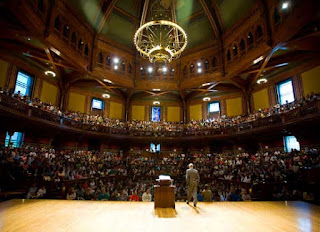
This line of thought converges with one of the common refrains of current thinking about pedagogy: the idea of the student as an "active learner."  As Socrates and Habermas illustrate in the images above, a very large part of teaching philosophy is the challenge of getting the student to think for himself/herself.  The student needs to take on the intellectual challenge as a serious one; and he/she needs to expend the real mental effort required to understand and deal with the problem.  This can't be distilled into an artful lecture by the professor; rather, it seems to require dialogue and intellectual exchange.  The student needs to be engaged in the debate; and he or she needs to be brought to see the stakes of the issue.  (In spite of the vast lecture hall that Michael Sandel confronts in the third image above, he too is capable of engaging and challenging the students in his classroom.  Here is a video of a lecture from his Harvard course on justice.)

Sunday, April 4, 2010

Norbert Elias on the individual


Norbert Elias opens his 1987 book The Society of Individuals with these words:
The relation of the plurality of people to the single person we call the "individual", and of the single person to the plurality, is by no means clear at present. But we often fail to realize that it is not clear, and still less why. We have the familiar concepts "individual" and "society", the first of which refers to the single human being as if he or she were an entity existing in complete isolation, while the second usually oscillates between two opposed but equally misleading ideas. Society is understood either as a mere accumulation, an additive and unstructured collection of many individual people, or as an object existing beyond individuals and incapable of further explanation. In this latter case the words available to us, the concepts which decisively influence the thought and action of people growing up within their sphere, make it appear as if the single human being, labelled the individual, and the plurality of people conceived as society, were two ontologically different entities.
This Preface was written around the time of the publication of the volume in 1987; but the core of the book was originally written in the context of the composition of Elias's 1939 book, The Civilizing Process: Sociogenetic and Psychogenetic Investigations.  So the ideas expressed in the primary essay of the book belong to the classic period of the development of his thought.

What is striking about this paragraph is Elias's insistence, essentially, that we don't know what we are referring to when we use the terms "individual" and "society."  He rejects the twin views of "individualism" and "holism", and he wants to arrive at a conception of "individual/society" that avoids the polarity between the two.

I interpret Elias's analysis here in a way that roughly parallels the intuition I was grappling with in formulating the idea of "methodological localism" (link).  Fundamentally, the idea is that we can't take the individual out of society or society out of the individual; instead, we begin with the socialized individual and build up more complex social processes and structures.  Here is a passage from the Preface that anticipates this idea of the socially constructed individual:
The entire stock of social patterns of self-regulation which the individual has to develop within himself or herself in growing up into a unique individual, is generation-specific and thus, in the broader sense, society-specific. My work on the civilizing process therefore showed me very clearly that something which did not arouse shame in an earlier century could be shameful in a later one, and vice versa - I was well aware that movements in the opposite direction were also possible.  But no matter what the direction, the evidence of change made clear to what extent individual people are influenced in their development by the position at which they enter the flow of the social process. (viii)
So individuals are socially and historically constructed; there is no such thing as the "pre-social" or "extra-social" individual.  Here is another statement of this point:
At birth individual people may be very different through their natural constitutions. But it is only in society that the small child with its malleable and relatively undifferentiated mental functions is turned into a more complex being. Only in relation to other human beings does the wild, helpless creature which comes into the world become the psychologically developed person with the character of an individual and deserving the name of an adult human being. (21)
But there are also dynamic and individuating features of societies; societies are distinct in ways that ultimately derive from the characteristics of existing individuals:
Society, as we know, is all of us; it is a lot of people together. But a lot of people together in India and China form a different kind of society than in America or Britain; the society formed by many individual people in Europe in the twelfth century was different from that in the sixteenth or the twentieth century. And although all these societies certainly consisted and consist of nothing other than many individuals, the change from one form of living together to another was clearly unplanned by any of these individuals.  (3)
What we lack - let us freely admit it - are conceptual models and an overall vision by which we can make comprehensible in thought what we experience daily in reality, by which we could understand how a large number of individuals form with each other something that is more and other than a collection of separate individuals - how they form a "society", and how it comes about that this society can change in specific ways, that it has a history which takes a course which has not been intended or planned by any of the individuals making it up. (7)
And here is how Elias suggests that we commonly think about social reality:
One section of people approaches sociohistorical formations as if they had been designed, planned and created, as they now stand before the retrospective observer, by a number of individuals or bodies. ... The opposing camp despises this way of approaching historical and social formations. For them the individual plays no part at all. ... A society is conceived, for example, as a supra-individual organic entity which advances ineluctably towards death through stages of youth, maturity and age. (4-5)
It appears that Elias frames a false dichotomy here when he asks how society came about: either specific individuals planned and intended that social institutions should have specific functions, or a society is a whole that possesses its own dynamics of development.  But there is a third possibility: social institutions have their current characteristics because of the actions and choices of countless individuals; but these characteristics are largely the unintended consequence of the strategic interactions among many individuals.  So individual agency lies behind social institutions and structures; but these agents are usually operating within the framework of a limited set of goals and beliefs that have nothing to do with the eventual shape of the social institution.

So we need to follow Elias's suggestion and look for new metaphors for understanding the relation between "society" and "individual."  We need metaphors that work better for the third option -- society as the unintended assemblage of many strategic activities of individuals.  Here is one: we might think of a social institution as a potlach supper rather than a seven-course meal designed by a chef.  Or, to use a metaphor explored in an earlier posting, we can understand society along the lines of a flea market: a somewhat orderly affair that derives from the separate and sometimes coordinated actions of hundreds of participants (link).  And in fact, Elias actually uses a similar metaphor:
And even in each present moment, people are in more or less perceptible motion. What binds the individuals together is not cement. Think only of the bustle in the streets of a large city: most of the people do not know each other. They have hardly anything to do with each other. They push past each other, each pursuing his or her own goals and plans. They come and go as it suits them. Parts of a whole? The word "whole" is certainly out of place, at least if its meaning is determined solely by a vision of static or spatially closed structures, by experiences like those offered by houses, works of art or organisms. (13)
Here is another interesting metaphor that Elias explores as a way of capturing "the social" -- the complex intertwining of behavior in formal dance.
Let us imagine as a symbol of society a group of dancers performing court dances, such as the frangaise or quadrille, or a country round dance. The steps and bows, gestures and movements made by the individual dancer are all entirely meshed and synchronized with those of other dancers. If any of the dancing individuals were contemplated in isolation, the functions of his or her movements could not be understood. The way the individual behaves in this situation is determined by the relations of the dancers to each other. (19)
But within the bustle of the street or the coordination of the dance there is an underlying order (just as we found in thinking about the flea market analogy):
The invisible order of this form of living together, that cannot be directly perceived, offers the individual a more or less restricted range of possible functions and modes of behaviour. By his birth he is inserted into a functional complex with a quite definite structure; he must conform to it, shape himself in accordance with it and perhaps develop further on its basis. (14)
And this order poses a problem for individualism:
This network of functions within a human association, this invisible order into which individual purposes are constantly being introduced, does not owe its origin simply to a summation of wills, a common decision by many individual people. (15)
But here the false dichotomy mentioned above is important.  It doesn't take an announced master plan to create a peasant militia or an age-specific practice of dating and courtship; rather, a series of opportunistic choices are made over time, by a number of different actors, leading to an institution that has characteristics that were intended by no one (see illustrations in Elizabeth Perry, Rebels and Revolutionaries in North China, 1845-1945).

This is an interesting and important contribution to the philosophy of society.  I'm inclined to think, though, that Elias does a better job of situating the "socialized, civilized individual" than he does in conceptualizing the social institution or structure.  There is a persistent structural-functionalism in the language, and a persistent attempt to attribute intentional design to social institutions, that fail to deliver on the promise of arriving at a better way of understanding both aspects of the "individual-society" relationship.

Friday, April 2, 2010

Public health estimates in Marx's Capital


Long stretches of Marx's Capital take the form of an effort at developing and defending an economic model of capitalism, based on the theories of value and surplus value.  But there are also recurring efforts at providing a descriptive sociology of capitalism: the forms of day-to-day life that British economic relations imposed upon the working class.  This dimension of the book is descriptive and detailed; it has much in common with Engels's approach in The Condition of the Working Class in England.

Marx was very interested in these descriptive investigations -- Dr. Simon, Dr. Julian Hunter, Mr. Smith, Dr. Bell, and the inquiries and Acts of Parliament in the 1860s that shed light on the depth of English poverty.  The index for Capital includes a section, "Parliamentary Reports and Other Official Publications," which includes references to over a hundred reports on factories, poverty, nutrition, and health.  These range from a Report of Select Committee, London, 1855, on "Adulteration of Bread", to "Reports of the Medical Officer of the Privy Council on Public Health" (1861-66).  And these reports constitute the core of empirical evidence that Marx brings to bear for his economic assertions throughout the work.  In fact, we might describe some parts of Capital as a sort of "meta-study" of current investigations of the public health status of England's cities.

This interest is particularly evident late in Capital where Marx turns to the topic of "The General Law of Capitalist Accumulation."  Consider one fairly detailed section, "The Badly Paid Strata of the British Industrial Class" (link).  Here Marx is offering the best information available, at the household level, concerning the standard of living of this stratum of the British working class.   Consider this passage:
During the cotton famine of 1862, Dr. Smith was charged by the Privy Council with an inquiry into the conditions of nourishment of the distressed operatives in Lancashire and Cheshire. His observations during many preceding years had led him to the conclusion that “to avert starvation diseases,” the daily food of an average woman ought to contain at least 3,900 grains of carbon with 180 grains of nitrogen; the daily food of an average man, at least 4,300 grains of carbon with 200 grains of nitrogen; for women, about the same quantity of nutritive elements as are contained in 2 lbs. of good wheaten bread, for men 1/9 more; for the weekly average of adult men and women, at least 28,600 grains of carbon and 1,330 grains of nitrogen. His calculation was practically confirmed in a surprising manner by its agreement with the miserable quantity of nourishment to which want had forced down the consumption of the cotton operatives. This was, in December, 1862, 29,211 grains of carbon, and 1,295 grains of nitrogen weekly.
Marx then quotes a Privy Council inquiry in 1863, which finds that
"in only one of the examined classes of in-door operatives did the average nitrogen-supply just exceed, while in another it nearly reached, the estimated standard of bare sufficiency [i.e., sufficient to avert starvation diseases], and that in two classes there was defect — in one, a very large defect — of both nitrogen and carbon. Moreover, as regards the examined families of the agricultural population, it appeared that more than a fifth were with less than the estimated sufficiency of carbonaceous food, that more than one-third were with less than the estimated sufficiency of nitrogenous food, and that in three counties (Berkshire, Oxfordshire, and Somersetshire), insufficiency of nitrogenous food was the average local diet.”
In other words, the Privy Council finds that important segments of the English working class were undernourished by the prevailing scientific standard of the day.  This official report is fundamentally damning of the current economic system; it led to conditions of near-starvation for its workers.

Marx goes on to describe other components of the standard of living -- housing, crowding, sanitation, and clothing, for which the working class are seriously deprived.  And in each case he believes that independent, disinterested observers have documented the conditions of misery in which the working class lived in England in the 1860s.

Consider another interesting example, Marx's use of the Select Committee's report on the adulteration of bread.  This occurs in an extended footnote in Chapter VI, "The Buying and Selling of Labour-Power."
In London there are two sorts of bakers, the "full priced," who sell bread at its full value, and the "undersellers," who sell it under its value.  The latter class comprises more than three-fourths of the total number of bakers....  The undersellers, almost without exception, sell bread adulterated with alum, soap, pearl ashes, chalk, Derbyshire stonedust, and such like agreeable nourishing and wholesome ingredients. (note 3) 
Marx goes on to describe in a little bit of detail the specific timing of the payment of wages, demonstrating the economic coercion that leads workers to agree to buy this adulterated bread.  

Or we might notice that Marx's index refers to a series of Parliamentary reports on child labor, and then consider the use that Marx makes of these reports.  Here is one example of his use of the child labor reports in the chapter on "The Working-Day":
The potteries of Staffordshire have, during the last 22 years, been the subject of three parliamentary inquiries....  For my purpose it is enough to take, from the reports of 1860 and 1863, some depositions of the exploited children themselves.  ... William Wood, 9 years old, was 7 years and 10 months when he began to work.  He "ran moulds" (carried ready-moulded articles into the drying-room, afterwards bringing back the empty mould) from the beginning.  He came to work every day in the week at 6 a.m., and left off about 9 p.m. "I work till 9 o'clock at night six days in the week." (Capital I, chap 7, sect. 3)
What is of special interest in these passages is the way that Marx's mind seems to have worked on these questions.  He was genuinely interested, it would seem, in the concrete details of the conditions of the English working class; and he was fortunate that there was something of an explosion of official and non-official interest in the same set of questions, including especially Parliamentary Blue Books.  These inquiries fall in the category of what we would today call the field of public health, and Marx was plainly an avid reader of the reports that resulted from these investigations.

It is not accident that brings Marx's detailed discussion of the nutritional status of the industrial poor into Part VII of Capital, "Accumulation."  It is Marx's view that the production of surplus value, and the accumulation  of wealth that it enables, is directly related to the production of the poverty of the worker.  So the circumstances that Marx describes in this section do not constitute simply an unfortunate current reality; they are the apotheosis of a system of production that was working well.

 
Design by Free Wordpress Themes | Bloggerized by Lasantha - Premium Blogger Templates