Monday, January 17, 2011

National values on racial equality


Today the country celebrates the birthday of Dr. Martin Luther King, Jr. Most of us think of Dr. King as a genuinely important American thinker, and one whose life and actions permanently changed some important values and thought processes in this country when it came to racial equality and affirming communities in the United States. His death by assassination at the age of 39 cut short a life of influence from which our country could have benefited greatly in the intervening decades.

How much have we changed in our thinking about race since 1968?  Is it possible to assess the degree of influence that Dr. King has had on current American attitudes about race and about what needs to be done?  How would we assess the nature and depth of changes that have occurred in American attitudes towards race, equality, and community since 1968? What were some of the mechanisms of value transmission through which those changes took place? And how would we attempt to sort out the elements of those changes that can be traced back to Dr. King?

One part of the mechanism of influence is pretty obvious. Dr. King was a visible and influential leader from the Montgomery bus boycott in 1955 to the month of his assassination in Memphis in 1968. He gave hundreds of speeches, he had a meaningful and visible footprint on television and radio, and he reached a mass audience during those years. White and black Americans probably heard his messages differently, but there is no doubt that King influenced millions of Americans during his lifetime.  So this is a very direct form of influence -- people who were exposed to the struggles of the Civil Rights era and to the speeches and actions of Dr. King, and who absorbed a new set of attitudes about racial equality and social progress from those experiences.

It is an interesting and difficult question to assess how much of that direct first-person influence persisted into the next generation of children and adults.  But here again, mechanisms of transmission are easy enough to identify.  Many of those persons who were directly influenced during the Civil Rights generation had children of their own, whom they influenced through their example and their speech, and a certain number of them became teachers and broadcasters and health care providers -- each creating his/her own avenue of influence on others.  So the primary contemporary effects of Dr. King's teachings and actions had a second- and third-generation echo.

Another form of influence during his lifetime was more focused. Dr. King was an elite civil rights leader and strategist, and he stood in a central position within networks of activists and leaders, both black and white. He was successful in positioning his own rhetoric and strategies in nodes of influence within these networks and organizations. His own views didn't always prevail -- but they did often enough to permanently influence debates about racial justice and strategy within the next generation of influencers. So King's philosophy and vision found vivid expression by the next generation of leaders and influencers both nationally and regionally. And these leaders in turn influenced future debates and many millions of people through their own political actions and leadership.

A third mechanism of influence stems from historical tragedy -- the assassination itself.  The traumatic impact on American consciousness of King's assassination surely had an impact on the degree to which his philosophy and vision penetrated the American psyche. It was a visceral warning for all of America about the virulence and violence of racial hatred. It served as an unforgettable signal that these conflicts must be resolved and that we must find ways of ending American racism. And Dr. King's message was a promising one: we can be better than this, we can move beyond slavery and discrimination to a world of equal love and respect.

All these pathways of influence contributed to other large changes as well, including especially the effort to broaden school curricula to include issues of race and racial equality.  Those curricular innovations were certainly influenced by Dr. King's example; and millions of American children from the 1970s through the present were exposed to positive ideas about equality and the value of diversity in language that had very much in common with Dr. King's vision of the future.  So it is reasonable to expect that young people's attitudes towards race in the 1970s through 1990s were very different from those of children educated in the 1940s and 1950s.

So how much change has there been in fundamental attitudes since 1954 (the year of the Supreme Court school desegregation decision, Brown v. Board of Education)? And how much of MLK's stamp do current American attitudes bear?  Howard Schuman and other scholars have attempted to investigate this question empirically (Racial Attitudes in America: Trends and Interpretations, Revised EditionBlack Racial Attitudes: Trends and Complexities).  Schuman and his colleagues work carefully through the main political events of the 1940s through 1960s, and attempt to synthesize public opinion data to assess the changes that occurred within the population over a fifty-year period.

It certainly appears that American attitudes towards race, and towards a racially just society, have changed dramatically since the 1950s.  The Civil Rights struggle itself -- the struggle by African-American men and women to overcome systematic discrimination and racism -- is surely the largest part of this change.  And there certainly were other visions and voices among civil rights leaders who helped to shape the debate.  But Dr. Martin Luther King, Jr.'s voice seems to have had the most pervasive and enduring impact on mainstream America when it comes to racial justice and an inclusive community.  Dr. King offered a unique combination of realism and optimism that seems to have worked very well with other deep American values.  Here is some realism, from "A Testament of Hope" included in A Testament of Hope: The Essential Writings and Speeches of Martin Luther King, Jr..
Whenever I am asked my opinion of the current state of the civil rights movement, I am forced to pause; it is not easy to describe a crisis so profound that it has caused the most powerful nation in the world to stagger in confusion and bewilderment.  Today's problems are so acute because the tragic evasions and defaults of several centuries have accumulated to disaster proportions. (313)
And here is some of his finest optimism, concluding the same essay:
A voice out of Bethlehem two thousand years ago said that all men are equal.  It said right would triumph.  Jesus of Nazareth wrote no books; he owned no property to endow him with influence.  He had no friends in the courts of the powerful.  But he changed the course of mankind with only the poor and the despised.  Naive and unsophisticated though we may be, the poor and despised of the twentieth century will revolutionize this era.  In our "arrogance, lawlessness and ingratitude," we will fight for human justice, brotherhood, secure peace and abundance for all.  When we have won these -- in a spirit of unshakable nonviolence -- then, in luminous splendor, the Christian era will truly begin. (328)


Friday, January 14, 2011

Rawls on political liberalism

Long after the transformative impact Rawls brought to social and political philosophy with A Theory of Justice: Original Edition (1971), Rawls continued to wrestle with the question of how a just society ought to work.  One major part of this question is how a just society ought to encompass major disagreements among its citizens about values and "conceptions of the good;" and much of his thinking is reflected in his 1993 collection of essays, Political Liberalism.  Here is how he formulates the central problem:
A modern democratic society is characterized not simply by a pluralism of comprehensive religious, philosophical, and moral doctrines but by a pluralism of incompatible yet reasonable comprehensive doctrines.  No one of these doctrines is affirmed by citizens generally.  Nor should one expect that in the foreseeable future one of them, or some other reasonable doctrine, will ever be affirmed by all, or nearly all, citizens.  Political liberalism assumes that, for political purposes, a plurality of reasonable yet incompatible comprehensive doctrines is the normal result of the exercise of human reason within the framework of the free institutions of a constitutional democratic regime.  Political liberalism also supposes that a reasonable comprehensive doctrine does not reject the essentials of a democratic regime. (xvi)
So, to start, Rawls recognizes that modern society is not based on consensus around the major values or issues; rather, individuals differ in their commitments about rights, justice, and the good human life.  How in the context of this pluralism of important value systems, is it possible for a modern society to nonetheless possess the features of civility and stability that we would desire?

Here, then, is what Rawls calls the problem of political liberalism:
How is it possible that there may exist over time a stable and just society of free and equal citizens profoundly divided by reasonable though incompatible religious, philosophical, and moral doctrines? Put another way: How is it possible that deeply opposed though reasonable comprehensive doctrines may live together and all affirm the political conception of a constitutional regime?  What is the structure and content of a political conception that can gain the support of such an overlapping consensus? (xviii)
One prior thought we may have had about a liberal society is that the state establishes no more than a neutral system of law, within the context of which individuals can pursue their own separate and incompatible conceptions of the right and the good.  So the liberal state is a neutral state -- one that gives no privilege to one conception of the good over another.

Neutrality is certainly part of the ideal of a liberal state; but it isn't quite enough.  The reason is that some conceptions of the good and the right require the intervention of the state for enforcement.  If the Alpha group believe that fetal stem cells are nascent human beings and therefore should never be used for the purpose of scientific research, while the Beta group believe that fetal stem cells are no more than useful compounds of organic molecules that can relieve human misery; then both sides of the debate want to prevail through legislation -- either to prohibit stem cell research or to permit stem cell research.  Each side sees its position as being driven by a moral imperative -- and therefore not to be compromised without an unacceptable loss of moral integrity on the part of the losing group.

To overcome this contradiction, neutrality is not enough.  We need to add a commitment to democratic, constitutional procedures as being the moral trump card when it comes to legislation about areas of conflict based on fundamental disagreements about the right and the good.  Essentially this comes down to a second-order commitment that every citizen needs to share:  When policy issues arise that lead to profound disagreement among blocs of citizens, the right solution is the procedurally correct solution arrived at through legitimate democratic processes.  In other words, all citizens need to put their commitment to legitimate democratic procedures ahead of their commitment to a particular conception of the good and the right. Democratic values supersede religious, political, and moral convictions when there is no choice but to legislate an issue.  Citizens are entitled to argue their case for or against proposed legislation; but they are then morally obligated to accept the democratically chosen outcome as a legitimate resolution of the issue.

Rawls captures this conundrum with the idea of toleration: the idea that citizens must tolerate and respect the strongly-held convictions of their fellow citizens, even while participating in a political process that leads to legislation that is inconsistent with those convictions.  This means that if the Alphas prevail through the political process, the Betas need to accept the outcome as morally legitimate -- even though it contradicts their own firmly held moral convictions.  But why would one accept the moral necessity of toleration?  Doesn't this mean sacrificing one's own moral convictions to the will of a contrary majority?  And doesn't this imply that one's own convictions are tentative and conditional?

The answer seems to go along something like these lines.  When one is a member of a society, one recognizes the inevitable fact of the kind of fundamental pluralism Rawls has described here.  This means that society will sometimes legislate about issues concerning which reasonable citizens disagree, based on fundamental moral convictions on both sides.  So the citizen is asked to bracket his/her particular moral convictions when considering outcomes, even as he/she is free to vigorously argue on the basis of those convictions during the process leading up to legislation.  The citizen is asked to take a double perspective on his/her own moral convictions: first-person, that these are my convictions and they seem binding and justified from my point of view; and third-person, that there is disagreement about these matters, and the only defensible process for resolving the issue is the democratic process in which each person's reasons count as much as every other person's.  This is something like Thomas Nagel's understanding of altruism in The Possibility of Altruism; the individual is asked to recognize the moral reality of other persons and not to assign a privileged role to his/her own perspective.

A key part of Rawls's own solution to this problem of democratic pluralism is the idea of an "overlapping consensus" among citizens.  Here is how he defines that idea:
Such a consensus consists of all the reasonable opposing religious, philosophical, and moral doctrines likely to persist over generations and to gain a sizable body of adherents in a more or less just constitutional regime, a regime in which the criterion of justice is that political conception itself. (15)
In such a consensus, the reasonable doctrines endorse the political conception, each from its own point of view.  Social unity is based on a consensus on the political conception; and stability is possible when the doctrines making up the consensus are affirmed by society's politically active citizens and the requirements of justice are not too much in conflict with citizens' essential interests as formed and encouraged by their social arrangements. (134)
So the ideal here is the notion that some set of constitutional arrangements may be acceptable from all points of view -- from Christian to libertarian to Muslim to socialist.  This hope seems to rest on the idea that a neutral, democratic set of political institutions give the best opportunity for the adherents of any particular theory of the good to pursue their interests; so each of the "reasonable opposing religious doctrines" may have good reason to endorse the neutral democratic constitution.  (This is a kind of "original position" argument, applied to opposing comprehensive doctrines.)

What makes this a consensus of any kind is not the notion that there is an overlapping set of values that persist across all the comprehensive doctrines; rather, it is the hope that there will be at least one political arrangement that can serve as the consensus choice of all the incompatible comprehensive doctrines.
The preceding account says that the consensus goes down to the fundamental ideas within which justice as fairness is worked out.  It supposes agreement deep enough to reach such ideas as those of society as a fair system of cooperation and of citizens as reasonable and rational, and free and equal.  As for its breadth, it covers the principles and values of a political conception ... and it applies to the basic structure as a whole. (149)
So -- what is a political liberal, according to Rawls?  It seems to boil down to this.  It is a moral individual who has his/her own conception of the good and set of fundamental doctrines; who recognizes nonetheless that he/she is a member of a polity that is fundamentally plural when it comes to conceptions of the good; who recognizes that there is no basis for insisting on privilege for one's own conception of the good; and who recognizes the moral legitimacy of constitutional democratic procedures when it is necessary to decide among policies that involve conflicting conceptions of the good.  It is a person who puts civic commitment to constitutional democratic processes ahead of one's one fundamental convictions when necessary.  And it is a person who is fully committed to ensuring the neutrality of the state across fundamental convictions.  Neutrality of law across persons and conceptions of the good, full recognition of fundamental pluralism within a modern society, respect for the equal worth of all other citizens, and a recognition that one's own beliefs have no basis for being privileged over those of other citizens -- these are the fundamental commitments of a political liberal.

We can now give a fairly simple explication of illiberal thinking as well.  It is moral, religious, or political fundamentalism -- the idea that one's own moral convictions are so compelling that no democratic process could legitimately override them.  It is the idea that the individual has a persistent right to oppose the state when the state's actions are inconsistent with one's own moral convictions.  It is authoritarian -- it endorses the idea that one's own group or party has the right to override the majority's will when the state contradicts one's fundamental convictions.  And it is, of course, a position that is fundamentally disrespectful of democracy and of the equal dignity and worth of one's fellow citizens.

Tuesday, January 11, 2011

Media and political culture


How are people's political beliefs, concerns, and passions influenced within a modern mass society? There are many mechanisms, certainly: family, school, place of worship, place of work, and military service, to name several.  But certainly the various channels of the media play an important role. Newspapers, television and radio, social media, and blogs have a manifest ability to focus some parts of the electorate on one issue or another.

So it seems worthwhile to ask whether it is possible to perform some empirical study of the content and value systems associated with various media channels.  (Here is a textbook by Klaus Krippendorff on the use of content analysis in journalism and the media; Content Analysis: An Introduction to Its Methodology.) This question falls into several parts: first, are there important differences in content and tone across various media channels? And second, what effects do these configurations of content and tone have on the users of the media?

The Pew Research Center's Project for Excellent Journalism offers a window into the first of these questions with a fascinating new tool (link).  The "Year in the News Interactive" tool is the front end of a valuable database that codes various media streams according to content.  The database is then searchable so that the user can produce reports on the percentage of the "newshole" devoted to a particular issue or person in a particular medium.  Here is a sample of what the tool produces:


This chart repays close examination.  It picks out five segments of media -- "All Media," "Large Papers," Talk Radio," "NBC Evening News," and "Fox News," and it compares these outlets with respect to five issues: Obama Administration, Health Care, Tea Party, Mosque Controversy, and Sarah Palin.  These are highly politicized issues, so it is interesting to see how the patterns of treatment differ across different segments of the media.

If we consider "All Media" as a benchmark -- representing the average amount of attention given by the media as a whole to various issues -- we see that Talk Radio and Fox News show a few remarkable patterns.  Both sources give the mosque controversy more than twice the percentage of the newshole; likewise the Tea Party gets twice as much attention with Talk Radio and Fox News as with All Media.  Fox News gives Sarah Palin over twice the exposure she gets from All Media -- and nine times the exposure she gets from Large Papers.  Both Talk Radio and Fox News give an inordinate amount of air time to Health Care and the Obama Administration.

Now take a different cut: the network news programs and Fox News with respect to a much less political list of topics -- BP Oil Spill, Haiti Earthquake, Toyota Accelerator Recall, and Cyberspace.


Here the main contrast that seems evident is that Fox News devotes significantly less time to the non-political issues.  Fox devoted about half the percentage of its newshole to the BP Oil Spill compared to NBC news; Haiti got roughly a third the amount attention on Fox; and the Toyota Accelerator Recall got less than half the exposure as it received on NBC news.

At a minimum, this shows something pretty interesting: the regular viewer or listener to Fox News and Talk Radio will get a very different view of the world from the person exposed to All Media or Large Papers.  These media channels give an inordinate amount of airtime to "hot button" issues that have the potential of inflaming their viewers.  And these channels spend much less time that the other media on non-political issues -- Haiti, Toyota recall, or Cyberspace.

What would be particularly interesting in today's environment is an additional dimension of content analysis, reflecting antagonism, intolerance, and hostility.  It would be very useful to have a few years of data on the percentage of the newshole devoted to incendiary reporting about issues, individuals, and the government.  Many observers have the definite impression that this kind of language has increased dramatically; it would be very useful to have quantifiable data on this topic.

(As we think about the tenor and extremism of some of the voices in political media today, it is sobering to remember the role that "hate radio" played in the Rwandan genocide; link.)

Sunday, January 9, 2011

Deciphering French society


Louis Maurin recently published a valuable book on contemporary French society, Déchiffrer la société française, which is intended to shed light on the social realities of France in a way that is genuinely accessible to the public. There are chapters on population, the family, schooling, immigration, unemployment, consumption, and social values, among other important topics (link).  The book is intended to capture and encapsulate some of the data that is available through French sources that will make the basic outlines of France more transparent to the public. (There is a companion website for the book as well.) Denis Clerc provides the preface for the book -- another voice in French society calling for greater transparency about inequalities.

Maurin believes that there is a wide gap between the rhetoric that French elites and journalists use to characterize contemporary French society, and the social realities. In order for France to successfully address the social problems it faces, it is important for the public to have a better understanding of the background and the current realities. So the goal of this project is straightforward:
À l’encontre de ce mouvement, ce livre vise à dresser un état de lieux et à expliquer certains mécanismes du fonctionnement de la société française. Il s’agit bien d’abord de «déchiffrer», car l’objectif est, autant que faire se peut, de mesurer et d’analyser des évolutions. Sans fétichisme du chiffre, il devient indispensable de mettre sur la table des données pour sortir de la rhétorique française où chacun se paie de bons mots. Ce qui permet à tout le monde d’avoir raison en même temps, faute de pouvoir être départagé par les faits. Dans la mesure du possible, nous essaierons de présenter des séries sur longue période, pour élargir les perspectives. L’objectif est aussi de « déchiffrer » des phénomènes qui ne sont pas tous immédiatement perceptibles. De dégager des tendances pour mieux comprendre l’évolution de la société dans un monde où l’avenir semble, pour beaucoup, très incertain. Sur la plupart des phénomènes présentés, vécus au quotidien, chacun a sa petite idée, qu’il s’agisse de famille, d’école, d’immigration, de chômage… Toute la difficulté de la démarche et son intérêt consistent à échapper aux expériences personnelles pour analyser le comportement d’un ensemble. (Avant-propos)
[To counter this trend, this book aims to develop a baseline description and to explain some mechanisms of how French society functions.  It is indeed a first effort, because the goal is, as far as possible, to measure and analyze trends.  Without making a fetish of data, it is necessary to provide tables of facts in order to escape the rhetoric to which everyone pays lip service.  Without facts, everyone can claim to be right at the same time.  Wherever possible, we attempt to present a series of data over a long period, to broaden the perspective.  The goal is also to "decipher" phenomena that are not immediately obvious.  We seek to identify trends in order to better understand society in a world where the future for many is very uncertain.  For most of the phenomena presented, each individual has his/her own perspective, whether it concerns the family, schooling, immigration, unemployment, ...  The challenge is to separate out one's personal experiences in order to analyze the behavior of the larger group.]
Each topic is a fundamental one -- population, nuptiality, family, schooling, immigration, employment, consumption.  And the data that Maurin summarizes are often striking and unexpected.

Here is a striking graph of the absolute number of marriages and divorces since 1960, and a graph of family size changes between 1900 and 1970.  The marriage rate increased sharply in the 1960s into the early 70s; it then went into a steep decline.  


Here are several graphs representing economic and social changes in the past thirty years.  The first tracks the percentage of adults in different socio-economic groups: workers, managers, professionals, executives, farmers, and permanently unemployed. The second tracks the fairly steep decline in the number of hours worked annually by a worker, from under 2000 to under 1500.  The third tracks the shifting composition of the workforce, documenting a dramatic decline in industrial labor from 35% to 15%.  And the fourth graph tracks union membership, from a high of 30% in 1949 to a low of 8% in 2005.  This is surprising for Americans who think of the French workforce as being highly unionized.


Here is an indication of how French consumption has evolved over the past sixty years.  Television and washing machines started early; home computers and mobile phones came in the decade of 1990-2000.  (It appears that several labels may be switched on this graph; it's hard to believe that microwave ovens became common well before refrigerators.  And in fact the 2007 snapshot from INSEE suggests that these two labels have been switched.)


Here is a snapshot from INSEE for household items for 2007:


And what about education?  Maurin draws attention to the progress of the bac over the past 60 years.  The creation of the bac technologique and the bac professionnel in 1968 and 1988 respectively conjoined with growth in the bac general to produce rapid increase from the mid 1980s through 1990s; and the total has remained flat since the 1990s.


Maurin expresses a certain amount of disappointment with the discipline of academic sociology in France for its failure to provide a "public" sociology -- an empirical and theoretical research program aimed at shedding light on the most pervasive patterns in French society today. ("Malgré des progrès récents, le monde scientifique — la sociologie, en particulier — ne semble plus vraiment chercher à dresser ce portrait social de la France;" avant-propos.) And here again in the conclusion:
La statistique n’est pas seule en cause : la recherche laisse de côté de très nombreux domaines, pourtant indispensables à la compréhension du monde contemporain, quand bien même les données existent. Les sociologues qui travaillent sur des sujets aussi essentiels que les revenus, la mobilité sociale ou la consommation ne sont qu’une poignée. Dans certains domaines, comme l’exclusion ou l’immigration, ils se comptent par dizaines… Personne ne conteste la nécessité de ces travaux. Il n’en demeure pas moins que, pour partie, la sociologie française s’attache aux «dominés », oubliant que, pour analyser les processus de domination, il faut aussi regarder vers le haut. (Conclusion)
[The data are not the only cause.  Researchers leave to the side many domains that are indispensable to comprehending the contemporary world, even when the data exist. Sociologists who work on such essential subjects as income, social mobility, or consumption are only a handful.  In some domains, such as exclusion or immigration, they are fewer than dozens.  No one can disagree about the necessity of this work.  Instead, the French sociologists prefer to focus on the "dominated", forgetting that it is necessary to look at the top in order to understand the processes of domination. (Conclusion)]
In short -- French society is as complicated as any other, with its own history and current social forces.  And many of the social realities the French currently face are obscure in their causes and their distribution across regions and classes.  So it is particularly important for authors like Maurin to help pull back the curtain from some of these basic social facts.

(Each chapter offers a short list of key internet sources that allow the reader to pursue the data questions of the chapter directly.  A few key resources on population, labor, poverty, family, immigration, and education include --
  • Eurostat (Service statistique de l'Union européenne link)
  • INED (Institut national d'études démographiques link)
  • INSEE (Institut national de la statistique et des Ã©tudes Ã©conomiques link)
  • CNAF (Caisse nationale d'allocations familiales link)
  • Ministère de la Justice link
  • Secrétariat d'état à la Famille link
  • Cité nationale de l'immigration link
  • Gisti (Groupe d'information et de soutien des immigrés link)
  • Ministère de l'éducation nationale link
  • CEE (Centre d'étude de l'emploi link)
  • Céreq (Centre d'études et de recherches sur les qualifications link)
  • IRES (Institut de recherches Ã©conomiques et sociales link)
  • Ministère de l'emploi link
  • Observatoire des inégalités link
  • Observatoire national de la pauvreté et de l'exclusion sociale link
  • Crédoc (Centre de recherche pour l'étude et l'observation des conditions de vie link)
  • Iresco (Institut de recherche sur les sociétés contemporaines link)
  • Cevipof (Centre de recherches politiques de Sciences-Po link)
There is a volume of valuable data available from these sources.)

Thursday, January 6, 2011

Historical GDP estimates for early modern China


Li Bozhong is one of China's most influential economic historians, and he is undoubtedly the most internationally connected.  Much of his work in the past several decades has been devoted to constructing a detailed economic history of the lower Yangzi Delta (for example, Agricultural Development in Jiangnan, 1620-1850).  His findings have been crucial empirical contributions to the "involution" debate (link, link, link) about whether the Chinese economy was stagnant and significantly less productive than the European economy.  Thanks to his research we now have a much more informed understanding of the economic dynamics of the Lower Yangzi region in the early modern period (1620-1850).  And his research largely supports the "no involution, significant productivity growth" interpretation.  (Ken Pomeranz has a nice review of Agricultural Development in Jiangnan, 1620-1850 here.)

Li's most recent book has now appeared in Chinese, and it takes an important step forward in terms of methodology.  (The cover and title are included above.  The book includes an extended summary in English, which allows non-Chinese speakers to get the highlights of method and findings.)  The important step that Li introduces here is a first effort to apply the methodology of historical national accounts to China. Essentially this method allows the researcher to use the discipline of GDP accounting to arrive at systemic and internally validated estimates of economic activity in a region over a period of time.  (Jan-Pieter Smits, Edwin Horlings, and Jan Luiten van Zanden provide an extensive and detailed description of the method in "Dutch GNP and its Components, 1800-19193" (link).  Olle Kranz describes the method in application to Sweden here.)

Li's current book is a massive effort (over 600 pages), but it is itself only a pilot project for a more ambitious study to come in future years.  Li has selected one limited district within his previous area of study in the lower Yangzi Delta (Huating-Lou), and attempts to apply the method of historical GDP to this limited region for a single period of time (1823-29).  His goal is to determine whether the discipline and method of historical GDP can shed new light on the scattered economic statistics and materials that more traditional economic histories have assembled.  The results are highly interesting, and they challenge several key assumptions that have been made about the early Qing economy.

Li hopes for two advantages from this approach.  The first is that it provides a unified framework within which to organize and validate existing economic data.  "Because the methods of the GDP study are quite elaborate and standardized, they can provide a coherent macroeconomic framework covering the whole economy" (603).  And the second is to provide a consistent basis for comparison with other historical regions where the same methods have been utilized.  This means that the kinds of comparisons suggested by recent work in Eurasian economic and demographic history will be enhanced as other scholars apply the methodology to European regions.

Huating-Lou is roughly a single county, Songjiang County, with an area of 870 square kilometers and a population in 1816 of 563,052.  (From the maps it appears that the county falls squarely within the current city of Shanghai.)  So the area covered by Li's study is a microcosm of the larger economic region in which it is lodged; Jiangnan had a population of roughly 36 million in the mid nineteenth century.  Li makes use of the same kinds of data sources he has used in earlier works: gazetteers, agricultural handbooks, and modern field investigations of the region (in particular, the Japanese South Manchurian Railway Company studies from 1937-41). Essentially Li proceeds by transforming the variety of data provided by these sources into a uniformly formatted table of national accounts.


The method involves attempting to estimate the magnitude of economic activity in several sectors by assessing production, expenditure, and income. The idea is that the data for these three aspects of the economy are fairly independent; but they should be expected to lead to similar estimates of overall economic activity. (If production estimates indicate a region is producing 10 million yuan of goods, but income estimates indicate only 2 million yuan of income, we can be assured that there is an important data inconsistency.) The method involves making use of the System of Historical National Accounts to provide a unified framework for collecting and presenting the economic data. (See also a paper by Frits Bos describing the use of national accounts as a tool for economic history (link).)

Here is a description of this method as implemented by Luiten van Zanden and colleagues for the Netherlands (link):
Our main method is to gather specific information on annual output and added value in each of the most important economic branches, following the System of National Accounts (SNA) used in contemporary economic-statistical research. The starting point is the production approach; the branches that are being reconstructed include agriculture, herring fisheries, peat extraction, production of textiles, sugar and paper, to name but a few. Weights will be derived from a reconstruction of the structure of the labour force in three moments in time: 1510/14, 1670/80 and around 1800. Combined, the chronological series and the data on the structure of the labour force will serve as a basis for estimating developments in the level and structure of national income.
Li's results are fascinating. First, he finds that production, income, and expenditure estimates for Huating-Lou in 1823-29 all converge on an estimate of about 13.5 million taels of silver. The production estimate is 13.5 million taels, the income estimate is 13.3 million taels, and the expenditure estimate is 13.9 million taels.  So the three systems of accounting all point to approximately the same level of economic activity.  This amounts to an estimate of GDP per capita of about 24 taels of silver.


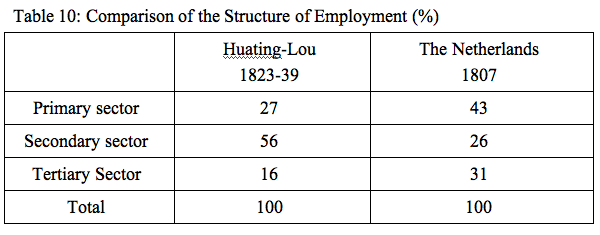
Second, the sectoral composition of the Huating-Lou economy is genuinely surprising (as indicated in table 1). We commonly think of China's Ming-Qing economy as largely rural and agricultural. But the primary sector, including agriculture and fisheries, amounts to only 31% of the local economy, while the secondary sector (manufactures and textiles) contribute 33% and the tertiary sector (commerce, service, government, etc.) contributes 36%. The prior expectation we might have had of the early modern Chinese economy as largely agricultural is flatly refuted for this region by the 1820s. This finding is corroborated by Li's analysis of the structure of employment in the region; only 27% of employment was in the primary sector, with 56% in the secondary and 16% in the tertiary sectors.

Third, Li points out that the composition of income is also somewhat surprising. Wages represented 61% of the Huating-Lou economy; rent 11%; interest 3%; profit 20%; and depreciation 6%. What is surprising about this estimate is the unexpectedly low percentage of all income that derived from rent -- contradicting the idea that the Chinese economy was a rent-dominated one. (Earlier work by Victor Lippit (Land Reform and Economic Development in China: A Study of Institutional Change and Development Finance) sought to estimate the total surplus created by the Chinese rural economy; he estimates 10.7% of income from rent, 3.4% of income from farm business profits, and 2.8% from rural interest payments.  See Understanding Peasant China: Case Studies in the Philosophy of Social Science, pp. 121-22, for more discussion.  Li's estimates of rent and interest are about the same as Lippit's, whereas Li's estimate of profits is substantially higher than Lippit's.)

All of this is highly interesting, though (as Li emphasizes throughout), it is based on only one small region during one limited time period.  So it will be very interesting to see whether it is possible to perform this kind of analysis for larger parts of the historical Chinese economy.

Estimating economic activity was one of the goals of this research.  The other was to establish a consistent basis for comparison across different parts of Eurasia.  Li takes up the comparison with the Netherlands that is made possible by the work mentioned above by Jan-Pieter Smits, Edwin Horlings, and Jan Luiten van Zanden (link). And indeed, the comparisons are very interesting.  Here is the comparison of the sectoral composition of Huating-Lou and the Netherlands:


And here is the comparison for the structure of employment:


The one comparison that Li does not highlight (in the English summary, anyway) is the GDP per capita comparison between Huating-Lou and the Netherlands.  This comparison raises some of the issues involved in a recent discussion here of the standard of living (post), since the Dutch analysis is denominated in guilders and the Chinese work is denominated in taels of silver.  Smits, Horlings and van Zanden estimate a Dutch population size of  2,163,092, implying a GNP per capita of 227 guilders per capita.  Recall that Li estimated a per capita GNP of 24 taels. 

So what is the conversion of tael to guilder? Here I have to go beyond my own specialized knowledge and speculate a bit, so this calculation shouldn't be taken uncritically.  The guilder was defined in 1840 as equivalent to 9.45 grams of fine silver (link).  A tael was equivalent to 37.3 grams of silver, according to Li. So in silver equivalents, the Dutch GDP per capita was 227*9.45 grams of silver, and the Chinese GDP per capita was 24*37.3 grams of silver -- 2,145 grams versus 895.2 grams.  By this estimate, the early nineteenth-century Dutch economy produced a silver equivalent per capita over two times that of the Chinese economy.  However, the purchasing power of silver was significantly greater in China than Europe; so this estimate overstates the disparity in real wage between the two regions.  In "Real Wages in Europe and Asia: A First Look at the Longterm Patterns" Robert Allen estimates the wage basket for China at 247.3 grams of silver, versus 579.7 grams of silver in England (link, pp. 180, 182).  If we took the wage basket as the basis of a cost-of-living deflator, then the disparity between the Netherlands and China essentially disappears.  The Dutch GDP per capita PPP-adjusted product is 3.7 against a 3.6 per capita PPP-adjusted product for China, using the wage basket as deflator.  This would indicate that the Dutch economy was marginally richer than the Chinese economy in the lower Yangzi region -- but not by much.

Li finishes this comparison by raising the question of traditional versus modern economies.  Both economies considered here contradict the assumptions of a "traditional" economy -- largely rural, largely agricultural, and largely stagnant.  Instead, these comparisons indicate a surprisingly urban, manufacturing- and service-based economy in the second decade of the nineteenth century, and Li argues that we can appropriately describe each of them as a "modern" economy.

Li's book is an important new contribution to Chinese economic history, and the historical GDP method seems to be a highly fruitful innovation. It is a really valuable new analytical perspective on the Chinese economy.  I hope the book will be translated into English as quickly as possible.

Wednesday, January 5, 2011

France as Theodore Zeldin saw it


Histories of France have been written from many points of view.  Emmanuel Todd's The Making of Modern France: Ideology, Politics and Culture (1988), Eugen Weber's Peasants into Frenchmen: The Modernization of Rural France, 1870-1914 (1976), and Robert Darnton's Mesmerism and the End of the Enlightenment in France (1968) have all brought a distinctive perspective to their interpretations of France. Each provides an approach that minimizes the goals of traditional narrative and instead focuses on the problematics of identity and culture.

Theodore Zeldin's writings on France are equally original and provocative (A History of French Passions 1848-1945: Volume I: Ambition, Love, and PoliticsFrance, 1848-1945: Politics and Anger). Like these other scholars, he is not an historian who focuses on a chronicle of events.  Instead, he wants to capture some threads of emotion, personality, and ordinary social life that begin to add up to something "French".  Here is how he frames the project in the preface to the first volume, Ambition and Love (the second volume is titled Politics and Anger):
France 1848-1945 may be read in the same way as one would a series of novels, each of which tells the story of a family or a community from a different point of view.  Each chapter and each volume may be read independently. Each has its own surprises, for I aim to show that France was not what it seemed to be; each has its own constellation of heroes or anti-heroes, because I do not see France as dominated by one man, one class or one set of principles. Taken as a whole, however, these portrayals of the many faces of the French are designed to make it possible to judge anew, and less partially, the idiosyncracies, the poses and the torments of a nation that has always irritated its neighbours, even when it has won their admiration and sometimes indeed their affection. (vii)
Since I believe that behaviour is muddled and obscure, and cannot be presented truthfully as simply a search for some ideal, like glory, justice or liberty, and since I do not presume to be able to prove anything when it comes to discussing human motivation, I have not written a general national narrative, held together by a more or less plausible string of causes.  Instead, I have made the individual my starting-point, and have tried to show him beset by a multitude of pressures, internal as well as external.  I have grouped his struggles around six passions: ambition, love, anger, price, taste, and anxiety. (vii)
My method is to hold up a multitude of mirrors around the French, so that they may be seen simultaneously from different angles; and my other volumes pursue these themes into other recesses of their personalities. To adapt to the kaleidoscopic vision I offer, the reader must, of course, be willing to put aside temporarily the expectations that he has of history, in the same way as he must put aside his traditional expectations when looking at the paintings of the Impressionists or the Cubists. I hope the experience will modify his attitude to the French, and to the past, but also that it will tell him something he did not know about himself. (viii)
So it is the ordinary individual rather than the iconic powerful leader; and it is the emotional setting rather than the deliberative process, that most interest Zeldin. But Zeldin also thinks that this study leads to the discovery of important commonalities across the French -- "the common beliefs, attitudes and values of Frenchmen, which often cut across ideological and class lines" (2).  So there is an historical point to writing about "the French" which will lead to different findings than "the British" or "the Germans."  Careful study and interpretation permits the historian to tease out a "style" or "persona" that distinguishes various national groups.

Zeldin clarifies this goal in these words:
I do not mean by this that I am seeking to define the immutable French soul, mind, or character.  But this is something many people talked about and I have tried to investigate why they came to believe that there was such a thing. (3)
This goal runs squarely up against the historiography of difference that Emmanuel Todd advocates in considering the French; Todd's view is that France was constituted through a very specific and intentional process of identity shaping (post), and that there was great diversity of thought and institution across the territory that became France.  But the two perspectives are not flatly contradictory; instead, Zeldin's approach can be understood as a kind of historical ethnography, while Todd's approach emphasizes processes and structures of nation formation.

Is this goal of discovering characteristic ways of thinking and feeling for a national population a credible one? I think it is, once we take a material and institutional view of the formation of personality.  The human being is socially constructed; this means that his/her psychology and mental and emotional frameworks are inflected by specific institutions and experiences.  And it is entirely believable that there might be enduring differences in the traditions and institutions through which English school boys and girls and French children absorb formative ideas about -- family, morality, anger, comportment, and nation.

How does Zeldin turn this historiographic goal into a workable program of research?  One key strategy that he pursues is to identify a handful of central categories of actors in French society -- doctors, notaries, the rich, bankers, industrialists, bureaucrats, peasants, workers -- and to trace out the specifics of how these categories functioned in France.  How were doctors educated?  How were they compensated?  How did they compete for clients?  What level of prestige did they enjoy?  Zeldin believes that each of these social categories represents a distinctive matrix of characteristics, relative to the analogous social groups in other countries.  So by taking the measure of these great social groups, Zeldin believes that he is also able to delineate some of the distinctive elements of French attitudes and social relations.

And what about the most numerous group -- the peasants?  How were they regarded in the nineteenth century?  Zeldin argues that peasants were essentially invisible to cultivated French society:
The peasants are not studied in Balzac's universal portrait of French society. Though he called one of his novels Les Paysans and devoted several volumes ostensibly to painting scenes of rural life, Balzac could not describe the peasants, because he was full of contempt for them.  They were savages, like Fenimore Cooper's Red Indians, and he was concerned with them only as subjects for his schemes to improve them. (131-32)
So contempt is one French attitude towards the peasant; another is the romanticized view that seems to trace back to Rousseau:
The romantics, the Catholic revivalists, the believers in a conservative and hierarchic order, all held him up as a model of a human unspoilt by progress.  George Sand wrote books about him or rather books about how she would have liked him to be, inaugurating a whole genre of rustic novels. ... Napoleon III inaugurated his reign with an inquiry into popular poetry forgotten 'because of a thoughtless contempt by our rather too worldly literature'. Folklore societies were formed. (133)
After surveying these elite attitudes towards peasants, Zeldin turns to an extended effort to decipher some of the social reality of the peasant in the nineteenth century.  And he finds that the stereotypes that French society applied to the peasant, from left to right, were unfounded.
These generalisations about the innate conservatism of the pesant need to be interpreted carefully in the context of French history.  The observance of traditional routines, agricultural and social, should not obscure the fact that conflict was part of those routines, and that the pressures involved in preserving them add up to a situation which is far from being one of stagnation. The peasants were neither satisfied nor contented. They were constantly trying to improve their lot, to enlarge their farms, to raise their status. Their world was torn by deep divisions, and by animosities both of interest and of pride. (135)
The sense of community depended also on the way the land was worked.  The common generalization that the peasants were innately individualistic and independent is another bourgeois myth.  It is important to remember that though individual peasant property had developed before the Revolution, ownership did not imply complete liberty to work the land as one pleased.  When the strips and plots were tiny, it was essential to co-operate in sowing and reaping. No man could reach his plot without going through those of his neighbours. (139)
Much of this material on the professions and the major social groups falls under the heading of "ambition" -- competition and striving for one's betterment.  This first volume ends with an extended discussion of "love" -- the family and children.
The family, as organised in France in these years, had an effect on people's lives as profound as any political regime or any economic force. It was a powerful institution which resisted change with remarkable vitality. (285)
 But here again, Zeldin finds that the realities of nineteenth-century France contradicted the common stereotypes of marriage, family, and children.

Zeldin's writing makes one think of a gifted interpreter of literature or art, more than of a traditional historian.  He is very sensitive to telltale nuances, and very creative in building an interpretation of the French based on a series of such insights.  In this regard it is "humanities-inspired history" rather than "social-science history."  Zeldin appears to affirm this point in saying that his historical writing does not aspire to the "objectivity" and neutrality of the sciences:
Historical study is a personal experience, and the subjective elements in it deserve to be valued, when so many other branches of knowledge are becoming largely technical. To admit that historians solve their problems of colour and light, that they create their compositions for reasons which are ultimately subjective, because these seem to them to be coherent and true, is not to admit a fault, but to assert that each individual historian can express himself in his work. (7)
So Zeldin's project is a broad one: to attempt to discern some of the important strands of mental and emotional framework through which historical French men and women thought and experienced their history.  It is a kind of personality psychology for a whole historical population.  And Zeldin affirms, as a literary critic would do as well, that there alternative tellings of this story.

Saturday, January 1, 2011

CPM in West Bengal


One thing that is interesting about Indian politics is the fact that states have a great deal of autonomy, and there are parties based in various states that are distinct from both Congress and BJP. One of those parties is the Communist Party of India, which has evolved into a pro-poor, anti-capitalist electoral party that has renounced violent revolution, following a split in CPI in the 1960s. The Communist Party of India (Marxist) (CPM or CPI(M)) emerged in the 1960s as a serious electoral party, and it has governed directly or through left coalitions in West Bengal and Kerala since the late 1970s. CPM gains between 5% and 6% of the national vote, and currently there are 46 CPM MPs in Parliament (out of 790). (The Wikipedia entry on CPI(M) provides a detailed timeline of the party's role in India since the 1960s. Here is a link to the People's Daily, one of CPM's key publications.)

Here is a table of seats won in elections between 1952 and 1987 in West Bengal:

(source: Atul Kohli, Democracy and Discontent, p. 274)

Many progressive Bengalis looked at the party as a pro-poor, progressive force in West Bengal during the 1980s. But substantial and rising criticism has developed in the past five years. So where is CPM today?

First, consider the positive view. Distinguished American political scientist Atul Kohli treated West Bengal in detail in his The State and Poverty in India (1989), and he credits CPM for much of the improvement of the status of the poor over a 20-year period in West Bengal.
It is argued that the capacity of the CPM to initiate a systematic attack on rural poverty stems from its political and class characteristics. The type of leadership, ideology, and organization the CPM regime brings to bear on the operation of political power enables it to perform two essential tasks: first, penetration of the countryside without being captured byt he landed classes; and second, controlled mobilization and incorporation of the lower classes to buttress state power as a tool of social reform. ... To gain an understanding of the CPM regime in West Bengal, one must begin by analyzing the nature of its leadership, ideology, and organization. The important thing to note about the leadership is that is neither concentrated in the hands of an individual nor, as one might expect, in the party alone. While the party wields great influence, leadership is shared by the three "wings" of the CPM, namely, the party organization proper, the Kisan Sabha (the peasant wing) and the parliamentary wing. (96-97)
Kohli gives an overview of CPM in West Bengal in his 1991 Democracy and Discontent: India's Growing Crisis of Governability:
The Communist Party of India, Marxist (CPM), has repeatedly been elected to office in West Bengal since 1977. The party is communist in name only and is essentially social-democratic in its ideology, social program, and policies. The party's disciplined, effective organization has minimized the debilitating elite factionalism and the related elite-led mobilization and countermobilization so common in some other states. The CPM has also consolidated a coalition of the middle and lower strata by implementing some modest redistributive programs. That systematic incorporation of the poor has reduced the attractiveness of populism and its emphasis on deinstitutionalization. And finally, the CPM has adopted a nonthreatening approach toward property-owning groups, whose roles in production and economic growth remain essential for the long-term welfare of the state. (267)
Here is Kohli's summary assessment in 1991:
After having been one of India's most chaotic states in the late 1960s, West Bengal has emerged in the 1980s as one of India's better-governed states. Surely there are lessons in this turnaround for any study of India's growing crisis of governability. For purposes of this concluding discussion, these lessons can be broadly divided into prescriptive and analytical.
The prescriptive lessons are limited. What has worked in West Bengal may not work in other states in India -- and is even less likely to provide an all-India model. The emergence of the CPM as a disciplined ruling party in West Bengal is a product of an unusual sociopolitical configuration -- its long regional traditions of elite radicalism and centralized organization, the weakness of caste as a principle for political organization, and the historical weakness of the Congress party....
In spite of the limited utility of the West Bengal case for generating any direct prescriptions, the analytical implications ... are very important. The West Bengal case highlights the significance of a well-organized reformist party for generating political order. The roots of the political chaos between 1967 and 1977, though complex, were mainly two related political conditions: the fragmentation of the state itself, and virulent elite-led mobilization.
The emergence of the CPM as a ruling party tamed many of the conflicts within West Bengal. As a well-organized party with a clear electoral majority, the CPM was able to create a cohesive government and fill the existing power vacuum. Organizational discipline also enabled the CPM to limit elite factionalism and the debilitating elite-initiated political conflicts that often follow. Thus, organizational cohesion at the heart of the state was crucial for taming political chaos.
The CPM's reformist orientation has enabled it to pursue some redistributive programs without fundamentally alienating property-owning productive groups. The CPM's performance in West Bengal has by no means been spectacular; it has left quite a few problems unresolved, and it has created some new problems. At the same time, however, it is undeniable that a reform-oriented, disciplined party has generated moderately effective government in West Bengal. (295-96)
So Kohli's assessment of CPM is quite favorable, at least through the early 1990s. Land reform and policies favorable to landless workers had a significant impact on poverty in West Bengal.  Now move forward to the early 2000's up to the present. Indian journalism suggests a high degree of discontent with CPM today. There are three large areas of criticism: cronyism and corruption; the use of political violence to silence opponents; and an economic development strategy that is too friendly to international business. And, for the first time in decades, the party is losing electoral support in West Bengal. Here is a fairly representative current critique of CPM in West Bengal (link). Here are a few key criticisms by Pratap Bhanu Mehta:
The governance failures of West Bengal, on virtually every indicator that matters -- roads, health, education, nutrition, poverty, infant mortality -- have recently been well documented in searing report by my colleague Bibek Debroy and his co-author Laveesh Bhandari. Even the much touted success in growth in agricultural productivity and decline in rural poverty has been tapering off for years. There is no question that West Bengal is ripe for a paradigm shift in its development model.
There is also no question that the local CPM has become a huge obstacle to the progress of the state. No matter how much Bengali intellectuals, out of a sense of misplaced nationalism, sanitise the issue, the CPM’s implication in violence, intimidation and coercion is extensive. It is now deeply implicated in the political economy of petty corruption in the state. It has virtually destroyed intellectual life in main institutions of the state.
One particular point of controversy has to do with the attempt to establish Special Economic Zones in West Bengal (link).  Here is a searing criticism of CPM's use of political violence against peasants from Mainstream in an effort to push forward with its plans to create a Special Economic Zone in Nandigram, involving largescale land confiscations:
The irony is that even though the CPI-M has become pro-capitalist, it has little respect for democratic norms or rule of law. So, even before the State Government machinery, centred in Kolkata, actually made any formal requests to peasants for taking over of their lands, a local party bigwig and a Member of Parliament from adjoining Haldia (it is a port town and is apparently booming) deemed fit to send out a circular stating that lands of villagers in quite a few villages will be taken over for the purpose of creating an SEZ. That created a furore among the villagers and a resistance started; they vowed that they will not part with their land which they have tilled for generations. The State Police tried to break the peaceful resistance of the villagers on March 14, and the deaths of innocent peasants led to a plethora of protests from the Opposition political parties and groups and also from independent intellectuals of Kolkata and beyond. Even Gopal Gandhi, Mahatma Gandhi’s grandson and the present Governor of West Bengal, found the killings to be a horrific incident and himself tried to visit the place where the deaths happened but was stopped mid-way by the CPI-M cadres.
The criticism is two-fold: that CPM's current economic policies are too favorable to international businesses; and that the government has been reckless in its use of force against peasants and critics.

Here is a rebuttal to these criticisms from LeftVoice. The document is interesting because it provides a defense of CPM's current policies and actions (link).
The primary political and developmental strategy of the Left Front had two inter-related components – land reform and decentralisation of political power from the state bureaucracy to institutions of local government (i.e. to panchayats and municipalities in rural and urban areas respectively). Right from the start, it was the contention of the Left Front, that refoming the way land was owned in the rural areas, where the bulk of the poor lived, was crucial to tackling the problems of poverty and under-development in the state. In this article we shall see what kind of property relations existed in the state before the Left Front came to power in 1977, how these relations created conditions of massive rural poverty, how the Left Front attempted to undertake land reforms to alter these property relations, how it realised that decentralisation of political power to local government institutions was the best way to undertake such reforms and how this whole strategy reduced rural poverty and also politically empowered the poor in the state to a degree not seen in other states of India.
So the hard question today is this: has CPM maintained the political commitments and integrity it evidently possessed in the 1970s and 1980s, so that it remains a positive force for social reform in West Bengal?  Or has it devolved into "party politics", leading to behaviors that have more to do with personal gain and party electoral success than social progress?

 
Design by Free Wordpress Themes | Bloggerized by Lasantha - Premium Blogger Templates